
 Evo AI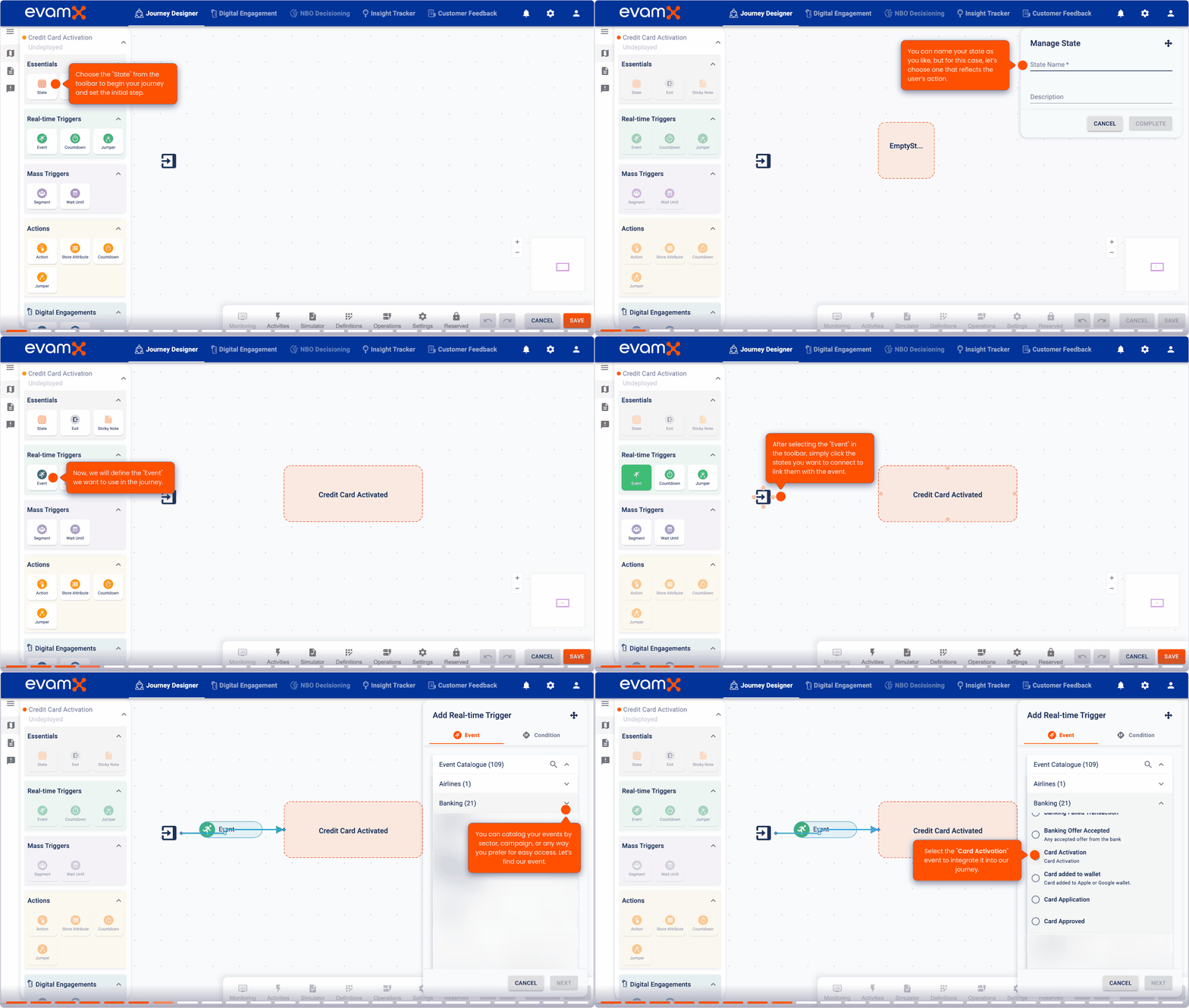
Share Post
Table of Contents
- The Platform Decision That Actually Matters
- What "Real-Time" Actually Means (and What It Doesn't)
- The Four Layers That Define a Serious Platform
- What This Looks Like in Practice
- The Operational Question Organizations Underestimate
- evamX: The Architecture Behind the Results
- The Evaluation Checklist
- The Platform Choice Is a Revenue Architecture Decision


Summarize with AI


The Platform Decision That Actually Matters
Most organizations shopping for an AI personalization platform already know what they want on paper: behavioral targeting, omnichannel delivery, predictive models, scalability. The vendor demos look similar. The capability matrices overlap. The pricing is negotiable.
What's harder to evaluate and what actually determines ROI, is whether the platform makes decisions in the moment a customer is present, or reconstructs that moment hours later from a batch export.
That gap, measured in milliseconds vs. hours, is the difference between a personalization platform and a personalization engine. And for organizations operating at scale, it is the single most important architectural question to answer before signing anything.
What "Real-Time" Actually Means (and What It Doesn't)
The term "real-time" appears in nearly every personalization vendor's marketing. It has been stretched to the point of near-meaninglessness. Here is a working definition that holds up under scrutiny:
True real-time personalization means the platform captures a customer event, evaluates it against live behavioral context and predictive models, makes a decisioning call, and delivers an action, all within the same interaction, in milliseconds.
What it does not mean:
- Processing events in micro-batches every 5 or 15 minutes and calling it "near real-time"
- Segmenting users at midnight and serving those segments the next day
- Triggering messages based on yesterday's behavioral export
The distinction matters because customer intent is momentary. A customer hesitating during a loan application at 2:14 PM is a different signal than the same customer at 2:14 AM. A user abandoning a cart while on mobile Wi-Fi vs. on a desktop at their office requires different logic, different timing, different content.
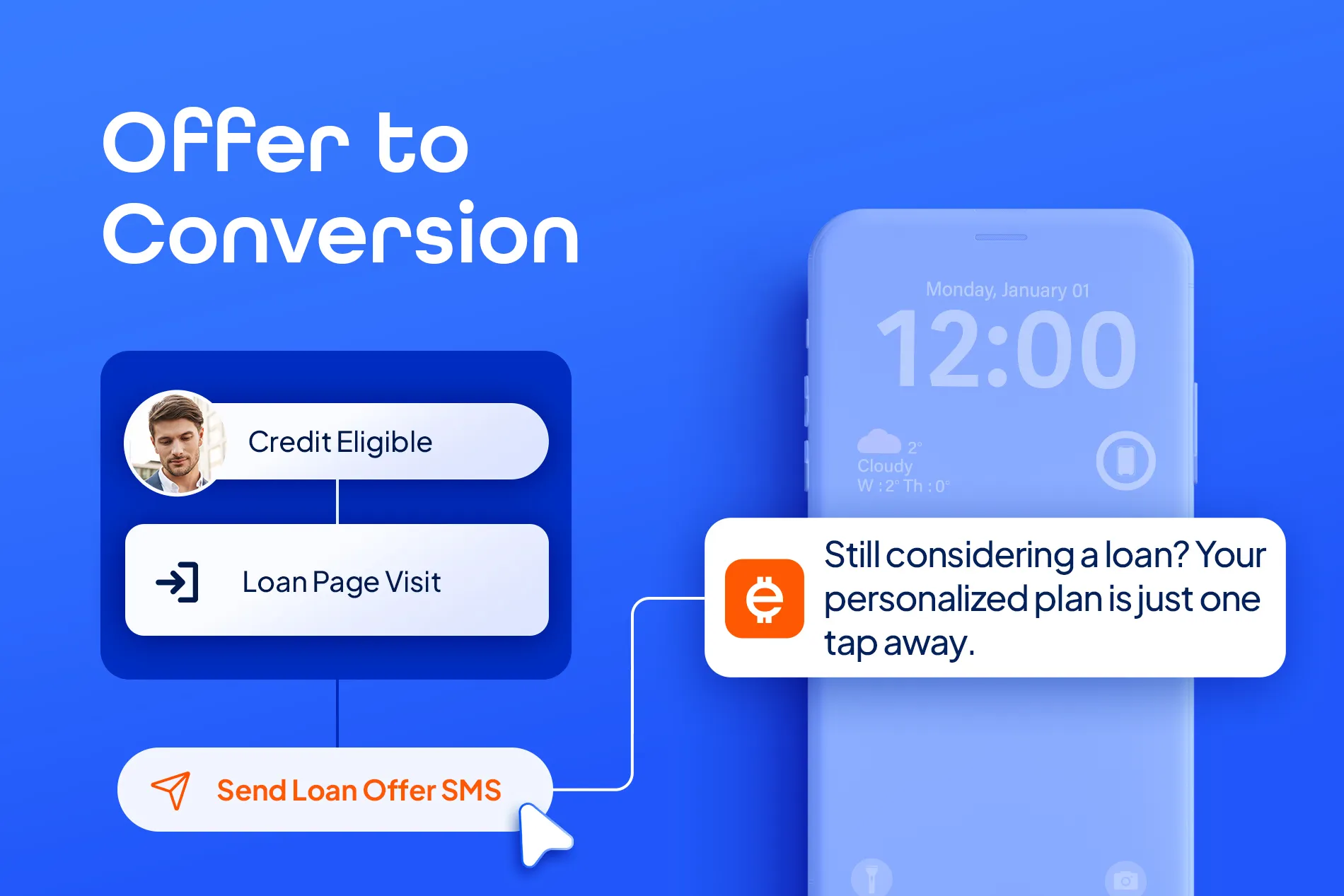
Platforms that operate on batch data miss these distinctions entirely, not because they lack AI, but because the AI is evaluating old context.
The Four Layers That Define a Serious Platform
When evaluating AI personalization platforms at the architecture level, the question isn't "does it do X?" every vendor claims to do X. The question is where in the stack X happens, and how fast.
Layer 1: Event Capture
The foundation of any personalization platform is its ability to ingest signals from wherever customers are mobile apps, web sessions, in-branch interactions, call center touchpoints, transaction systems, third-party data sources.
Most platforms handle digital channels reasonably well. The gaps emerge around offline channels (ATMs, branch visits, IVR), legacy systems (core banking, billing platforms), and high-frequency event sources (telco network events, financial transaction streams).
A platform that can only personalize what happens on your app is not a personalization platform, it's an app engagement tool.
What to evaluate: Can the platform ingest streaming events from operational and transactional systems in real time, without requiring a data warehouse copy or a custom ETL pipeline? Does it operate on streaming data or stored data?
Layer 2: Contextual Decisioning
This is where most platforms fail to differentiate themselves credibly. Every platform has a rules engine. Most have some form of predictive model integration. Fewer have a decisioning layer that evaluates all inputs simultaneously, behavioral signals, business rules, suppression logic, offer eligibility, channel preferences, send-time optimization and produces a prioritized action in sub-second time.
The key architectural distinction: Next Best Action (NBA) vs. Next Best Experience (NBX).
NBA logic selects the best offer from a catalog. NBX logic determines the best offer and the best channel and the best moment and the best content variant, evaluated together, not sequentially. For customers interacting across mobile, web, email, SMS, WhatsApp, and in-branch, the difference is significant.
What to evaluate: Can the platform integrate natively with your existing ML models (e.g., Databricks, in-house scoring APIs) without duplicating work? Does it evaluate decisioning logic in real time, or apply it to a pre-segmented batch?
Layer 3: Omnichannel Orchestration
Delivering a message is table stakes. Orchestrating a journey where each step responds to what the customer actually did, not what you predicted they'd do, requires a different kind of infrastructure.
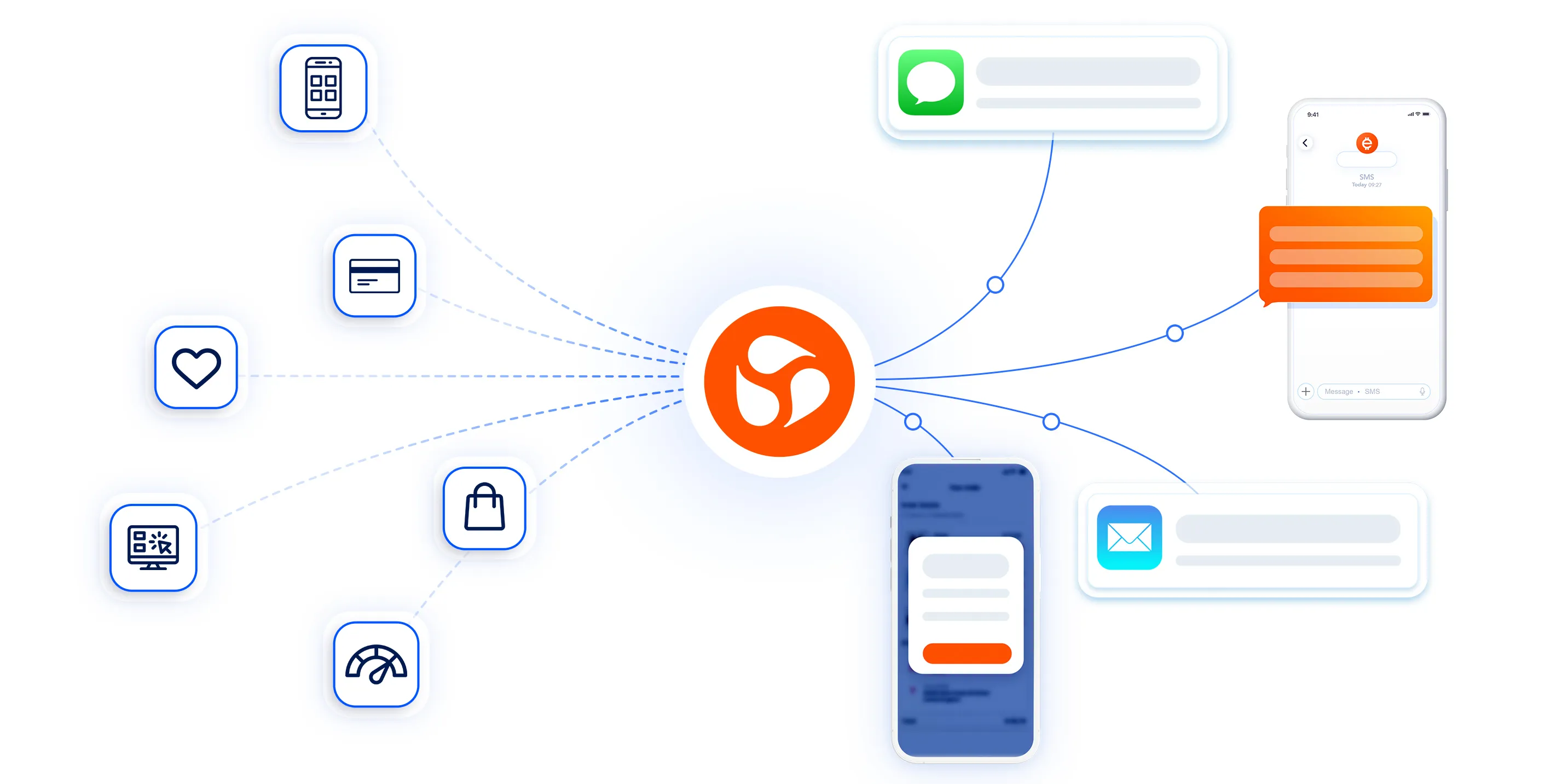
Real omnichannel orchestration means: if a push notification fails to deliver, the system intelligently routes to SMS. If a customer clicks through, the journey branches. If a customer calls the call center mid-journey, the agent screen updates with live context. If a fraud alert fires, a parallel suppression logic kicks in across all channels simultaneously.
This is not a feature. It is an architectural capability and it requires that all channels run from a single decisioning layer, not separate tools loosely integrated via API.
What to evaluate: Is channel orchestration native to the platform or bolted on via third-party integrations? Can business teams modify journey logic, branching rules, and suppression caps without engineering support?
Layer 4: Closed-Loop Learning
Personalization platforms that don't learn from outcomes are static, they get smarter only when someone manually updates the model. At scale, this is unsustainable.
Closed-loop learning means that campaign performance, customer responses, and conversion signals feed back into the decisioning models in real time not in the next quarterly model refresh. A/B tests and control groups are managed automatically. Underperforming journeys are surfaced immediately. The system improves with every interaction.
What to evaluate: How is model feedback structured? Is there a manual step in the loop, or is it genuinely automated? How are control groups and statistical significance managed at scale?
What This Looks Like in Practice
Across banking, telecommunications, and retail, three industries where personalization ROI is most measurable, the difference between batch and real-time architecture shows up in the same metrics: conversion rates, activation rates, churn reduction, and ARPU.
Banking: A leading bank in Southeast Europe used real-time behavioral triggers to reach customers at the precise moment of intent, during a card application hesitation, after a first transaction, when a competitor product was being researched. The result was a 2x increase in campaign conversion rates, 150% growth in credit card upsell performance, and €9M in incremental revenue through personalized limit increase offers.
Telecommunications: A major mobile operator running 200+ real-time customer journeys daily across a base of tens of millions of subscribers doubled next-best-offer acceptance rates by replacing batch campaign logic with millisecond decisioning. Every network event, a data top-up, a dropped call, a competitor SIM detected, became an orchestration trigger.
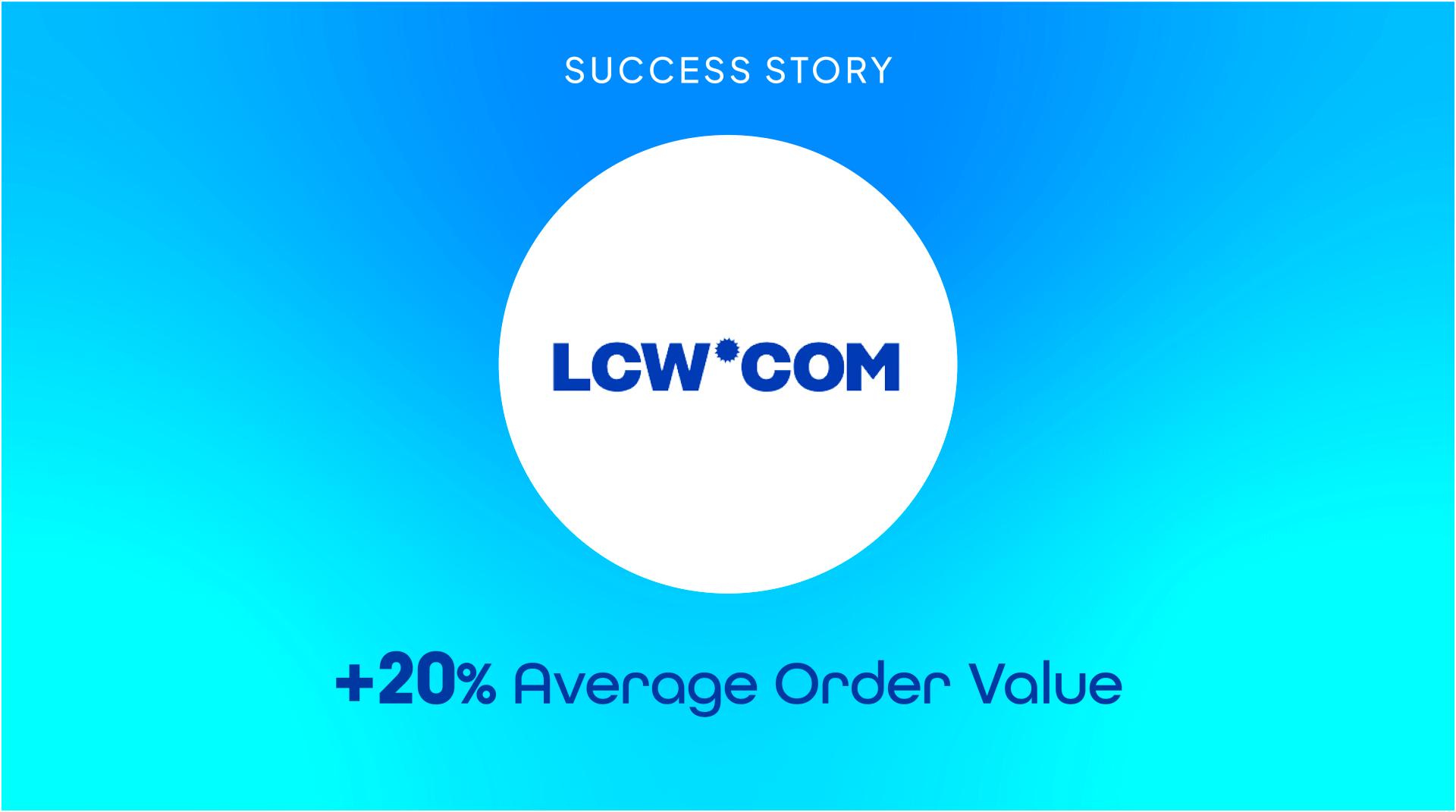
Retail: A global fashion retailer rebuilt its cart abandonment and re-engagement logic around real-time behavioral signals rather than scheduled sends. The outcome was a 20% lift in average order value, not from more messages, but from better-timed ones.
The common thread is not the AI model. It is the architecture that connects the model to the moment.
The Operational Question Organizations Underestimate
Beyond the technology, there is a question of who can operate it.
Most enterprise personalization platforms are built for data and engineering teams, business users must file tickets to change a rule, add a suppression condition, or update message content. In organizations where fraud patterns evolve weekly or product promotions change monthly, this creates an operational bottleneck that erodes the platform's real-time advantage.
The platforms worth evaluating at the C-level are those where a marketing or CX team can configure, launch, and modify journeys independently without waiting for engineering capacity. This is not a nice-to-have. It is the difference between a platform that is used vs. one that is maintained.
evamX: The Architecture Behind the Results
evamX is built on the premise that every customer signal, a transaction, a session event, a channel interaction, a behavioral shift, deserves a response in the moment it occurs. The platform processes over 600 million personalized interactions daily across 70 global brands in banking, telco, retail, and aviation.
The architecture is designed around four principles that map directly to the evaluation layers above:
Zero-copy event processing. evamX captures streaming events from core banking systems, CRM, card platforms, mobile apps, call centers, and third-party sources without requiring data duplication or custom pipelines. Events are acted upon in milliseconds, not after they've moved through a warehouse.
NBX Decisioning Engine. Unlike standard NBA logic, evamX's NBX engine evaluates offer, channel, timing, and content simultaneously, integrating natively with existing ML models in tools like Databricks, so organizations don't rebuild what they've already built.
Single-layer omnichannel orchestration. Push, SMS, email, WhatsApp, web, in-app, ATM, branch, IVR, and agent screen, all orchestrated from one platform, with intelligent fallback, behavioral branching, and cross-channel suppression applied in real time.
Business user autonomy via Journey Designer and Evo AI. Business teams configure journeys, modify suppression rules, launch A/B tests, and update personalization logic without IT dependency. Evo AI, evamX's GenAI layer, enables teams to build campaign strategies, generate journey flows from natural language, and receive continuous optimization recommendations.
For organizations evaluating platforms at the architecture level, evamX also supports on-premise, cloud, and hybrid deployment, critical for institutions with data residency or regulatory requirements and is designed to meet EU AI Act and GDPR compliance standards.
The Evaluation Checklist
For C-level and platform evaluation teams, these are the questions that matter most:
Architecture
- Does the platform operate on streaming events or stored data?
- What is the actual latency between event capture and action delivery?
- Is there a data duplication requirement (warehouse copy, ETL)?
Decisioning
- Does the platform evaluate offer, channel, timing, and content simultaneously?
- Can it integrate natively with existing ML infrastructure?
- Is A/B testing and control group management automated?
Operations
- Can business teams modify journeys without engineering support?
- How are suppression rules, frequency caps, and eligibility logic managed?
- What is the implementation timeline, and how is the migration handled?
Compliance and scale
- What are the deployment options (on-premise, cloud, hybrid)?
- How does the platform document AI decisions for regulatory auditability?
- What is the proven scale, events per second, concurrent journeys, connected data sources?
The Platform Choice Is a Revenue Architecture Decision
Organizations that have moved from batch personalization to real-time contextual engagement don't describe it as a marketing upgrade. They describe it as a revenue architecture change, one that restructures how they capture, evaluate, and act on customer intent across every touchpoint.
The AI is necessary but not sufficient. The model that predicts churn is only as valuable as the platform's ability to act on that prediction in the 30 seconds when it still matters.
That is what real-time personalization platforms are ultimately being evaluated on, not the model quality, but the speed and coherence of the loop between signal, decision, and action.