
Share Post
Table of Contents
- What Intent Actually Means
- The Signals That Carry Intent
- Why Timing Is the Entire Argument
- The Gap Between Detection and Action
- What Real-Time Intent-Based Marketing Actually Requires
- What This Looks Like When It Works
- The Shift That Makes It Real


Summarize with AI


Most marketing teams don't have a data problem. They have a timing problem.
The signals are already there, a customer browsing loan options, a subscriber whose data usage just spiked, a shopper who added three items to a cart and then went quiet. These moments carry intent. They tell you what a customer wants, right now, in the most direct way possible.
But by the time most systems act on those signals, the moment is over. The customer has decided without you. The window that was open for thirty seconds has been closed for twelve hours.
Intent-based marketing is built around a different premise: that the value of a signal is almost entirely determined by how quickly you respond to it.
What Intent Actually Means
In marketing, "intent" is often treated as a category, someone is "in-market" for a product, or belongs to a "high-intent segment." These are useful constructs for planning. They are not useful for execution.
Real intent is not a segment. It is a moment.
A customer who checks their credit limit is expressing something specific, right now. A telecom subscriber who calls support about a competitor's offer is signaling something that has a shelf life measured in hours, not weeks. A retail shopper who returns to the same product page three times in a single session is not in a "consideration segment", they are on the edge of a decision.
Intent-based marketing recognizes this. It shifts the focus from who a customer is to what a customer is doing, and treats every behavioral signal as a perishable opportunity that expires if it goes unanswered.
The Signals That Carry Intent
Customer intent surfaces across every layer of interaction, and the most actionable signals are rarely the obvious ones.
Behavioral signals, how customers move through digital environments are the most immediate. A product page visited twice in one session. A calculator tool used but not submitted. A feature explored but not activated. Each of these behaviors tells a story about where a customer is in their decision process without them ever having to say it.
Transaction signals, reveal financial intent with unusual precision. A balance check immediately before a purchase. A failed payment attempt. A sudden change in spending patterns. A large deposit followed by browsing for investment products. These signals don't need interpretation, they come pre-loaded with context.
Lifecycle signals, mark the inflection points where customers are most open to engagement. The first week after onboarding, when habits are still forming. The moment a loyalty milestone is crossed. The silence after a previously active customer stops engaging. These are not behavioral anomalies, they are structural moments where the right message at the right time has an outsized impact.
Contextual signals, add the layer of circumstance that determines relevance. The same customer on mobile at 11 PM has different needs than that same customer on desktop at 9 AM. Location matters. Channel matters. The sequence of actions in the preceding minutes matters. Intent is not just a signal, it is a signal in context.
The challenge is that none of these signal types is sufficient on its own. A single browsing event means little. A browsing event combined with a recent transaction, a lifecycle milestone, and a channel preference pattern means something specific. Intent-based marketing at its most effective is the practice of reading these signals together, in real time, and acting on the combination before any individual signal fades.
Why Timing Is the Entire Argument
There is a version of "intent-based marketing" that most organizations already practice. They identify high-intent customers from last week's behavioral data, build a segment, design a campaign, and deploy it on Tuesday. This is not without value, it is better than ignoring intent signals entirely.
But it is not intent-based marketing. It is intent-informed marketing. The distinction matters more than it might appear.
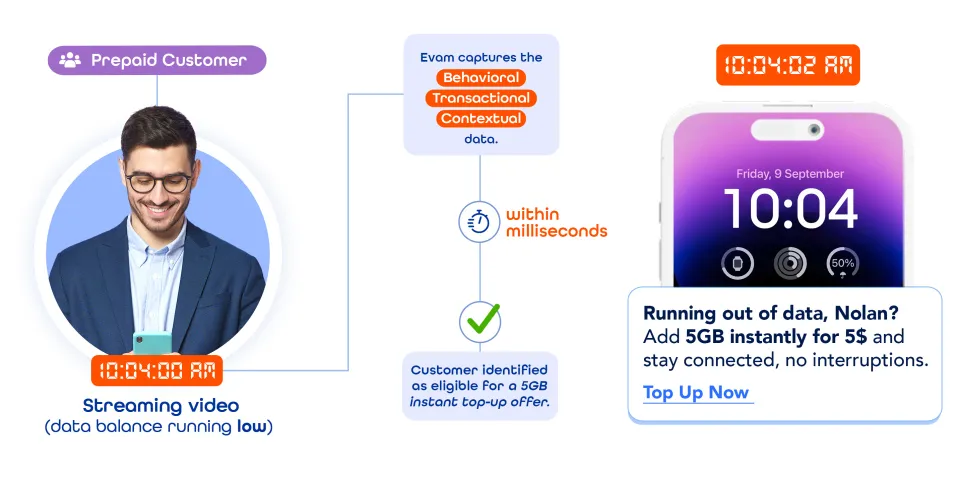
When a customer is actively exploring a financial product, their receptiveness to a relevant offer peaks during that exploration and drops sharply within hours. When a subscriber is considering switching carriers, every day without engagement is a day the competitor has more time to close the deal. When a shopper is three clicks from completing a purchase, the difference between a 10-minute response and a 24-hour response is often the difference between a conversion and an abandoned cart.
This is the core argument for real-time intent-based marketing, and it does not rest on personalization theory or AI sophistication. It rests on a straightforward observation: customer intent has a half-life, and the half-life is short.
Organizations that act on intent in minutes consistently outperform those that act on intent in days, not because their messages are more creative or their segments are more refined, but because the customer is still there when the message arrives.
The Gap Between Detection and Action
Recognizing intent is one problem. Acting on it immediately is a different problem, and it is usually the harder one.
Most organizations have reasonable tooling for the detection side. Analytics platforms surface behavioral patterns. CRM systems log transaction histories. Segmentation tools identify clusters of similar behavior. The data exists, and increasingly, the models that interpret it exist too.
The gap lives in the execution layer, the distance between a signal being recognized and a response reaching the customer. In most marketing stacks, that distance is filled with batch processes, data warehouse transfers, campaign scheduling queues, and channel-specific tools that don't share context with each other.
A customer signals intent on mobile. That event goes into an analytics pipeline. Hours later it appears in a segment update. The next morning it informs a campaign scheduled for Thursday. By Thursday, the intent that existed on Monday is not just cold, it has been replaced by entirely new context that the Thursday campaign knows nothing about.
This is not a data quality problem. It is an architecture problem. And it cannot be fixed by adding more data or building better models. It requires a different kind of infrastructure: one that captures signals, makes decisions, and delivers actions within the same interaction, without the intermediate steps that introduce lag.
What Real-Time Intent-Based Marketing Actually Requires
Moving from intent-informed to intent-based marketing means closing the gap between signal and action to near zero. In practice, this requires four things working together.
Continuous event capture across every touchpoint. Intent signals don't only arrive through digital channels. A call center interaction, an ATM transaction, a branch visit, a point-of-sale event, these carry as much intent as a mobile session, often more. A real-time intent-based system ingests from every source simultaneously, treating the full ecosystem as a single stream of signals rather than a collection of separate data sources.
Contextual decisioning, not rule matching. A rule that says "if customer browses loan page, send loan offer" is not intent-based marketing. It is automation. Real decisioning evaluates a signal alongside everything known about that customer in that moment, their history, their lifecycle stage, their recent channel behavior, current offer eligibility, suppression logic, and predictive models, and produces not just an action, but the right action for that specific customer at that specific moment. This is the difference between next best action and next best experience.
Omnichannel execution from a single layer. The action selected by the decisioning layer must reach the customer where they are, immediately, without re-queuing through a separate channel tool. If the best action is a push notification, it goes now. If push isn't available, the system routes intelligently to SMS or in-app. If the customer calls the contact center mid-journey, the agent sees live context. All of this needs to happen from one orchestration layer, not from five tools loosely integrated via API, because any handoff between tools reintroduces lag.
Closed-loop learning. Intent signals don't just inform actions, actions generate new signals. A customer who receives an offer and ignores it is telling the system something. A customer who clicks but doesn't convert is telling it something different. A customer who converts immediately changes the context for every subsequent interaction. Real-time intent-based marketing systems learn from outcomes continuously, updating their models with each interaction rather than waiting for periodic recalibration.
What This Looks Like When It Works
In financial services, real-time intent detection turns passive account activity into active engagement opportunities. A customer who checks their savings balance and then browses fixed deposit rates is not just browsing, they are signaling investment intent within a narrow window. A bank that responds within that window, with a contextual offer calibrated to that customer's balance and history, converts at a dramatically higher rate than one that schedules a generic savings campaign for the following week.
In telecommunications, intent surfaces constantly at the network and account level. Data usage approaching a cap. A call to support about a competitor's promotional offer. A device upgrade search on the operator's portal. Each of these signals has a short action window. Operators who respond to them in real time, with a contextual bundle upgrade, a proactive retention offer, a relevant device recommendation, recover revenue that would otherwise leave.

In retail, the most valuable intent signals are the ones closest to the conversion moment. A shopper who abandons a cart is not necessarily lost, they are in a decision state that the right message, delivered at the right moment, can resolve. The difference between a 5-minute re-engagement and a 5-hour one is often larger than any other variable in the conversion equation.
Across all three contexts, the pattern is the same. The signal existed. The customer's intent was real. The outcome was determined not by the quality of the offer but by whether the response arrived while the intent was still active.
How evamX Enables Intent-Based Marketing
evamX is designed around the architecture that intent-based marketing actually requires, not as a set of features added to an existing platform, but as the core design principle.
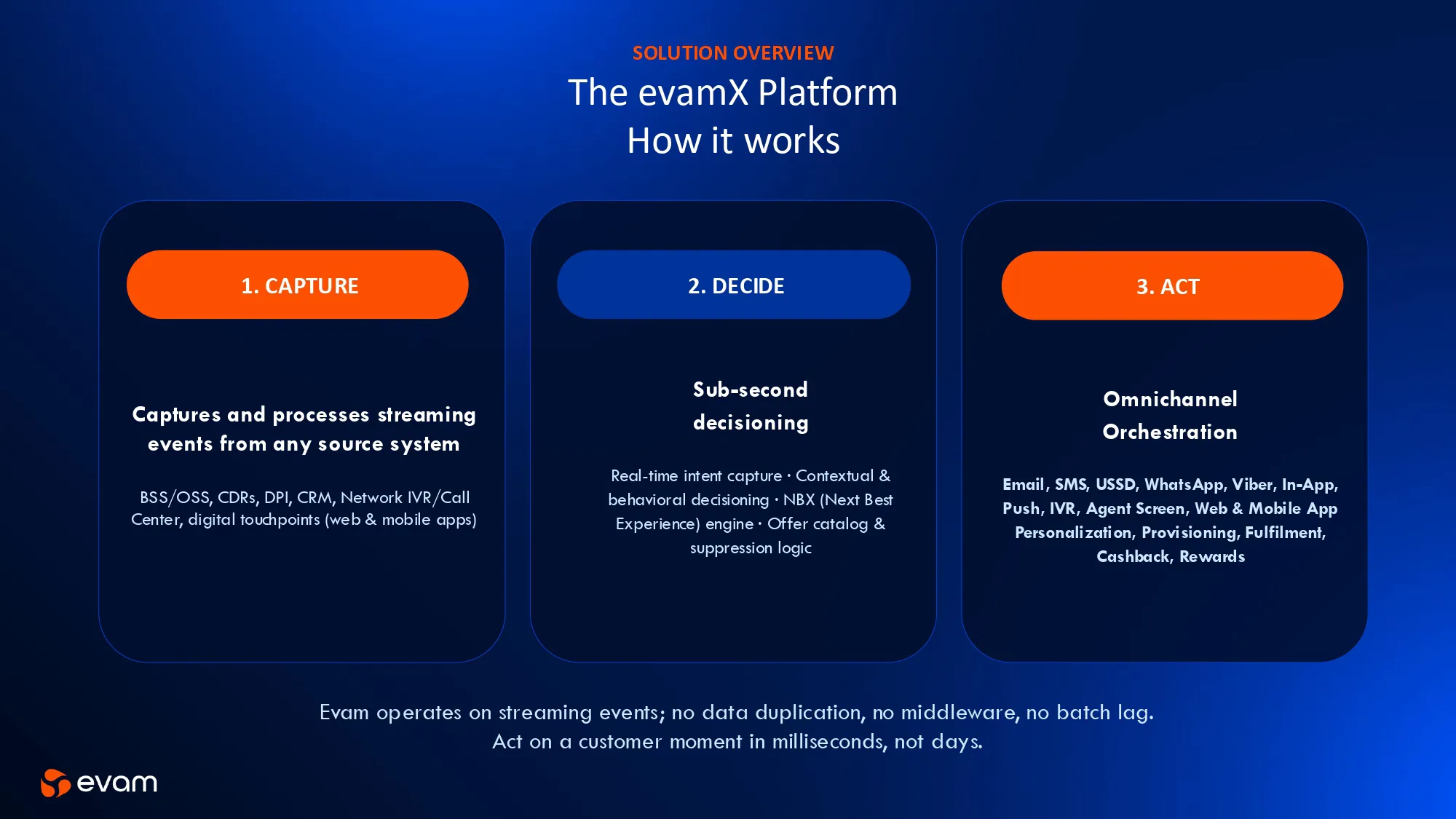
Every customer event, a transaction, a session interaction, a channel touchpoint, a support contact, an offline moment, is captured as a live signal and brought into a unified decisioning layer without batch processing or data duplication. The NBX engine evaluates each signal in full context: behavioral history, lifecycle stage, predictive models, business rules, channel preferences, and real-time suppression logic. The result is not a campaign trigger. It is a decision about the best possible action for that customer in that moment.
That decision is executed immediately across the appropriate channel, push, in-app, SMS, email, web, call center, or branch, from a single orchestration layer. No re-queuing. No channel-specific delay. No context lost in handoff.
For marketing and CX teams, Journey Designer provides a no-code environment where intent-based journeys can be configured, modified, and launched without engineering support, because the speed of execution is only valuable if teams can also update logic at the speed that customer behavior changes. Evo AI adds a continuous optimization layer, surfacing which signals are converting, which journeys are underperforming, and what adjustments are most likely to improve outcomes.
The result is a shift that organizations working this way consistently describe the same way: less time managing campaigns, more time making decisions. Fewer scheduled sends, more responses to what customers are actually doing. Less guessing about what segment to target, more certainty about what this customer needs right now.
The Shift That Makes It Real
Intent-based marketing is not a tactic. It is a structural change in how an organization relates to its customers, from a broadcast model, where messages are prepared in advance and delivered to segments on a schedule, to a response model, where every customer interaction generates an immediate, contextually appropriate reply.
That shift requires a different architecture. It requires capturing signals in real time, making decisions in milliseconds, and executing across channels from a single layer. And it requires an organization that is willing to move from managing campaigns to orchestrating decisions.
The companies that have made that shift don't describe it as a personalization upgrade. They describe it as a fundamental change in how fast they can move, and how much of the revenue that was previously invisible to them, because it existed only in moments that passed too quickly, is now being captured.
Intent doesn't wait. The question is whether your systems can move at the same speed.
Explore how evamX turns real-time signals into immediate action: