
Share Post
Table of Contents
- Why Most Intent Signal Lists Miss the Real Problem
- The Signals Worth Watching, and Why They Expire
- Turning a Signal Into an Action Before It Goes Cold
- How evamX Supports Real-Time Intent Signal Detection


Summarize with AI


Most guides to detecting buying intent signals are really just lists: pricing page visits, repeat product views, cart abandonment, a spike in app opens, a call to support. These are all real signals. None of them explain why two businesses tracking the same signal get completely different results from it.
The real difference is not which signal you watch. It is how long the gap is between the signal showing up and something happening in response. A pricing page visit flagged in a weekly report is a different signal than the same visit flagged the moment it happens, even though the behavior is identical. Buying intent has a short shelf life, and most of the work of "detecting" it is really the work of noticing it before that shelf life runs out.
Why Most Intent Signal Lists Miss the Real Problem
Intent signal checklists tend to assume the hard part is knowing what to look for. In practice, most teams already know what to look for. A telecom customer who checks their data usage three times in a day is signaling something. A retail shopper who returns to the same product page four times in a week is signaling something. A banking customer who opens a loan calculator and closes it without submitting is signaling something. None of this needs advanced detection to notice.
What actually decides whether a signal turns into a sale is whether anything happens while it's still fresh. A report that runs once a week will catch all of these behaviors eventually. It just catches them after the moment that made them valuable has already passed. By the time a weekly report flags that loan calculator visit, the customer may already have gotten a rate somewhere else, or simply moved on. The signal was detected. It just wasn't detected in time to matter.
The Signals Worth Watching, and Why They Expire
Not every signal fades at the same speed, which is part of why generic checklists are a poor guide to what to prioritize. A customer researching a large purchase over several weeks gives off a slow-moving signal, where a same-day response and a three-day response aren't very different. A customer who abandons a checkout mid-transaction gives off a fast-moving signal, where the gap between an immediate nudge and a next-day email is often the gap between a sale and a lost one.
The signals that reward real-time detection the most are tied to a specific moment rather than a general trend: a cart abandonment, a declined payment, a pricing page visited right after a support call, a sudden jump in usage that suggests a customer is about to outgrow their plan. These are moments where the customer's context is unusually clear and unusually short-lived. A system that only reviews behavior on a schedule treats a five-minute-old signal and a five-day-old signal the same way, which means it simply can't catch the highest-value window, even when it tracked the signal correctly.
Turning a Signal Into an Action Before It Goes Cold
Detecting a signal and acting on it are often treated as two separate jobs, run by two separate teams on two separate timelines. Marketing owns the campaign that eventually reaches the customer. Analytics owns the report that eventually surfaces the behavior. The gap between those two ownership lines is usually where the real delay comes from, more than any technical limit.
Closing that gap means treating detection and action as one step instead of two handoffs. A pricing page visit isn't useful as a data point in next month's report. It's useful as a trigger for a specific next action, in whatever channel the customer is already in, while the visit still reflects live interest rather than something that happened a while ago. This holds across sectors: a telecom operator responding to a usage spike with a relevant upgrade offer, a bank responding to loan calculator activity with a pre-qualified next step, a retailer responding to repeated product views with a real-time nudge instead of a batch retargeting email the next day.
How evamX Supports Real-Time Intent Signal Detection
evamX captures behavioral signals, a pricing page visit, a usage spike, an abandoned flow, the moment they happen, instead of waiting for a scheduled export. It doesn't just log the signal either. The NBX decisioning engine checks each one against the customer's live context to tell a real signal from noise, a pricing page visit right after a support ticket means something different than the same visit on its own, and decides whether it's worth acting on.
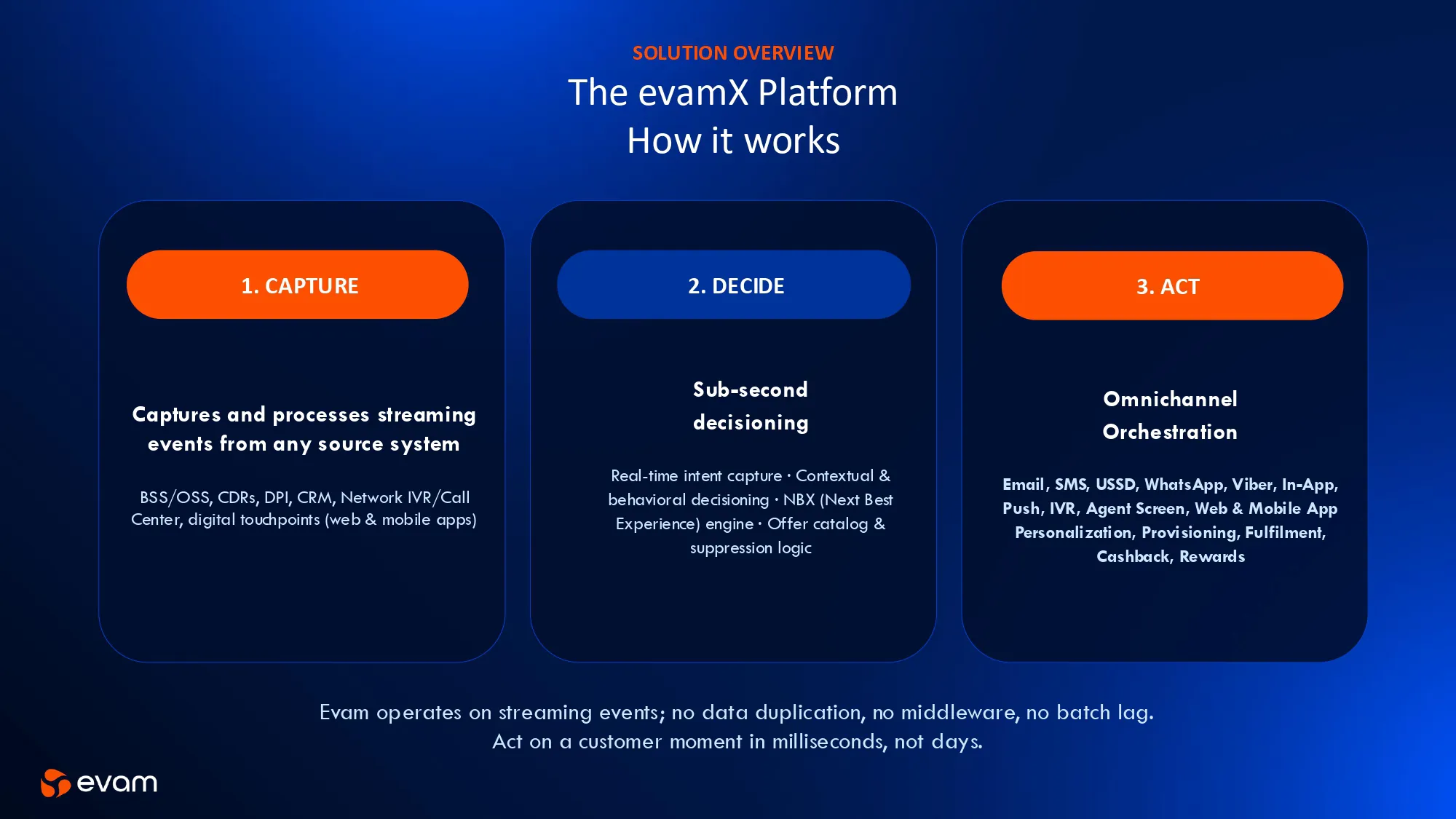
Once a signal clears that bar, evamX acts through whatever channel the customer is already in: a push notification, an in-app message, an agent's screen, a website banner. The response goes out while the intent behind the signal is still live, not in next week's report. Business teams can also set up and adjust which signals matter and what should happen when they fire on their own, without waiting on an engineering ticket every time the rules need a tweak, which is usually where real-time efforts get stuck in practice. For a closer look at how AI shapes this kind of real-time detection more broadly, see our piece on the role of AI in mobile app personalization.