
Share Post
Table of Contents
- What Next Best Action Software Is Actually Supposed to Do
- The Rule-Based Trap
- What Separates a Decisioning Engine from a Campaign Tool
- The Organizational Dimension That Software Cannot Solve Alone
- What to Evaluate When Selecting Next Best Action Software
- Why This Matters More in High-Volume, Regulated Environments
- How evamX Delivers Next Best Action Decisioning


Summarize with AI


There is a category problem in how next best action software is sold and evaluated. Most platforms that carry this label are not decisioning engines. They are campaign orchestration tools with a decision layer bolted on: systems that were built to execute pre-planned actions at scale and then extended, through rules and segments, to simulate the appearance of intelligent decisioning.
The distinction matters more than most evaluations recognize. A campaign orchestration tool decides in advance. A decisioning engine decides in the moment. The first approach requires someone to anticipate every relevant customer scenario and build a rule for it. The second approach evaluates each customer interaction against live context and determines the best action dynamically, without requiring that scenario to have been pre-programmed.
For organizations that interact with customers at high volume across regulated, complex environments, banking, telecommunications, insurance, the gap between these two approaches is not academic. It shows up in conversion rates, in churn numbers, in service costs, and in the quality of individual customer relationships at scale.
What Next Best Action Software Is Actually Supposed to Do
The concept of next best action emerged from the recognition that individual customers, even within the same demographic segment, have meaningfully different needs at any given moment, and that the right action for one customer in one context may be entirely wrong for another customer in what appears to be the same situation.
Next best action software is supposed to resolve this by making the action decision at the individual level, in real time, based on everything the system knows about that customer at that moment: their history, their current behavior, their product holdings, their recent interactions, their predicted propensity, and the business rules that govern what can and cannot be offered to them.
When this works correctly, it produces a system that behaves like a highly informed advisor operating across every customer touchpoint simultaneously: one that knows not just who the customer is, but what they are doing right now and what they are most likely to need next.
When it does not work correctly, it produces something that looks like next best action from the outside: a system that selects from a menu of options for each customer, but operates on stale data, pre-computed segments, and rules that were written weeks ago for situations that no longer apply to this customer in this moment.
The Rule-Based Trap
The most common failure mode in next best action software implementations is over-reliance on rules.
Rules are necessary. Eligibility constraints, regulatory requirements, suppression logic, and business priorities all need to be encoded in the system in a structured way. The problem is not that rules exist. The problem is when rules are the primary mechanism for generating the next best action decision, rather than a constraint layer that sits on top of a genuine predictive and contextual decisioning foundation.
A rule-based system asks: "Does this customer match the criteria for action X?" It evaluates a set of conditions, segment membership, product ownership, recency thresholds, and returns the first action whose conditions are met. If the rules were well-written and the data is current, this produces a reasonable result. If the data is stale, or the customer's situation has changed since the rules were last updated, or the scenario is one that no one anticipated when the rules were written, the system returns an action that is technically eligible but contextually wrong.
A genuine decisioning engine asks a different question: "Given everything we know about this customer right now, what is the action most likely to produce the best outcome for both the customer and the business?" This evaluation draws on predictive models, real-time behavioral signals, and contextual data, not just pre-written conditions, and produces a ranked output that reflects the actual probability distribution of outcomes, not just eligibility.
The practical difference is most visible at the edges: the customer whose situation just changed, whose recent behavior contradicts their historical profile, or whose current context makes a technically eligible action the wrong one to deliver. Rule-based systems handle these cases poorly. Genuine decisioning engines are specifically designed to handle them well.
What Separates a Decisioning Engine from a Campaign Tool
For technology and marketing leaders evaluating next best action software, several architectural characteristics distinguish a genuine decisioning engine from an orchestration tool that approximates the same output.
The first is the latency of the data foundation. A decisioning engine that operates on batch-refreshed customer profiles is not a real-time decisioning engine, regardless of how the marketing materials describe it. Genuine real-time decisioning requires that the data available to the decision at the moment of a customer interaction reflects what has happened up to that moment, including events from seconds ago, not hours ago. This requires a streaming data architecture at the foundation, not a warehouse that refreshes on a schedule.
The second is the nature of the scoring model. Rule-based systems evaluate binary conditions. Decisioning engines produce ranked probability scores. When a customer interaction occurs, a decisioning engine does not ask whether the customer is eligible for an action. It asks which of the eligible actions is most likely to produce the desired outcome for this specific customer in this specific context, and ranks them accordingly. This requires machine learning models that are trained on outcomes, not just behavioral attributes.
The third is suppression and eligibility intelligence. In a rule-based system, suppression logic is explicit: if condition A, do not show offer B. In a decisioning engine, suppression is more sophisticated: the system understands that a customer currently in a service recovery journey should not receive a promotional message, even if no explicit rule has been written for this exact scenario, because the contextual signals indicate that a promotional action would be counterproductive. This kind of contextual suppression requires the system to maintain a live understanding of what the customer is experiencing across every active journey simultaneously.
The fourth is cross-channel consistency. A decisioning engine produces a single ranked decision that applies across every channel. Every touchpoint: mobile app, ATM, web portal, contact center agent screen, outbound push notification, reflects the same decision, made from the same context, at the same moment. This means that when a customer declines an offer on one channel, every other channel knows immediately. When a customer converts, every pending action related to that conversion closes simultaneously. This requires the decisioning layer to be architecturally separate from the channel execution layer, connected to all channels rather than embedded within any single one.
The Organizational Dimension That Software Cannot Solve Alone
There is a component of next best action software effectiveness that sits outside the technology itself but is equally determinative of outcomes: the speed at which the teams who own the decisioning logic can modify it.
The most sophisticated decisioning engine in the world produces suboptimal results if the business users who understand customer behavior and product strategy cannot update the models, rules, and priorities it operates on without waiting for an IT development cycle. In most enterprise environments, this is precisely the constraint that limits next best action performance: the technology can evaluate a decision in milliseconds, but changing what the technology evaluates takes weeks.
Effective next best action software resolves this by separating the decision logic layer from the technology execution layer in a way that business users can directly access. Offer catalogs, eligibility rules, suppression windows, priority weights, and model parameters should be configurable by the marketing or CVM team through a UI that does not require engineering intervention. The ability to simulate the effect of a logic change before it goes live: to see who would receive what action under the new configuration, is particularly valuable: it closes the loop between intent and confidence for teams that cannot afford to run experiments that affect millions of customers.
This is where many next best action software implementations that look strong on paper underperform in practice. The decisioning capability is there. The organizational interface to the decisioning capability is not.
What to Evaluate When Selecting Next Best Action Software
For organizations at the platform selection stage, a useful framework is to push past the feature demonstration and into the architecture conversation.
Ask where the data comes from at the moment of a decisioning event. Is it a live stream from source systems, or a refreshed profile from a data warehouse? If the answer is a warehouse, ask what the refresh cadence is and whether the vendor considers this real-time. The answer will tell you more about the system's actual capabilities than any feature list.
Ask how the system handles a scenario that has never been explicitly configured. What does it do when a customer triggers an interaction that matches no existing rule or campaign? Does it return a default action, or does it fall back on a model-based recommendation? The answer reveals whether you are evaluating a rule engine with a predictive layer or a decisioning engine with a rule constraint layer.
Ask how business users interact with the decisioning logic. Can a CVM manager change an offer priority without an IT ticket? Can they simulate the outcome of a suppression rule change across the current customer base before activating it? The answer reveals the organizational usability of the platform, which is what determines long-term performance more than any technical specification.
Ask about cross-channel consistency. If a customer declines an offer through the mobile app at 9 AM, how quickly does the ATM network and the call center agent screen reflect that decline? If the answer involves any kind of batch process or overnight sync, the cross-channel consistency the platform promises is not operating in real time.
Why This Matters More in High-Volume, Regulated Environments
The gap between rule-based orchestration and genuine decisioning becomes most costly at scale and in regulated environments. A bank with 10 million customers and 50 active products cannot write explicit rules for every relevant combination of customer context, product eligibility, and channel state. The combinatorial complexity exceeds what any rule library can practically manage. This is where the probabilistic, model-based approach of a genuine decisioning engine provides compounding returns: as the model trains on more outcomes, it handles edge cases and novel scenarios better than any static rule set could.
In regulated environments, the suppression and eligibility intelligence of the decisioning engine also intersects with compliance requirements in ways that matter operationally. A system that can enforce regulatory constraints: communication frequency limits, product eligibility requirements, mandatory cooling-off periods, as native properties of the decisioning layer, rather than as a separate compliance overlay, reduces operational risk and the cost of maintaining compliance as regulations change.
How evamX Delivers Next Best Action Decisioning
evamX is built as a decisioning engine, not a campaign orchestration tool with a decision layer added. Its architecture starts with event streaming at the data foundation: every customer interaction across core banking, card systems, mobile and web apps, ATM networks, IVR, and call center platforms is ingested as a live event, without batch lag, making current data available to every decisioning cycle.
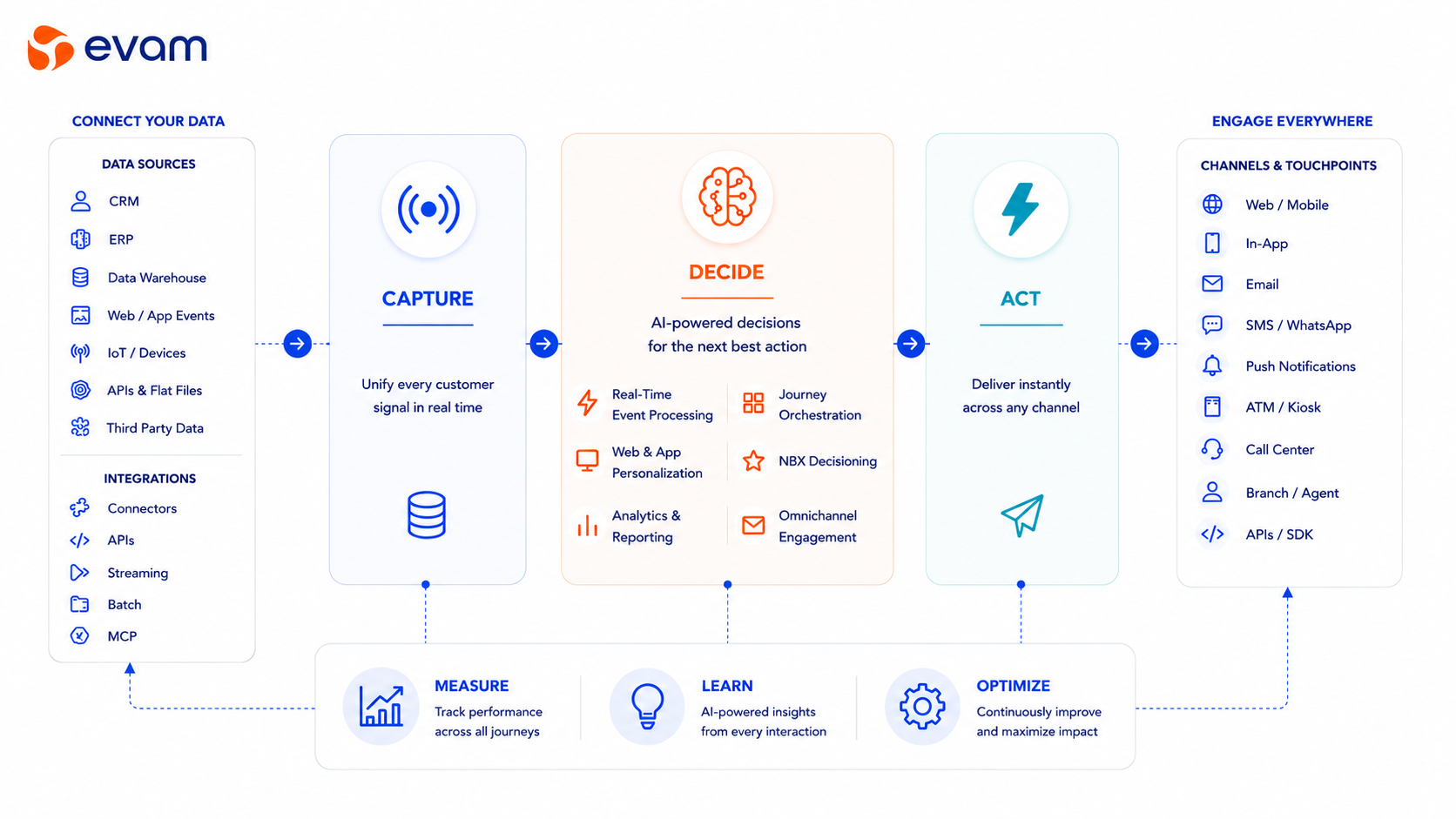
The NBX engine evaluates each inbound event against the full live customer context: active journeys, product holdings, predictive model scores, offer eligibility, suppression rules, and business priority weights. The output is a ranked next best action decision: not the first eligible action, but the best action for this customer in this moment, delivered in milliseconds to whatever channel the customer is currently using.
Cross-channel consistency is native to the architecture. A decline on one channel propagates immediately to every other channel. A conversion closes every related pending action simultaneously. Every touchpoint reflects the same decision from the same decisioning layer.
For marketing and CVM teams, Journey Designer provides direct access to the offer catalog, eligibility rules, suppression logic, and priority configuration, without IT dependency. Changes can be simulated against the live customer base before activation. Evo AI continuously surfaces which decisioning configurations are driving outcomes and where adjustments will improve performance.

evamX connects to existing infrastructure through pre-built connectors and a zero-copy streaming layer, with deployment options including on-premise, private cloud, cloud, and hybrid, built for the integration complexity and compliance requirements of banking and telecommunications environments.