
 Evo AI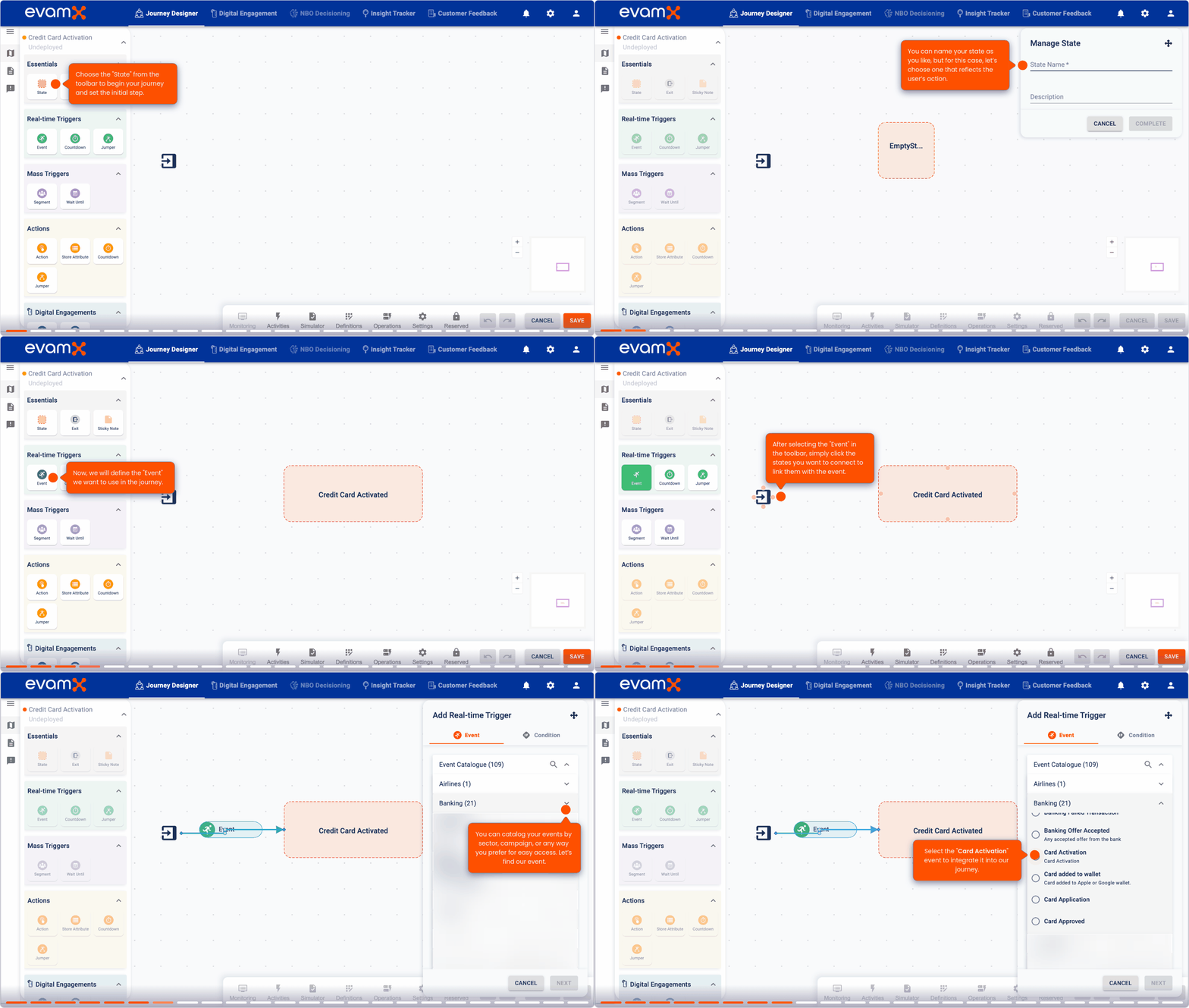
Share Post
Table of Contents
- What Separates Real Engagement from Scheduled Messaging
- Onboarding: The Window That Closes Faster Than Most Teams Realize
- Proactive Engagement: Acting Before the Customer Has to Ask
- Cross-Sell and Upsell: Intent Is Perishable
- Churn Prevention: The Signal Always Arrives Before the Decision
- Service Recovery: Turning a Failure into a Trust Moment
- What These Examples Have in Common
- How evamX Powers Real-Time Customer Engagement


Summarize with AI


Most customer engagement examples you find online describe what should happen. A customer shows interest, the brand responds with a relevant message, the customer converts. The logic is clean. The reality is messier.
What most examples leave out is the infrastructure problem: the gap between detecting a customer signal and acting on it fast enough for the action to matter. A customer who abandons a loan application at 9 AM and receives a follow-up email at 3 PM is not experiencing real-time engagement. They are experiencing a delayed campaign that happened to reference something they did earlier. The intent has cooled. The moment has passed.
Real-time customer engagement is not a messaging strategy. It is an architectural commitment: the decision to build systems that detect, decide, and act within the same interaction, not in the next batch window. The examples below are drawn from how this actually plays out in banking and telecommunications, where the consequences of missing a customer moment are immediate and measurable.
What Separates Real Engagement from Scheduled Messaging
Before getting into specific examples, it is worth being precise about what "real-time" actually means in a customer engagement context, because the term is used so loosely that it has nearly lost its meaning.
A message sent within 24 hours of a customer action is not real-time. A push notification triggered by a segment refresh that ran at 2 AM is not real-time. A personalized email based on last week's browsing behavior is not real-time. These are all forms of batch-delayed engagement dressed in the language of immediacy.
Real-time customer engagement means the system detects a customer event as it occurs, evaluates it against the customer's full live context, makes a decision about the right response, and delivers that response within the same session, often within seconds. The customer is still present. Their intent is still active. The window has not closed.
This distinction produces fundamentally different outcomes in practice. Not because the message itself is necessarily better, but because the timing changes everything about how the customer receives it.
Onboarding: The Window That Closes Faster Than Most Teams Realize
A new banking customer completes their account opening on a mobile app. They are at peak engagement with the brand, curious, attentive, and still in the session. What happens next determines whether this customer becomes actively engaged or quietly dormant.
In a traditional engagement model, the onboarding journey is pre-planned: a welcome email goes out immediately, a follow-up message arrives on day three, a product introduction lands on day seven. This sequence was designed in advance, and it executes regardless of what the customer actually does between those touchpoints.
In a real-time model, the sequence adapts. If the customer, immediately after completing registration, navigates to the savings account section and spends 90 seconds comparing product options, that behavior is a signal. A real-time system detects it, evaluates the customer's profile against savings product eligibility, and surfaces a personalized savings offer within the same session, not in the day-three email. The customer is already thinking about savings. The offer arrives while that thought is active.
The same principle applies in telecommunications. A subscriber who completes SIM registration and immediately checks their data balance is signaling concern about consumption. A real-time system can respond with a contextual data plan offer before the subscriber navigates away, before they have a chance to compare alternatives or defer the decision to another day.
Proactive Engagement: Acting Before the Customer Has to Ask
One of the most underutilized customer engagement approaches is proactive outreach, reaching the customer at the moment a problem is forming rather than waiting for them to contact support after it has materialized.
A mobile banking customer attempts to make a payment and it is declined because their account balance is marginally below the transaction amount. In a reactive model, the customer sees an error message, feels frustrated, and either retries later or uses a different payment method. The bank logs the failed transaction. Nothing else happens until the customer initiates contact.
In a proactive real-time model, the failed transaction is an event that triggers an immediate evaluation. The system checks the customer's profile: are they pre-approved for an overdraft facility? Do they have a linked account with available funds? Is there a credit product they are eligible for that would resolve this specific situation? The answer to one of these questions might be yes, and if it is, the relevant solution is surfaced in-app before the customer has closed the error screen.
This is not a campaign. No one planned this specific interaction in advance. It is the system recognizing a moment of need and responding to it in real time, with information that is actually useful to the customer right now.
In telecommunications, the equivalent is detecting when a subscriber's data allowance is nearly exhausted, specifically at the moment the threshold is crossed, and surfacing a top-up offer while the subscriber is actively trying to use data. The offer is relevant because the need is active. The timing ensures the subscriber does not have to seek the solution independently.
Cross-Sell and Upsell: Intent Is Perishable
The most effective cross-sell and upsell interactions in financial services and telecommunications share a common characteristic: they happen at a moment when the customer's behavior has already revealed a specific interest.
A bank customer who logs into mobile banking and visits the personal loan section: comparing rates, using the calculator, adjusting the loan amount, is expressing intent. They are in an active consideration phase. Most banks respond to this behavior eventually: the customer might receive a loan promotion email later that week, or see a banner on their next app login. By that point, the customer may have already applied elsewhere, decided against it, or simply moved on.
A real-time system detects this exploratory behavior as it happens, checks whether the customer is pre-approved for a loan amount within the range they were exploring, and presents a personalized offer within the same session. The conversion rate on this interaction is substantially higher than on any follow-up campaign, because the customer does not have to reconstruct the context or reactivate the interest they felt earlier. They are already there.
The same dynamic applies when a telecom subscriber browsing upgrade options lingers on a specific plan for an extended period. That behavior is intent. Responding to it with a targeted offer in the same session, particularly one that acknowledges what they were looking at, converts at a meaningfully different rate than a generic upsell campaign sent two days later.
Churn Prevention: The Signal Always Arrives Before the Decision
Customers rarely churn without warning. They leave gradually, reducing usage, ignoring communications, making fewer transactions, engaging less frequently with the product. The signals are there. The question is whether the system can detect them early enough, and respond meaningfully enough, to change the trajectory.
Traditional churn prevention works on batch logic: a model runs weekly, identifies customers above a churn risk threshold, and populates a campaign audience. The campaign launches. Some customers respond. Others have already decided.
Real-time churn prevention works differently. It monitors behavioral signals continuously: changes in login frequency, shifts in transaction patterns, reduced engagement with specific product features, increased contact center interactions, competitor-related search behavior detected through app usage patterns. When a combination of signals crosses a threshold, the system responds immediately, in whatever channel the customer is currently active in, with an intervention calibrated to what the signals suggest.
A banking customer who has made no transactions in 14 days, not logged into the mobile app in a week, and called the contact center twice with unresolved complaints is sending a clear signal. A real-time system that connects these dots across all three channels can trigger a proactive outreach: a personal contact from a relationship manager, an in-app message acknowledging the service issues, a retention offer relevant to the customer's specific product profile, before the customer has made a formal decision to leave.
In telecommunications, a subscriber who has stopped using data, is only making calls on wifi, and has visited a competitor's website through the carrier's own app is communicating intent. The operator has a narrow window. Real-time systems can identify this window and act within it. Batch systems identify it in the next weekly model run, by which point the window has often closed.
Service Recovery: Turning a Failure into a Trust Moment
Every customer relationship encounters friction. Transactions fail, products underperform, service issues go unresolved. What differentiates the organizations that retain customer trust through these moments from those that lose it is not the absence of problems: it is the speed and quality of the response.
A real-time service recovery example from banking: a customer submits a dispute for an unrecognized transaction. The dispute is logged. In a traditional model, the customer receives a confirmation email and waits. The next interaction is whatever the resolution timeline produces. In a real-time model, the submission of a dispute triggers an immediate evaluation: is this customer high-value? Is this their first dispute, or a pattern? What is the current resolution timeline for this dispute type? The answers inform an immediate response: a personalized acknowledgment, a realistic timeline, possibly a goodwill gesture if the customer's value profile justifies it, delivered in-app before the customer has navigated away from the dispute screen.
This is not a better template. It is a different architecture. The system is not waiting for a scheduled communication to trigger. It is responding to the event in the moment it occurs, with a response calibrated to the specific customer and the specific situation.
What These Examples Have in Common
Each of the scenarios above shares an underlying structure. A customer action generates a signal. The signal is evaluated against the customer's live context. A decision is made about the right response. The response is delivered while the customer is still present and the moment is still open.
The difference between organizations that consistently execute this way and those that aspire to but cannot is not primarily a technology difference. It is an architectural difference. The organizations doing this well have made a specific investment: in streaming data infrastructure that captures events in real time, in centralized decisioning that evaluates context rather than applying pre-written rules, and in omnichannel execution that can act across whatever channel the customer is using without requiring a channel-specific campaign to be built in advance.
The technology enables the strategy. But the strategy: the commitment to meeting the customer in the moment rather than in the next campaign window, has to come first.
How evamX Powers Real-Time Customer Engagement
evamX is built for the architecture these examples require. Every customer interaction across mobile and web apps, core banking and billing systems, card platforms, ATM networks, IVR, and contact center infrastructure is captured as a live event, with no batch lag and no pipeline delay between the moment something happens and the moment the system can act on it.
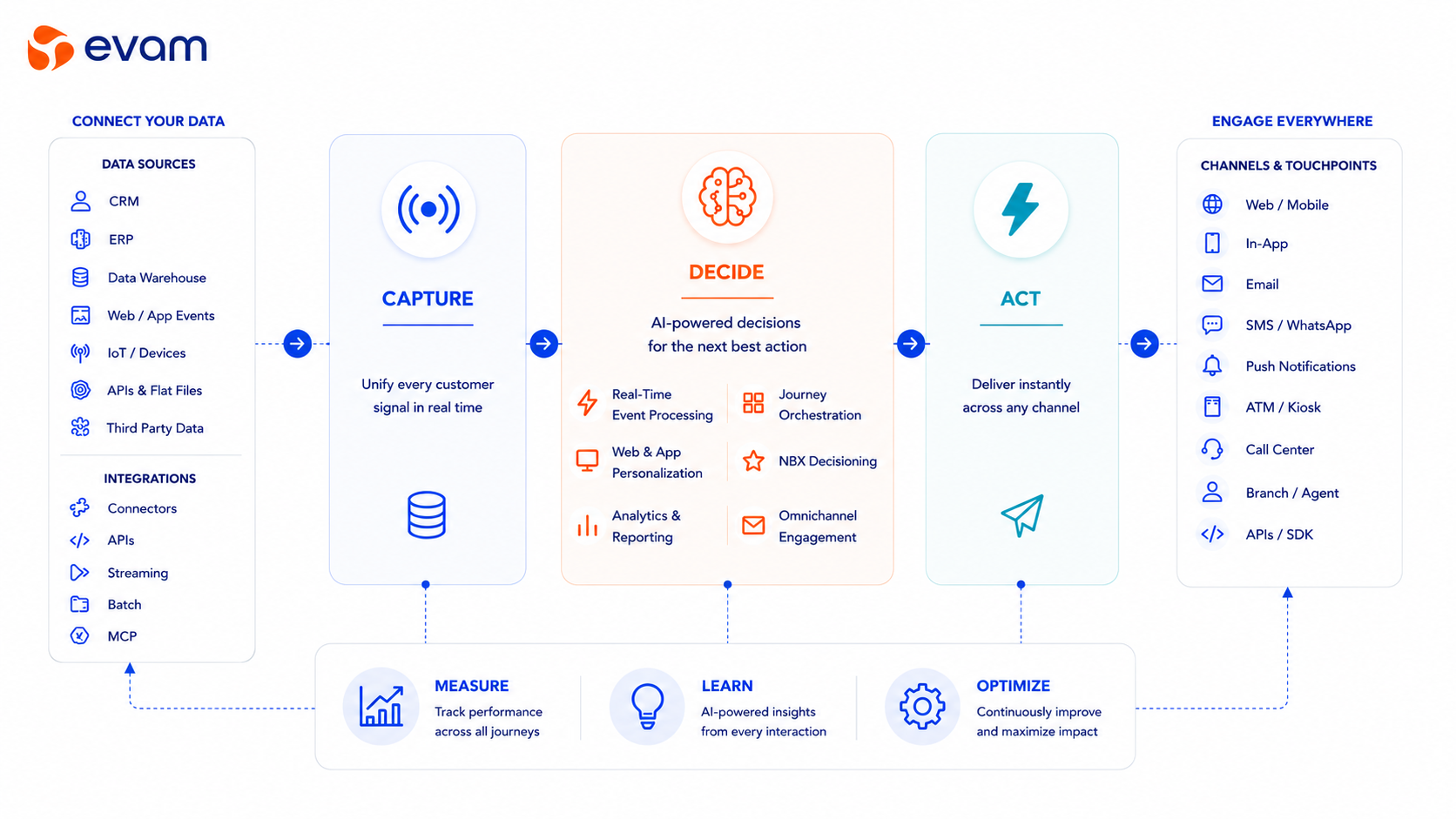
The NBX decisioning engine evaluates each event against the customer's full live context in milliseconds: their product holdings, behavioral history, active journeys, predictive model scores, offer eligibility, and suppression rules. The output is a single ranked decision about the right next action for this customer, in this channel, at this moment, delivered automatically through whatever touchpoint the customer is currently using.
Evo AI monitors engagement performance continuously, surfacing which journeys are converting and where adjustments will improve outcomes, without requiring a manual review cycle. Business teams can build, modify, and launch journeys through a visual Journey Designer without IT dependency, and simulate the outcome of logic changes against the live customer base before activating them.
evamX serves global enterprises across banking, telecommunications, and retail, delivering personalized, real-time customer engagement at the moment it matters.