
Share Post
Table of Contents
- Why Traditional Retention Strategies Are Losing Their Edge
- The Structural Retention Advantage: Ecosystem Depth
- Detecting Silent Churn Before It Becomes Visible Churn
- Six Retention-Driving Journeys Operators Are Activating Today
- The Metrics That Measure Structural Retention
- What Real-Time Orchestration Changes About Retention
- How evamX Powers Structural Retention for Telecom Operators
- The Retention Equation Worth Solving


Summarize with AI


There is a retention playbook that almost every telecom operator knows by heart. A customer signals churn intent. The system flags them. A retention offer goes out, usually a discount, a bill credit, or a free month. The customer stays. The metric improves.
The problem is not that this playbook fails. The problem is that it only works once.
A customer who stays because of a discount is not a loyal customer. They are a customer waiting for the next discount or for a competitor to offer a better one first. Retention built on price is structurally fragile, and in a market where every operator can match a price cut within hours, it is also increasingly expensive.
The telecom operators with the strongest long-term retention numbers are not the ones with the most aggressive discount programs. They are the ones that have made leaving genuinely difficult, not through contracts or lock-in, but because the customer's relationship with the operator runs too deep across too many services to walk away from.
That is the shift this guide is about. From reactive retention to structural retention. From discounting to ecosystem depth.

Why Traditional Retention Strategies Are Losing Their Edge
The logic of traditional telecom retention is simple: identify customers who are about to leave and give them a reason to stay. Churn models score the base. High-risk customers receive a retention offer. The team measures save rate and moves on.
This approach has three fundamental weaknesses that compound over time.
It is reactive by design. A customer flagged as high churn risk is already close to the door. The window to intervene without a significant financial concession is narrow. Retention at this stage is expensive, and the customers who accept discount offers are disproportionately the ones who will churn again at the next renewal.
It misses silent churn entirely. Silent churn is the gradual disengagement that precedes the cancellation decision, declining app visits, weaker recharge rhythm, reduced interaction with anchor services. By the time a traditional churn model flags these customers, the emotional decision to leave has often already been made. The retention offer arrives too late to change the relationship, only to delay the inevitable.
It optimizes for the wrong metric. Save rate measures how many customers were retained after flagging. It does not measure how many customers were never at risk in the first place, because the CVM strategy built a relationship too valuable to leave. The operators that compete on save rate are playing defense. The operators that compete on ecosystem depth are playing a different game entirely.
The Structural Retention Advantage: Ecosystem Depth
The most durable form of customer retention in telecom is not a loyalty program or a contract term. It is the number of services a customer uses across the operator's ecosystem.
The data is consistent across markets: customers anchored across multiple services churn at 30–40% lower rates than single-service subscribers. A household with mobile, broadband, a digital wallet, and an OTT subscription does not churn because one of those services has a bad month. The relationship is too embedded, the switching cost too high, and the combined value too difficult to replicate elsewhere.
This is what ecosystem depth means in practice. Not a bundle discount. Not a forced package. A genuine expansion of the relationship across services the customer actively uses, each one adding a new reason to stay and a new signal the operator can use to serve them better.
The shift from single-service retention to ecosystem retention changes the economics of CVM fundamentally. Customer acquisition cost is spread across multiple revenue streams. ARPU per household grows. Churn intervention becomes less frequent because fewer customers reach the at-risk threshold. And when retention offers are needed, they are smaller, because the relationship does not depend on a single price point.
Detecting Silent Churn Before It Becomes Visible Churn
The most expensive churn is the kind that arrives without warning. A subscriber who has mentally decided to leave months before they actually port their number, still paying, still on the books, but already gone in every meaningful sense.
Silent churn has early warning signals. They are subtle, and they require real-time behavioral monitoring to catch. But they are consistent across markets and customer segments.
Declining app engagement. A customer who used to open the operator's app daily and now opens it weekly is telling the system something. Not dramatically, but the trend is directional.
Weakening recharge rhythm. Prepaid customers who top up less frequently, in smaller amounts, or who have shifted to minimum viable top-ups are reducing their investment in the relationship. The pattern usually precedes a port by weeks.
Reduced interaction with anchor services. A customer who stops using their digital wallet, cancels their OTT subscription, or stops engaging with loyalty rewards is removing the ecosystem anchors that create switching cost. Each anchor removed makes the eventual departure easier.
Shallow ecosystem penetration. Customers who hold only one product, a single mobile line with no adjacent services are structurally the most vulnerable. They have no ecosystem switching cost. A competitor price advantage, a service issue, or a friend's recommendation is enough.
The intervention logic for silent churn is different from reactive retention. The goal is not to save a customer who has decided to leave. It is to add a second anchor product before price-led churn crystallizes to deepen the relationship while it is still intact, not after it has already frayed.
A subscriber with declining app engagement and a single-product relationship is not a churn risk yet. They are a relationship development opportunity. The operator that adds a wallet, an OTT subscription, or a smart home service at this moment is not just retaining a customer. They are transforming a fragile single-service relationship into a durable multi-service one.
Six Retention-Driving Journeys Operators Are Activating Today
Modern telecom retention is not a campaign. It is an orchestrated set of journeys, each designed to deepen the customer relationship at the right moment across the right channel.
These are the six journeys delivering the strongest retention impact for operators building toward ecosystem CVM:
1. Silent Churn Prevention Through Ecosystem Depth
Identify customers with declining engagement, weakening recharge rhythm, and single-product relationships. Intervene with a second anchor product, wallet, OTT, or smart home, before price-led churn emerges. Retention becomes portfolio-led: more reasons to stay, fewer reasons to leave. Key outcomes: higher save rate, multi-product adoption, lower silent churn rate.
2. Wallet Activation for Ecosystem Anchoring
High-frequency prepaid users who have not yet activated a wallet are a retention vulnerability. Turn them into wallet users and the relationship immediately deepens, each wallet transaction is a new behavioral signal, a new touchpoint, and a new switching cost.
Journey: activation incentive → first transaction → habit reinforcement → ecosystem expansion.
3. Convergence and Family Bundle Orchestration
Single-line households are the highest-risk segment. Identify broadband customers with no mobile lines, or households using competitor SIMs, and orchestrate family bundle offers at the moment intent is detectable, shared home Wi-Fi usage, multi-device household patterns, inbound calls. ARPU per household grows. Churn resistance grows with it.
4. Spend-Triggered Ecosystem Offers
Every wallet transaction is an intent signal. A customer who pays at an airport is about to travel, a roaming pack offer is relevant right now. A customer who pays for a streaming subscription is already in an entertainment mindset, an OTT bundle upgrade has a high conversion probability. Converting spend signals into relevant offers in real time deepens the relationship without a single retention discount.
5. Unified Inbound Retention Offers
When a customer contacts support, by app, web, store, or call center, they are at a high-attention moment. Ensuring that every inbound channel delivers the same personalized retention offer, determined in real time by a single decisioning layer, eliminates the inconsistency that erodes trust. The same customer should not receive a discount offer on the web and a standard renewal pitch on the phone.
6. Persona-Driven Value Expansion
Building behavioral personas in real time, gamer, frequent traveler, content consumer, digital finance user, enables operators to proactively offer services that match how customers actually live, before a competitor does. A gamer who receives a relevant gaming bundle is not just a converted upsell. They are a customer whose relationship with the operator has become harder to replace.
The Metrics That Measure Structural Retention
Retention teams that shift toward ecosystem CVM need a different measurement framework. Save rate is a lagging indicator of reactive retention. Structural retention requires leading indicators that measure relationship depth before the risk emerges.
Ecosystem Product Penetration, average products per household. The single strongest predictor of long-term retention. Operators targeting 3+ products per household as the baseline for a "retained" customer are building structurally rather than reactively.
Retention Depth, multi-service customer stickiness. Measures how embedded the customer relationship is across the ecosystem. High retention depth means churn resistance that does not depend on contract terms or price matching.
Silent Churn Rate, the percentage of the base showing disengagement signals without yet having requested a port. Operators that track this metric proactively consistently outperform those that measure only actual churn.
Journey Velocity, time from detecting a retention signal to delivering an intervention. In real-time CVM, this is measured in milliseconds for automated journeys. Slower velocity means more silent churn customers crossing the point of no return before an intervention arrives.
Multi-Product Adoption Rate, the rate at which single-service customers are converted to multi-service relationships through orchestrated journeys. This metric captures the proactive retention work that save rate never sees.
What Real-Time Orchestration Changes About Retention
The difference between a retention strategy that discounts and one that deepens relationships is not just philosophical. It is architectural.
Discount-led retention can be executed with a batch CVM system. Flag the at-risk customers. Send the offer. Measure the save rate. The timing does not need to be precise because the offer is the same regardless of what the customer is doing when it arrives.
Ecosystem-led retention requires real-time orchestration. The moment a customer's app engagement starts declining is the moment to add an anchor product, not three weeks later when the batch model flags them as high risk. The moment a household's Wi-Fi usage pattern reveals multiple devices is the moment to offer a family bundle, not after the competitor has already made the first move.
Real-time orchestration connects three things that batch systems keep separate: the signal, the decision, and the action. A behavioral event is captured the moment it occurs. The decisioning layer evaluates it in full context, lifecycle stage, ecosystem penetration, channel preference, offer eligibility, in milliseconds. The action reaches the customer before the moment closes.
For retention specifically, this speed advantage is not marginal. The window between a customer beginning to disengage and making a decision to leave is short, often days, sometimes hours. The operators that act within that window, with a contextually relevant offer that deepens the relationship rather than discounting it, convert a churn risk into a retention win without a single price concession.
How evamX Powers Structural Retention for Telecom Operators
evamX is built for the architecture that ecosystem retention requires, real-time signal capture, AI-powered decisioning, and omnichannel orchestration from a single platform layer.
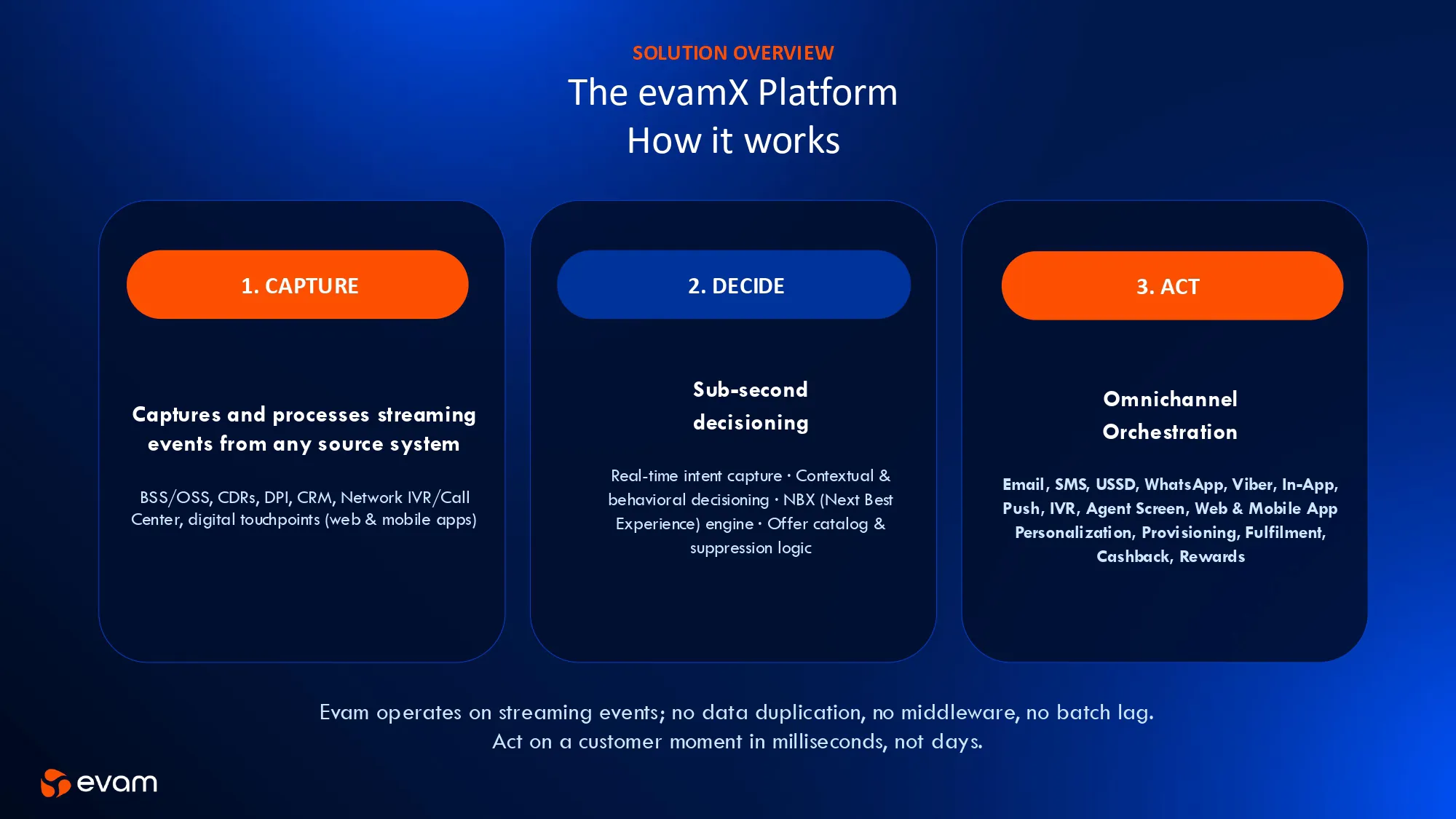
For telecom retention teams, this means:
-> Silent churn detection in real time, behavioral signals from app usage, recharge rhythm, wallet activity, and anchor service interaction are monitored continuously, with intervention triggers that fire before the customer reaches the at-risk threshold
-> NBX decisioning that evaluates the best retention action in full context, which product to add, which channel to use, which moment to act, in milliseconds
-> Single-layer omnichannel delivery, push, SMS, in-app, IVR, agent screen, so the same retention decision reaches the customer consistently, regardless of which touchpoint they are on
-> Business-owned journey management, CVM and retention teams configure, launch, and modify journeys without IT dependency, so the pace of retention strategy matches the pace of customer behavior
-> Ecosystem journey library, six ready-to-activate journeys covering wallet activation, silent churn prevention, family bundling, spend-triggered offers, and persona-driven value expansion
Operators running ecosystem CVM with evamX consistently report the same outcome: fewer customers reach the reactive retention threshold, because the proactive relationship-building work has already happened. Save rate improves not because the offers are better, but because fewer customers need saving.
The Retention Equation Worth Solving
Every telecom operator faces the same equation: the cost of retaining a customer versus the cost of acquiring a new one. Acquisition costs are high and rising. Retention costs, managed well, are lower, but only if the retention strategy builds structural loyalty rather than bought loyalty.
The operators that solve this equation best are not the ones with the deepest discount programs. They are the ones that have built ecosystem relationships deep enough that most customers never reach the point of leaving, because the relationship has become too valuable, too embedded, and too convenient to replace.
That is the retention strategy worth building. Not a better save rate. A smaller population of customers who ever need saving.
Explore how evamX helps telecom operators build structural retention: