
 Evo AI
Share Post
Table of Contents
- The Real Problem Isn't Integration. It's Activation.
- Evam + Salesforce: Turning CRM Records Into Real-Time Moments
- What Evam Reads from Salesforce
- What Evam Does with That Data
- Example: Upsell at the Moment of Intent
- How Evam Connects to Any Enterprise System
- The Full Enterprise Ecosystem Evam Works With
- The Business Value of an Integrated Stack
- How Integration Works in Practice: What to Expect
- The Bottom Line


Summarize with AI


It's one of the first questions we hear in almost every enterprise sales conversation: "Does Evam integrate with Salesforce?" The short answer: yes.
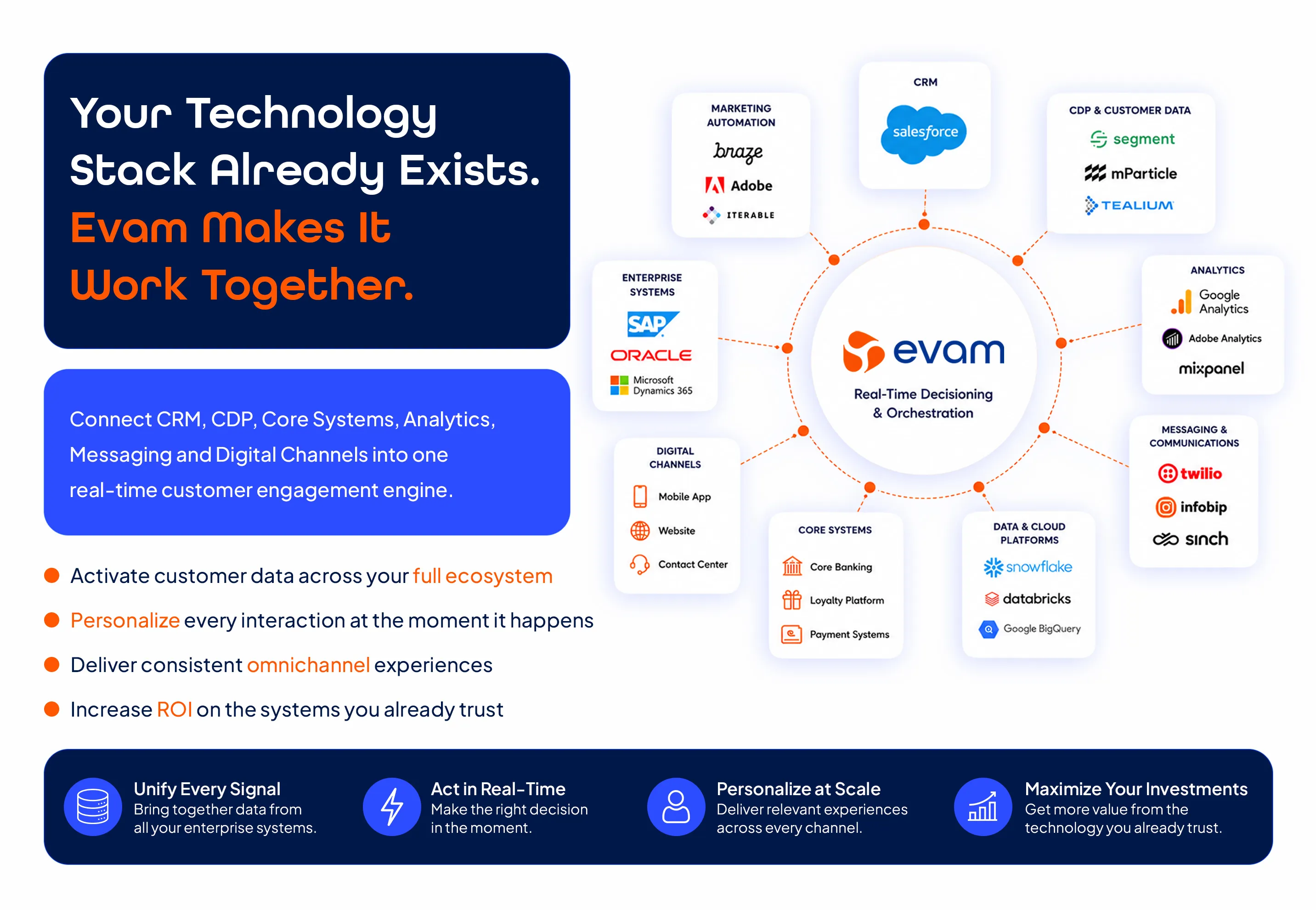
The longer answer — and the more important one — is this: Evam was architected from day one around the assumption that your technology stack already exists, already works, and already holds years of valuable customer data. Our job isn't to replace it. Our job is to finally make it act in real time.
This post breaks down exactly how Evam connects to Salesforce and the broader enterprise ecosystem — event brokers, databases, CDPs, core banking systems, telecom BSS/OSS, e-commerce platforms, loyalty engines, and beyond. No jargon. No hand-waving. Just a clear explanation of how integration works and why it matters for your business.
The Real Problem Isn't Integration. It's Activation.
Most enterprise organizations don't have a data problem. They have an activation problem.
Salesforce holds your CRM records — customer history, account attributes, service interactions. Your data warehouse holds transactional history and behavioral segments. Your core banking system streams every deposit, loan repayment, and card swipe in real time. Your CDP holds unified customer profiles built from dozens of sources.
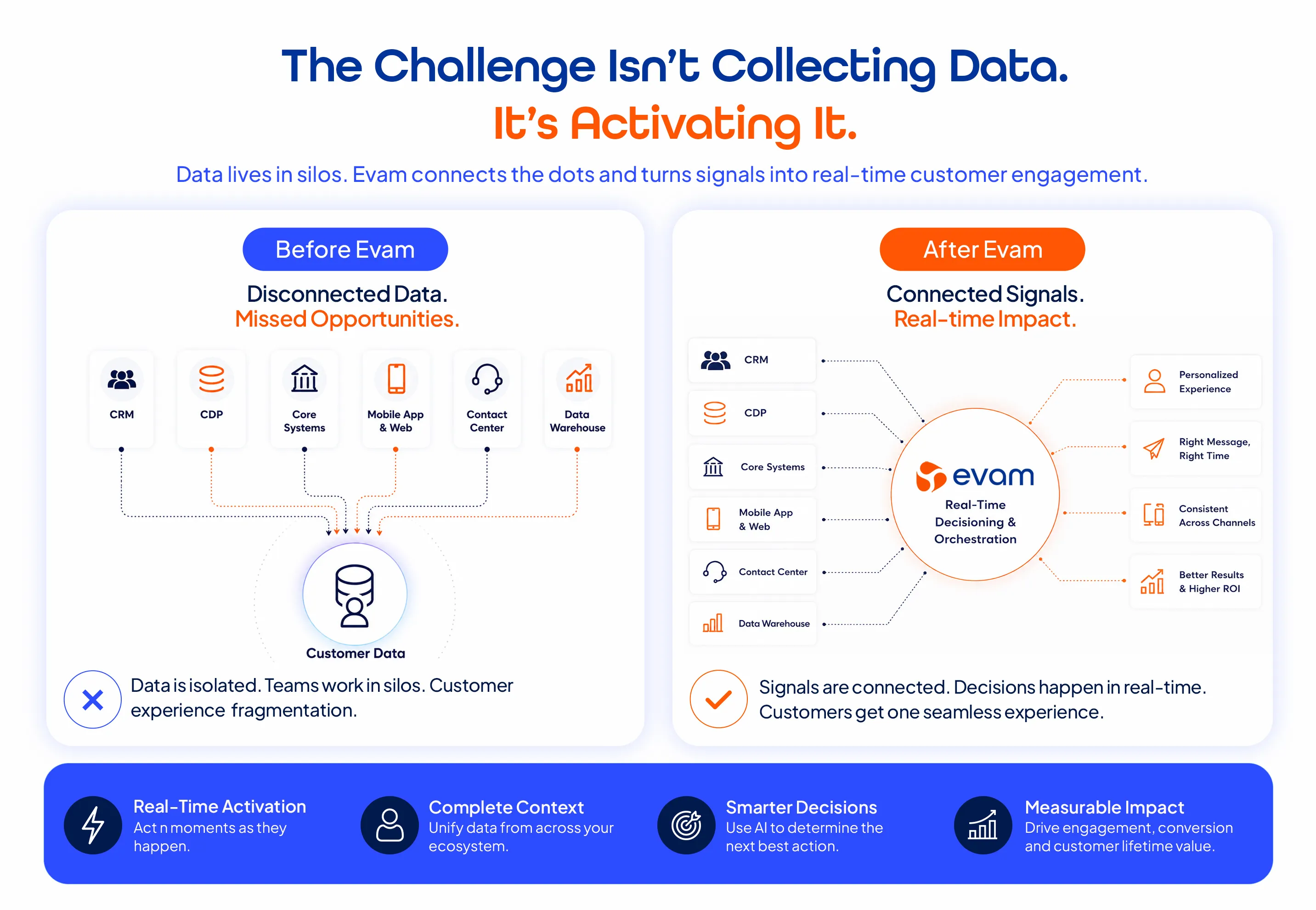
None of these systems, on their own, can take that data and do something with it at the exact moment a customer is engaging — logging into their mobile app, completing a transaction, triggering a churn signal, or responding to an offer.
That's the gap Evam closes.
Evam connects to your existing data infrastructure and transforms it into a real-time decision engine — without moving your data, duplicating it, or requiring custom ETL pipelines.
The result: every customer signal your systems already capture finally gets used at the moment it matters.
Evam + Salesforce: Turning CRM Records Into Real-Time Moments
Salesforce is one of the most widely deployed CRM platforms in the enterprise world, and it's typically one of the richest sources of customer relationship data in any organization. But by design, CRM systems are record-keeping platforms — they capture what happened. They're not built to act on what's happening right now.
Evam integrates with Salesforce to bridge that gap. Here's what that looks like in practice:
What Evam Reads from Salesforce
Customer account attributes and lifecycle stage
Contact history and service interaction records
Opportunity and product ownership data
Custom objects and segmentation fields your team has built
Lead scoring and qualification flags
What Evam Does with That Data
Enriches real-time event context — so when a customer triggers an event in your mobile app, Evam knows their full CRM profile immediately
Powers eligibility and suppression logic — CRM-defined segments and product ownership inform which offers a customer can or cannot receive
Feeds decisioning rules — value tier, tenure, engagement history all become live inputs into Evam's Next Best Experience engine
Writes back outcomes — engagement results, campaign responses, and journey completions can be surfaced back into Salesforce records
Example: Upsell at the Moment of Intent
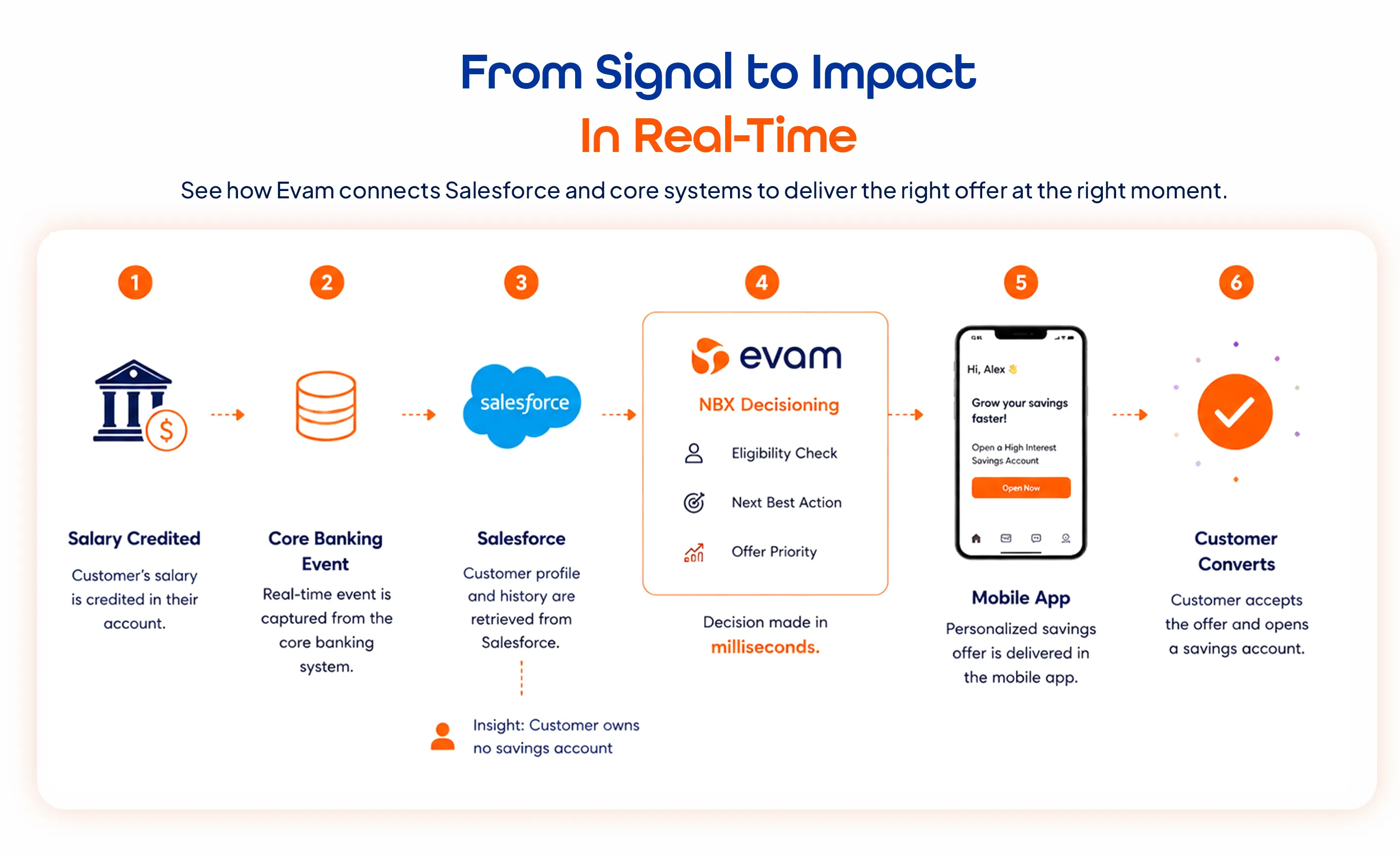
A retail banking customer logs into mobile banking after receiving their salary. Evam captures the salary credit event from core banking in real time, enriches it with their Salesforce CRM profile (product gap: no savings product), applies NBX decisioning, and delivers a personalized savings offer inside the mobile app within milliseconds — before the customer has navigated away from the dashboard. No batch run. No next-day campaign. Real time.
How Evam Connects to Any Enterprise System
Salesforce is one integration point. The architecture that supports it supports your entire stack. Evam is built on a zero-copy, event-driven integration model — meaning your data stays in your systems, and Evam operates on live streams and on-demand queries rather than duplicated datasets.
There are three primary integration patterns Evam uses:
1. Event-Based Streaming (Real-Time)
Evam ingests live event streams from message brokers and REST APIs, enabling sub-second decisioning the moment something happens — in core banking, in your mobile app, or anywhere along the customer journey.
Kafka / Kinesis / RabbitMQ — high-throughput message queues
HTTP / HTTPS Listener — RESTful API push endpoints
SOAP Listener — legacy web services (common in telecom and banking)
ActiveMQ / Pub-Sub — message bus patterns
Mobile & Web SDK — in-app and browser event streams
2. Database & Storage Connectors (Enrichment & Segmentation)
Evam pulls structured data for profile enrichment, segmentation, and eligibility checks from any relational, columnar, or cloud data store — on-premise or cloud-native.
Microsoft SQL Server, Oracle, PostgreSQL, Vertica, MySQL / Sybase DB, Cassandra, Teradata, Amazon RDS
3. File & Batch Transfer (Historical Data)
For systems that don't expose real-time APIs, Evam supports scheduled data ingestion — bringing in historical segments, model scores, and batch-processed attributes that enrich real-time decisions.
SFTP / FTP file ingestion, Scheduled database exports, CSV / JSON / XML batch imports
The Full Enterprise Ecosystem Evam Works With
| System Type | Examples | What It Enables in Evam |
| CRM | Salesforce, Microsoft Dynamics, custom CRM | Customer profile enrichment, product ownership, lifecycle stage, suppression |
| Core Banking System | Temenos, Finastra, Oracle FLEXCUBE, Misys | Real-time transaction events, account balance triggers, loan lifecycle signals |
| CDP | Segment, Tealium, mParticle, Adobe Experience Platform | Unified customer profiles, behavioral segments, identity resolution |
| Data Warehouse | Snowflake, Redshift, BigQuery, Teradata, Vertica | Historical segments, ML model scores, batch enrichment attributes |
| Telecom BSS/OSS | Amdocs, Comverse, Netcracker | Subscriber events, usage triggers, plan expiry, roaming signals |
| Loyalty & Rewards | Custom loyalty engines, points platforms | Tier status, reward balance, points expiry triggers for real-time offers |
| E-commerce Platform | Shopify, Magento, custom platforms | Browse events, cart abandonment, purchase history, product affinity |
| Mobile Banking / App | Custom iOS/Android apps via SDK | In-app behavior, screen visits, session depth, feature engagement |
| Messaging Providers | Twilio, Sinch, Vonage, Firebase, APNs | SMS, push notification, WhatsApp delivery and engagement tracking |
| Marketing Automation | Braze, HubSpot, Adobe Campaign | Cross-platform journey handoffs, suppression sync, audience sharing |
| Call Center / IVR | Genesys, Avaya, Cisco, custom IVR | Inbound call triggers, complaint events, agent screen decisioning |
| ATM / Kiosk / POS | NCR, Diebold, custom terminal networks | Physical touchpoint events for real-time in-session personalization |
Zero-Copy Architecture: Why It Matters for Enterprise IT
Integration projects fail in enterprises for a predictable reason: they require data to move. Data migration, duplication, and transformation create compliance risk, latency, maintenance overhead, and political friction between IT and business teams.
Evam's zero-copy architecture eliminates this entirely.
Your data never leaves your environment — Evam subscribes to events and queries data stores on demand, but no data is replicated into a separate Evam-managed layer
No custom ETL pipelines — Evam's native connectors handle transformation at the edge, without requiring a dedicated data engineering build
No middleware required — Evam operates directly on your event brokers (Kafka, Kinesis, etc.) and databases (Oracle, SQL Server, Teradata, etc.)
Deployment flexibility — on-premise, private cloud, public cloud, or hybrid. Evam fits around your IT governance model, not the other way around
Security & Compliance Note
Evam is ISO 27001 and ISO 27034 certified. All data in transit is encrypted via TLS 1.2/1.3, with mTLS for internal service-to-service communication. PII fields are encrypted at rest with AES-256. For regulated industries (banking, telecom), Evam supports fully on-premise deployment with no external data dependencies. For full security documentation, visit trust.evam.com.
The Business Value of an Integrated Stack
Technical architecture is only half the story. The reason organizations invest in integration is outcomes. Here's what a fully connected Evam deployment delivers:
Faster Time-to-Value
Because Evam works with your existing systems rather than requiring data migration, implementation timelines are measured in weeks, not quarters. Your CRM data, your customer profiles, your transaction feeds — all immediately available as inputs to real-time decisioning from day one.
Higher ROI on Existing Technology Investments
Salesforce didn't become valuable because it stored data. It became valuable because it organised it. Evam makes that data productive in real time — so your Salesforce investment, your CDP investment, your data warehouse investment all compound rather than sit in silos.
Real Personalisation at Scale
Personalisation at scale requires three things: rich customer data, real-time signals, and the ability to decide and act in milliseconds. Integration is what connects all three. When Evam has access to your full data ecosystem — CRM attributes, transaction history, behavioral signals, loyalty tier — every decision becomes genuinely contextual, not just segmented.
Reduced Operational Complexity
A single platform that connects to your entire stack means fewer point-to-point integrations to maintain, fewer data quality issues from duplicated datasets, and fewer handoff failures between systems. One event. One decision. One orchestration layer.
How Integration Works in Practice: What to Expect
For prospects evaluating Evam, integration is typically the first technical question and the last blocker. Here's what a standard integration process looks like:
Discovery workshop (1-2 days): Evam's integration team maps your existing data sources, event brokers, and system architecture. We identify which connectors apply and what event schemas need to be defined.
Connector configuration (1-3 weeks): Native connectors are configured to your Salesforce instance, core banking system, event brokers, and data stores. No custom development required for standard integrations.
Event schema definition (1-2 weeks): Business and technical teams align on which events to capture, what attributes they carry, and how they map to decisioning rules. Evam's event catalog accelerates this process.
Go-live and hypercare (30 days): Dedicated engineering support post go-live, with SLA-backed incident response (P1: 30-minute response, 4-hour resolution).
The Bottom Line
Enterprise software should never operate in isolation. The value of any platform — Salesforce, Evam, or anything else — is multiplied when it works with the systems around it.
Evam was built to be the decisioning and orchestration layer on top of your existing data investments. Whether your customer data lives in Salesforce, a core banking system, a CDP, a data warehouse, a telecom BSS/OSS, or all of the above — Evam can connect to it, activate it, and turn it into real-time customer experiences.
You don't need to replace your technology to create better customer experiences. You need to make the technology you already have act in real time.
That's what Evam does.