
 Evo AI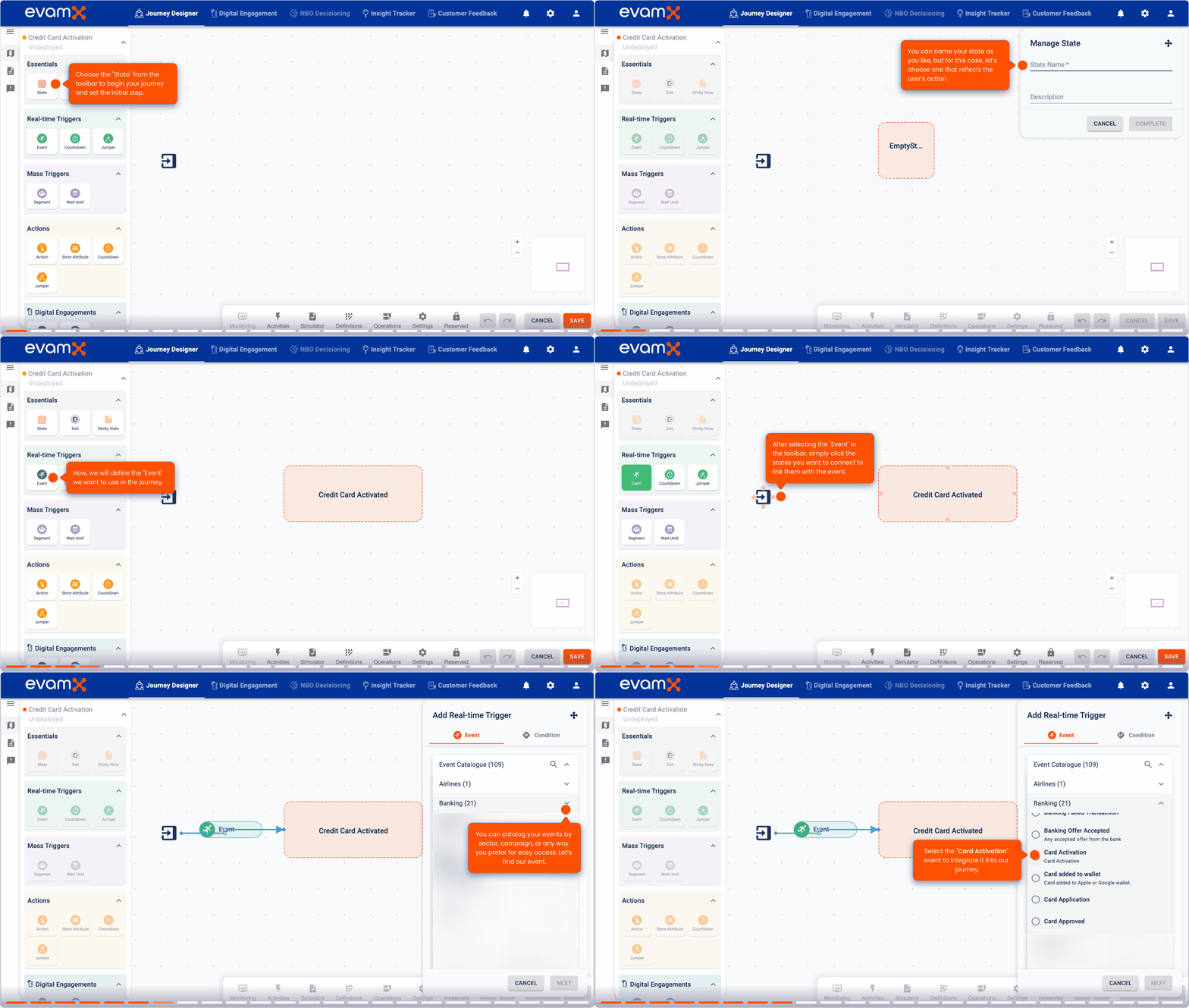
Share Post
Table of Contents
- Why Customers Churn and Why the Real Reason Is Usually Missed
- The Signals Churn Leaves Before It Arrives
- Five Churn Reduction Strategies That Work
- What Churn Reduction Looks Like Across Industries
- The Role of Real-Time Decisioning in Churn Reduction
- How evamX Powers Churn Reduction at Scale
- The Churn Reduction Equation


Summarize with AI


Most businesses discover they have a churn problem too late.
Not too late in the sense that recovery is impossible, but too late in the sense that the customer has already decided. The cancellation, the port, the non-renewal: these are not decisions. They are announcements. The decision happened weeks earlier, during a series of small moments that the business either missed or failed to respond to meaningfully.
This is the fundamental challenge of churn reduction. The moments that matter most: the first sign of disengagement, the gradual withdrawal, the quiet shift in behavior that precedes the exit, are invisible to systems built to detect churn only after it has crystallized.
Reducing customer churn effectively requires moving earlier in that sequence. Not managing exits better, but building relationships deep enough that fewer customers reach the exit in the first place.
Why Customers Churn and Why the Real Reason Is Usually Missed
Ask most businesses why customers churn and the answers come quickly: price, service quality, a competitor's offer, a bad experience. These are the reasons customers give when asked. They are not always the real reasons.
Price is rarely the root cause of churn. It is the reason customers use when they have already decided to leave and need something to say. A customer who is genuinely satisfied with the value they receive does not churn because a competitor is €2 cheaper per month. A customer who has been slowly disengaging for three months will use price as the reason because it is simpler than explaining that they never felt understood, never received a relevant offer, and gradually stopped seeing why the relationship was worth maintaining.
Service failures are similar. A single bad experience rarely causes churn in a customer with a deep, multi-service relationship. It causes churn in a customer who was already at the margin, one whose relationship with the business was thin enough that a single friction point was sufficient to tip the decision.
The pattern is consistent across industries: churn is rarely a sudden event. It is the final expression of a relationship that has been eroding for some time, usually through a combination of irrelevant communications, missed moments, and a gradual failure to demonstrate value.
Understanding this changes the churn reduction strategy entirely. The question is not "how do we save customers who are about to leave?" It is "how do we build relationships that are too valuable to leave?"
The Signals Churn Leaves Before It Arrives
Churn is predictable, not because customers announce their intentions, but because disengagement follows a recognizable pattern. The signals are subtle, and they require continuous behavioral monitoring to detect, but they are there.
Declining engagement frequency. A customer who used to interact with a product or service daily and now does so weekly is moving away from the center of the relationship. The change is gradual. It does not trigger a standard churn flag. But the direction is clear.
Reduced breadth of usage. A customer who has stopped using features or services they previously engaged with is simplifying their relationship by removing the layers that made staying valuable. In telecom, this might be a wallet that stops being used. In banking, a savings product that goes dormant. In retail, a loyalty program that stops being redeemed.
Shift to minimum viable engagement. Customers approaching churn often reduce their relationship to its smallest functional core, the single service they cannot immediately replace, while withdrawing from everything else. This pattern is a reliable early warning signal that precedes an exit by weeks or months.
Single-product vulnerability. Customers who hold only one product or service with a business have no ecosystem switching cost. Every interaction they have is an evaluation: is this still worth it? Customers with multiple services embedded in their daily lives are asking a different, harder question: is replacing all of this worth the effort?
Inbound contact with unresolved issues. A customer who contacts support, does not receive a satisfying resolution, and then goes quiet is not satisfied. They are resigned, and resignation is often a waypoint between dissatisfaction and departure.
The businesses that reduce churn most effectively are not the ones with the best save scripts. They are the ones that detect these signals early enough to respond before the customer reaches the decision point.
Five Churn Reduction Strategies That Work
1. Build Ecosystem Depth Before the Risk Emerges
The most durable churn reduction strategy is not a retention program. It is the deliberate expansion of the customer relationship across multiple products and services, so that by the time a churn risk would normally emerge, the relationship is too embedded to leave easily.
The evidence for this is consistent. Multi-service customers churn at 30–40% lower rates than single-service customers. The additional switching cost is part of the reason. More significant is that customers with deeper relationships receive more relevant interactions, generate more behavioral signals that the business can respond to, and accumulate more evidence that the relationship is worth maintaining.
Building ecosystem depth is not about selling customers products they do not need. It is about identifying, at the right moment, which adjacent service genuinely adds value to their existing relationship, and offering it when they are most likely to see that value.
A telecom subscriber who heavily uses mobile data is a natural candidate for a streaming bundle at the moment they are running low on data. A banking customer who regularly transfers money internationally is a natural candidate for a foreign exchange product at the moment they initiate a transfer. A retail customer who buys consistently from one category is a natural candidate for a loyalty tier that rewards category depth. Each of these is a relationship expansion that reduces churn risk, not as a side effect, but as the primary mechanism.
2. Intervene at the Signal, Not the Symptom
Traditional churn management waits for the symptom , a model that flags a customer as high risk after their behavior has already deteriorated significantly. Real-time churn reduction intervenes at the signal, the early behavioral indicator that precedes deterioration.
The difference in timing is significant. A customer whose app engagement has been declining for two weeks is still recoverable with a relevant offer or a proactive service interaction. A customer whose churn model score has crossed a threshold after six weeks of declining engagement is often already past the point where anything other than a significant financial concession will change the outcome.
Early intervention does not require dramatic gestures. A customer showing early disengagement signals often responds to something as simple as a relevant offer delivered at the right moment, a proactive message that demonstrates the business has noticed their usage pattern and has something relevant to say about it, or a service interaction that resolves a friction they had not yet escalated.
The requirement is speed. Intervention at the signal rather than the symptom means acting within days of the first behavioral indicator, not weeks.
3. Replace Discount-Led Retention with Value-Led Retention
Discounts retain customers. They do not build loyalty. A customer who stays because of a bill credit is not more likely to stay next renewal. They are more likely to expect another credit, and to churn if one is not forthcoming.
The economics of discount-led retention are also structurally unfavorable. The customers most likely to accept retention discounts are disproportionately the most price-sensitive, which means they are also the most likely to churn again at the next opportunity. Heavy discounting programs often retain the wrong customers while failing to address the underlying relationship quality issues that produced the churn risk.
Value-led retention addresses the relationship rather than the price. It asks: what does this customer actually need right now, and how can we deliver it in a way that makes staying more valuable than leaving? The answer might be a relevant product offer, a service upgrade, a loyalty reward, a proactive resolution of a friction point, or simply a communication that demonstrates genuine understanding of how the customer uses the product.
Value-led retention is more complex to execute than discount-led retention. It requires real-time behavioral data, contextual decisioning, and omnichannel delivery. But it builds relationships that hold without financial concessions. That is the only kind of churn reduction that compounds over time.
4. Orchestrate Retention Across Every Touchpoint Consistently
One of the most common failures in churn management is inconsistency across channels. A customer who is in a retention journey receives a discount offer via push notification and then receives a standard upsell pitch when they call the contact center, because the agent has no visibility into the active retention journey. The inconsistency signals to the customer that the business does not actually know them. It can accelerate the churn it was designed to prevent.
Effective churn reduction requires that retention logic is orchestrated from a single decisioning layer across every channel the customer might use. When a retention journey is active, every channel reflects it. When a customer converts, whether accepting an offer, resolving an issue, or activating a new service, every pending action in that journey is updated immediately.
This is omnichannel retention in its most useful sense: not multiple channels delivering the same message, but a single coherent relationship expressed consistently through whatever channel the customer chooses to use.
5. Close the Loop: Learn From Every Outcome
Churn reduction that does not learn from its own results is static. The same customers who were retained last quarter by the same offers will eventually recognize the pattern. The churn model that was accurate six months ago will drift as customer behavior evolves.
Effective churn management requires continuous closed-loop learning: every customer response, whether a save, a churn despite intervention, a rejection of a retention offer, or a successful ecosystem expansion, feeds back into the decisioning models. Propensity scores update. Offer rankings adjust. The system improves with each interaction.
This is the mechanism that separates churn reduction programs that maintain performance over time from those that deliver initial results and then plateau. The loop between action and outcome, closed in real time, is what makes the system compound.
What Churn Reduction Looks Like Across Industries
The churn signals and the intervention logic vary by industry, but the underlying architecture is the same: detect early, respond in context, build depth.
In telecommunications, the most valuable churn signals are usage-based. A prepaid subscriber whose recharge rhythm is weakening. A postpaid customer with a single line whose household has multiple devices on competitor networks. A high-usage customer whose data consumption has dropped without a plan change. Each of these signals a relationship at risk, and each one has a specific intervention that builds depth rather than offering a discount. A family bundle offer to the multi-device household. A streaming bundle to the high-data-usage customer whose consumption has dropped. A wallet activation journey to the single-product subscriber who has no ecosystem anchor.
In financial services, the most predictive signals are behavioral rather than transactional. A savings account that has stopped growing. A credit card that has shifted from primary to backup use. A digital banking app whose session frequency has halved. Each of these indicates a customer who is maintaining the relationship out of inertia rather than value, and who is vulnerable to a competitor that demonstrates more understanding of their financial life. The intervention is not a retention offer. It is a proactive product recommendation, a financial milestone acknowledgment, or a relevant cross-sell that demonstrates the bank sees the customer's full financial picture.
In retail and e-commerce, churn signals show up in purchase frequency, category breadth, and loyalty program engagement. A customer who has shifted from weekly to monthly purchases. A loyalty member who has stopped redeeming rewards. A subscriber who has stopped opening promotional emails. Each of these customers is still technically active, but their relationship with the brand is contracting. The intervention that works is not a discount code. It is a relevant product recommendation based on their actual purchase history, a loyalty reward calibrated to a milestone they are close to reaching, or a re-engagement journey that reminds them of the value they have accumulated.
The Role of Real-Time Decisioning in Churn Reduction
Every churn reduction strategy described above has one architectural requirement in common: the ability to detect a signal and respond to it before the moment closes.
A real-time decisioning platform captures behavioral events as they occur , across every touchpoint, from every data source, and evaluates them in full customer context in milliseconds. It determines the best action not from a batch-refreshed segment but from the customer's current state: what they have done in the last hour, the last day, the last week, and how that compares to their historical pattern.
The action it selects is not a campaign. It is a decision about the specific thing that is most likely to deepen the relationship, reduce the churn signal, or expand the ecosystem footprint of this customer at this moment. That decision is delivered immediately, through the most appropriate channel, without re-queuing through a separate tool.
This is the difference between churn management that reacts to what has already happened and churn reduction that responds to what is happening now. The former manages exits. The latter prevents them.
How evamX Powers Churn Reduction at Scale
evamX is built around the architecture that proactive churn reduction requires , real-time event processing, AI-powered contextual decisioning, and omnichannel orchestration from a single platform layer.
For churn reduction specifically, evamX delivers:
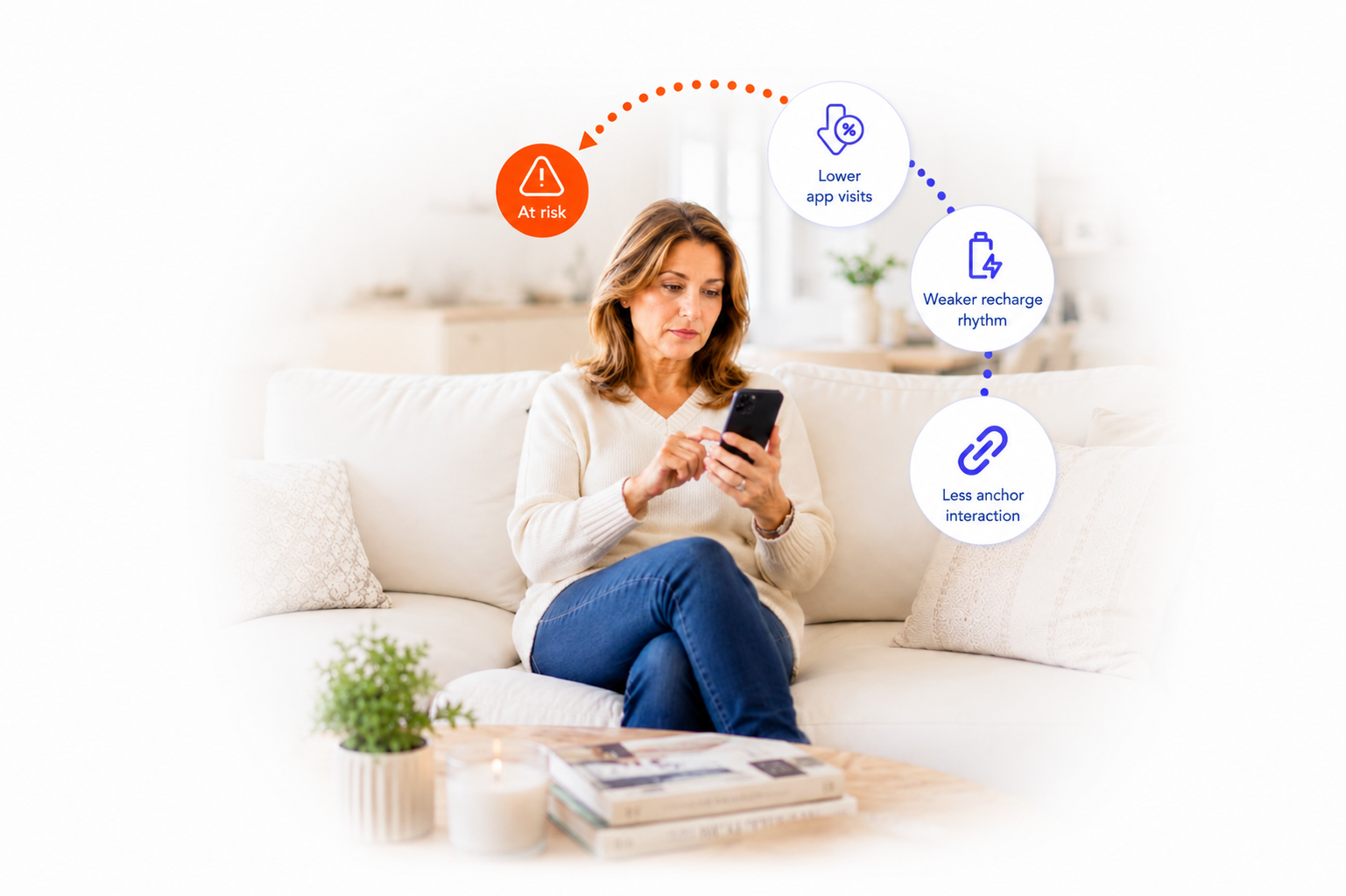
Continuous behavioral signal monitoring across app usage, transaction activity, product engagement, channel interactions, and lifecycle milestones, with intervention triggers that fire at the signal, not the symptom
NBX decisioning that evaluates the best retention action in full context, evaluating which product to add, which offer to make, which channel to use, and which moment to act, all in milliseconds
Single-layer omnichannel orchestration ensuring that retention journeys are reflected consistently across push, in-app, SMS, email, web, IVR, and agent screen
Ecosystem journey library covering wallet activation, silent churn prevention, family bundling, spend-triggered offers, and persona-driven value expansion , each designed to build relationship depth before churn risk emerges
Closed-loop learning that continuously updates churn propensity models and offer rankings based on real outcomes, compounding retention performance over time
Business-owned journey management through Journey Designer and Evo AI, so retention teams can update intervention logic at the pace customer behavior changes , without IT dependency
Across telecom, banking, and retail, organizations running proactive churn reduction with evamX consistently report the same outcome: fewer customers reaching the reactive retention threshold, because the relationship-building work has already happened. Save rate improves not because the offers are better , but because fewer customers need saving.
The Churn Reduction Equation
Every business loses some customers. The goal is not zero churn , it is a churn rate low enough that growth outpaces it, and a retention strategy deep enough that the customers who stay are worth keeping.
That requires moving earlier in the churn sequence. It requires building relationships across multiple services so that leaving becomes genuinely costly. It requires detecting disengagement signals before they become decisions. And it requires responding to those signals in the moment they still matter , not in the next campaign cycle.
The businesses that reduce churn most effectively are not the ones that are best at saving customers. They are the ones that have built relationships worth keeping , and a platform fast enough to maintain those relationships at the moment they need it most.
Explore how evamX helps reduce customer churn across telecom, banking, and retail: