
Share Post
Table of Contents
- Why Most Banks Measure Engagement the Wrong Way
- What a Real Customer Engagement Platform for Banks Needs to Do
- Where Engagement Actually Gets Won or Lost
- What This Looks Like in Practice
- How evamX Powers Customer Engagement in Banking
- Where to Go Next


Summarize with AI


Ask a bank how it measures customer engagement and the answer is usually a channel inventory: mobile app, online banking, branch, call center, ATM, all present, all technically "engaged." That inventory says almost nothing about whether the bank is actually engaging well, because being present on a channel and responding to what a customer is doing on it are two different capabilities, and most banks only have the first one.
Customer engagement in banking is decided less by which channels exist and more by how fast the gap closes between a customer signal and the bank's response to it. A customer who checks a loan calculator and closes the tab without applying is a signal. A customer who declines an offer at the ATM and logs into the app minutes later is a signal. Whether that signal turns into a stronger relationship or a missed one depends entirely on what happens in the minutes right after it, not on how many channels the bank happens to operate.
Why Most Banks Measure Engagement the Wrong Way
The default metrics, app downloads, login frequency, channel adoption, describe activity, not engagement. A customer can be highly active across every channel a bank offers and still receive interactions that feel generic, delayed, or disconnected from what they were actually doing a moment ago. The more useful question isn't how many people opened the app. It's how a specific journey performed, where customers dropped off, what triggered a re-engagement, and whether the response happened while it still mattered, the kind of view a channel-adoption number can't answer on its own.
The deeper problem is architectural. Most banks run engagement through separate systems for each channel, a marketing platform for campaigns, a CRM for service history, a core banking system for transactions, each with its own view of the customer and its own schedule for acting on what it sees. A customer's behavior gets fragmented across these systems, which means no single one of them ever has the full picture at the moment a decision needs to be made. Good engagement isn't possible from a fragmented view of the customer, no matter how sophisticated any one system is on its own.
What a Real Customer Engagement Platform for Banks Needs to Do
A genuine customer engagement platform for banks has to clear three bars that a generic marketing tool, built for retail or e-commerce, usually doesn't.
It has to unify context across every banking touchpoint, not just digital ones. A decision made from app behavior alone, ignoring what happened at the branch or through the call center that same week, is working from an incomplete picture. Banking customers move across channels constantly, and the platform has to follow them, not just watch whichever channel it was built for.
It has to respect compliance and eligibility as a first-class requirement, not an afterthought bolted onto a generic decisioning engine. A relevant offer that a customer isn't actually eligible for isn't engagement, it's a problem waiting to surface in an audit. This is the single biggest reason retail-first engagement tools tend to struggle when deployed inside a bank.
It has to act inside the moment, not around it. A system that reviews engagement weekly and adjusts a campaign for next month is still fundamentally reactive to the past. The moments that actually shape a banking relationship, a large withdrawal, a declined transaction, a support call about a fee, are moments, not trends, and they require a response inside the same session, not the next planning cycle.
Where Engagement Actually Gets Won or Lost
Banking engagement rarely breaks in dramatic moments. It breaks in small, repeated ones: a notification that doesn't reflect what the customer just did, an offer repeated after it was already declined, a service issue that gets resolved on one channel and then followed up on again through another as if it never happened.
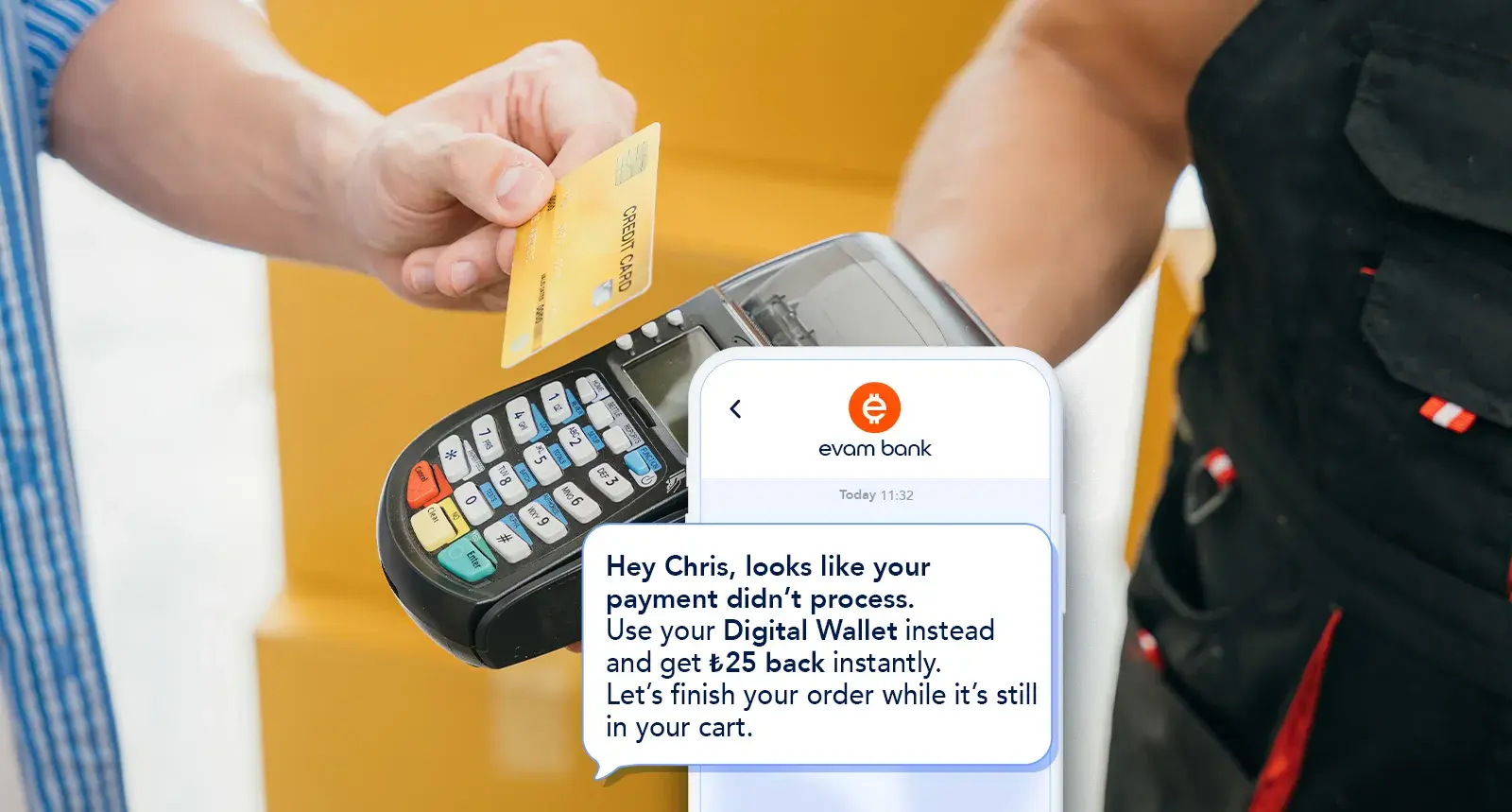
Each of these individually looks minor. Compounded across dozens of interactions a year, they're what separates a bank a customer feels understood by from one they merely use. This is also where contextual, real-time offers do the heaviest lifting, turning a moment that would otherwise pass unnoticed, a login, a transaction, a hesitation, into a specific, relevant next step instead of a missed opportunity. Our piece on how next-best-offer decisioning works in banking covers this specific mechanism in depth, including why most banks' attempts at it break down architecturally rather than strategically.
What This Looks Like in Practice
Home Credit Kazakhstan rebuilt its engagement approach around real-time, event-based response rather than scheduled bulk campaigns, and the results were substantial: a 6x higher conversion rate and dormant customers reactivated through timing rather than a better offer. Alfiya Khussainova, the bank's Director of Customer Value Management and Cross-Selling, described the shift as turning ideas into reality fast enough to reach customers at the moment that mattered, not after it had passed.
Kapital Bank shows what this looks like sustained at scale. Running 96 active real-time scenarios and processing more than 2 million customer events daily, the bank grew incremental deposit sales by 16 percent, a result that depends on engagement staying relevant across millions of daily interactions rather than degrading into noise as volume grows.
Neither result came from adding a channel or a bigger campaign budget. Both came from shortening the distance between a customer signal and the bank's response to it.
How evamX Powers Customer Engagement in Banking
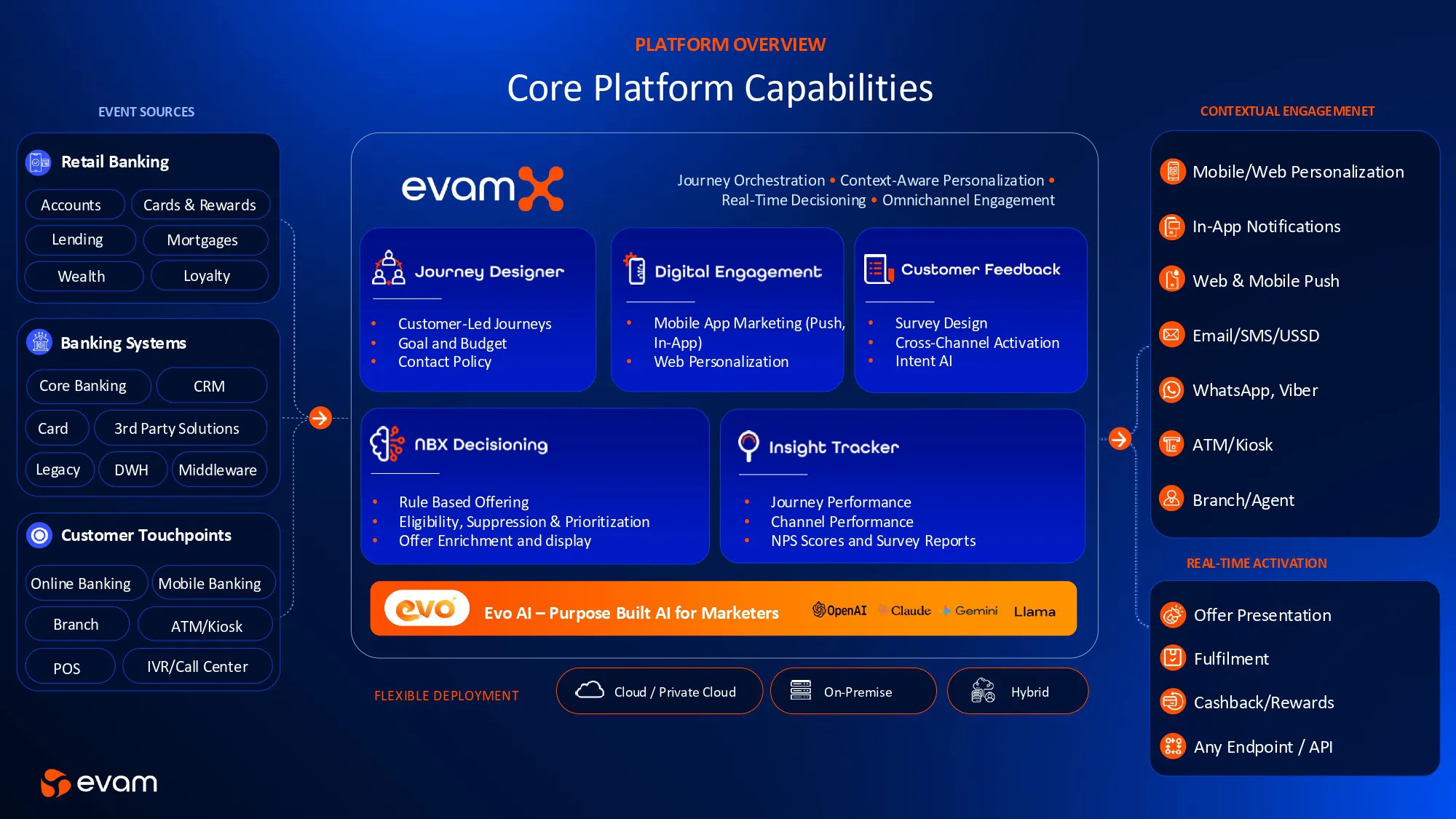
evamX unifies signals from across the banking environment, core banking, card transactions, mobile app, call center, branch, into a single real-time decisioning layer, so a customer's context travels with them from channel to channel instead of resetting at each one. The NBX decisioning engine evaluates each signal against eligibility, compliance rules, and the customer's full history, then acts in the moment rather than on a review cycle, through whichever channel the customer is actually using.
Suppression and priority logic run across every channel simultaneously, so an offer declined on one doesn't get repeated on another, and a resolved issue doesn't generate a redundant follow-up. Journey Designer gives CVM and marketing teams direct control over the rules governing these interactions, without an engineering ticket for every adjustment.
Closing the loop matters just as much as reacting quickly. evamX's Customer Feedback module lets a bank trigger a short survey directly inside a journey right after the moment that matters, a completed transfer, a resolved support call, a card activation, while the experience is still fresh rather than through a generic survey days later that arrives disconnected from what actually happened. Because responses link back to the same journey and channel, a low satisfaction score isn't just a number in a quarterly report. It's a signal the same decisioning layer can act on directly. For a broader view of how this fits into the wider shift happening across banking, our piece on AI in banking covers the trends driving this shift industry-wide.
Where to Go Next
Home Credit Kazakhstan and Kapital Bank didn't win engagement with a bigger rewards catalog or another channel. They won it by closing the gap between what a customer just did and how fast the bank responded to it.
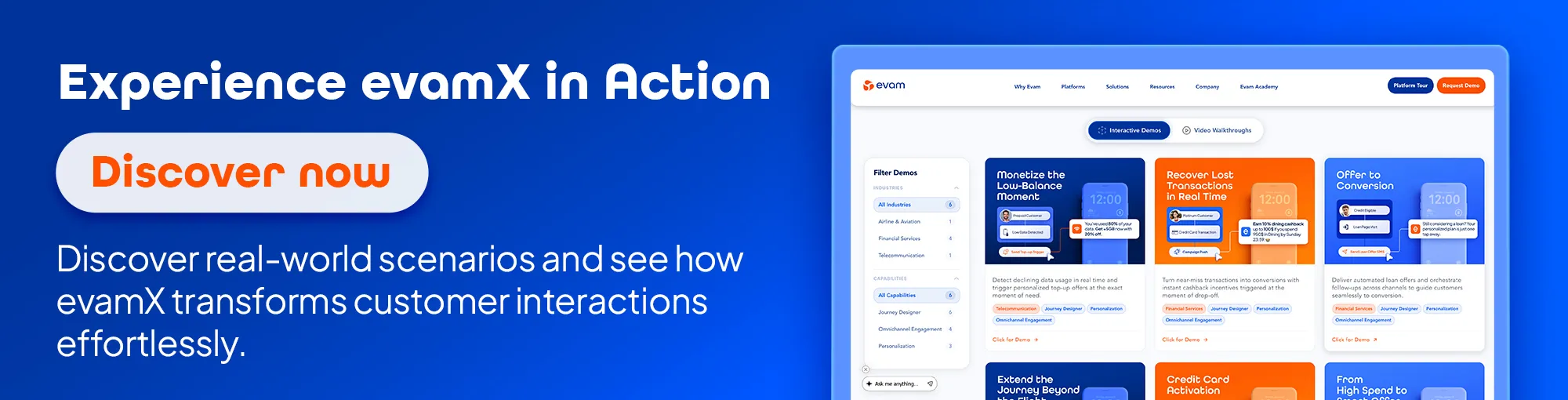
If you want to see what this looks like against your own customer base, our team is glad to walk through it with you. Reach out through our contact page or explore the Product Demo Hub directly.