
Share Post
Table of Contents
- Why Every Platform in This Category Sounds the Same
- What Actually Separates One Platform From Another
- How the Major Platforms Compare
- Where Evam Fits, and Where It Doesn't
- Where to Go Next


Summarize with AI


Search "customer journey orchestration platform" and nearly every result says roughly the same thing: connect every touchpoint, orchestrate the journey in real time, personalize at scale. Category convergence in language has outpaced convergence in the underlying product, which makes real differences hard to see from a features page alone.
Those differences matter more in some industries than others. A retail brand coordinating app and email notifications has different requirements than a bank or a telecom operator managing compliance-sensitive, high-volume decisions. Here's how seven platforms compare across the dimensions that actually matter for that evaluation.
Why Every Platform in This Category Sounds the Same
Most customer journey orchestration platforms trace back to one of two starting points: a marketing automation tool that added real-time triggers, or a customer data platform that added execution capability. Both architectures can claim orchestration capability, but neither guarantees the compliance handling or multi-channel coordination that regulated industries need.
The result is a category where marketing language flattens real differences in architecture, industry depth, and decisioning speed. Comparing platforms on their homepage claims tells you almost nothing. Comparing them on decisioning latency, industry-specific compliance handling, and deployment flexibility tells you most of what you actually need to know.
What Actually Separates One Platform From Another
Real-Time Decision Speed. Some platforms marketed as real-time refresh recommendations on an hourly or daily cycle, which is faster than a human-run campaign but not the same as evaluating a live signal in milliseconds. The gap only shows up under real usage, not on a spec sheet.
Industry-Specific Rules. A platform built for retail campaign orchestration can usually add eligibility and suppression logic for banking or telecom as a custom project. A platform built around that logic from the start handles it as a baseline capability, which shows up in implementation time and long-term maintenance cost.
Deployment Flexibility. Multitenant SaaS is the default for most of this category, which works well for many industries. Banks in particular often need private cloud or on-premise options for data residency reasons a pure SaaS architecture can't always satisfy.
Journey Modification Authority. Some platforms require a technical team for meaningful changes to live logic. Others are built so a marketing or CVM team can adjust triggers, rules, and channel logic directly, which matters far more to total cost of ownership than the sticker price of the license.
How the Major Platforms Compare
| Platform | Real-Time Decisioning | Industry Depth | Deployment Options | Who Can Edit Live Journeys | Best For |
| Evam (evamX) | Sub-second, event-driven via NBX engine | Banking, telecom, retail with native eligibility/suppression | Cloud, private cloud, on-premise, hybrid | Business teams via Journey Designer and Evo AI | Regulated, high-volume industries that need sub-second decisioning with compliance controls built in |
| Adobe | Strong via Adobe Journey Optimizer | Broad horizontal reach, less banking/telecom-specific | Primarily cloud-based, enterprise-tier | Marketing teams with technical setup for complex logic | Large enterprises already standardized on the Adobe Experience Cloud stack |
| Braze | Fast cross-channel messaging with AI-driven triggers | Retail, media, app-first brands; less compliance-focused | Multitenant SaaS | Marketer-friendly, geared toward campaign/lifecycle | Consumer app and media brands running high-volume cross-channel campaigns |
| MoEngage | Fast, mobile-first triggers with growing AI capabilities | Strong with mobile-first growth teams, especially in emerging markets | Multitenant SaaS | Marketer-friendly, campaign-oriented | Mobile-first growth teams scaling app engagement in emerging markets |
| Salesforce | Decisioning layered on CRM-first architecture | Broad reach, less banking/telecom specialization | Multitenant SaaS | Strong no-code tooling, real-time depth varies | Teams that want journey orchestration built directly into an existing Salesforce CRM |
| Bloomreach | Strong in AI-driven personalization and unified data | Retail/e-commerce; less banking compliance specialized | Cloud-based SaaS | Marketing-led, positioned for CDP/campaign teams | E-commerce brands prioritizing AI-driven product personalization |
None of these are weak platforms. Each is a legitimate, widely deployed choice for the use case it was built around. The distinction that matters is fit: a bank or telecom operator choosing a platform built primarily for retail campaign orchestration typically ends up building the compliance and latency requirements that should have been there from the start.
Where Evam Fits, and Where It Doesn't
Evam is built specifically for industries where a journey decision has to be fast, compliant, and coordinated across channels a typical retail-first platform doesn't prioritize: ATM, IVR, call center, and core banking or telecom systems, alongside the usual app, web, and messaging channels. That focus is a genuine strength for banking, telecom, and retail operators managing high-volume, real-time decisions, and a genuine mismatch for a brand whose orchestration needs stop at email and app push.
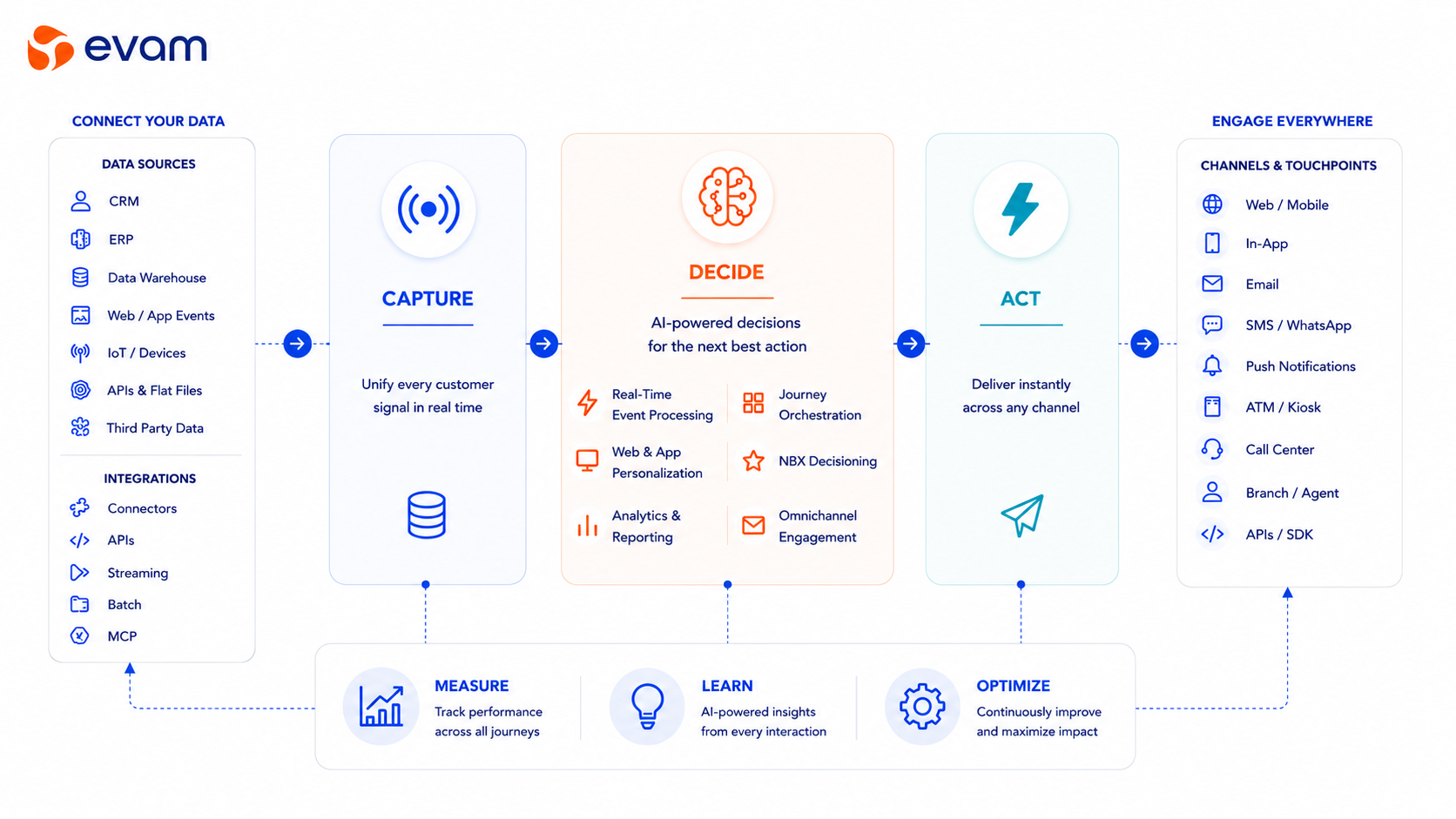
Our customer journey orchestration platform page covers the full architecture in more depth, and our pieces on customer journey orchestration from signup to renewal in real time and banking journey orchestration real-time use cases go deeper on specific patterns.
Where to Go Next
The honest way to choose between these platforms isn't by comparing marketing pages. It's by asking how each one handles the specific decision that matters most in your business, and how fast it can actually make that decision when it counts.
If you want to see what real-time customer journey orchestration looks like against your own systems, our team is glad to walk through it with you. Reach out through our contact page or explore the Product Demo Hub directly.