
Share Post
Table of Contents
- Why This Is Where We're Strongest
- The Moment Before a Decision Is Where Value Lives
- What This Looks Like Inside Real Banks
- The Architecture Behind It
- How evamX Powers Real-Time Banking Journeys
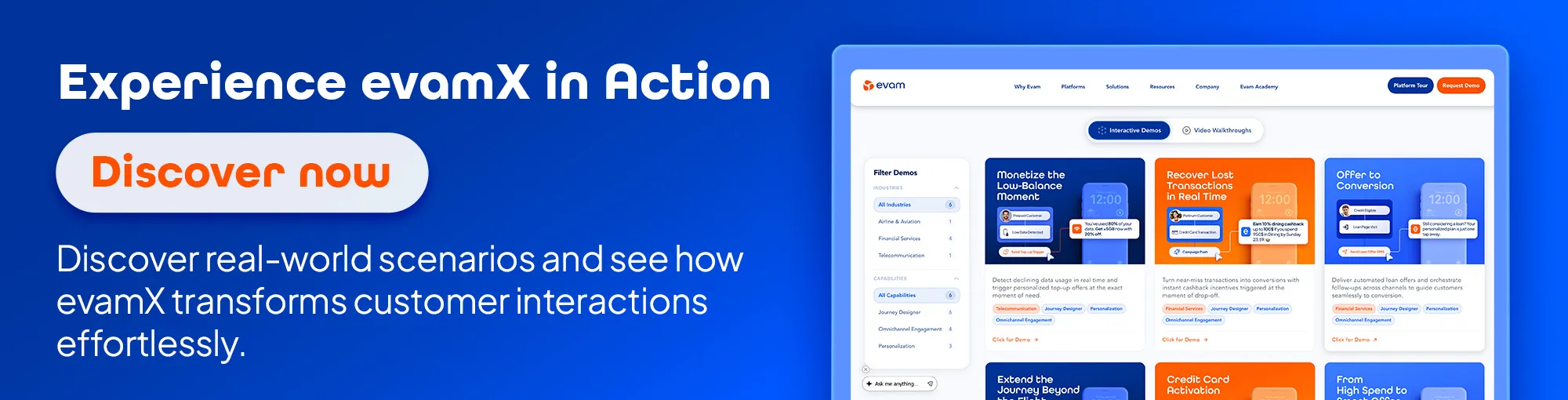
- See It Running Today


Summarize with AI


Every vendor in this space talks about customer journey orchestration. Most of them mean designing flows: onboarding sequences, cross-sell campaigns, retention tracks, mapped out in advance and set to run.
Real banking customers don't follow a flow. A payment fails. A loan calculator gets opened and closed without a submission. A transfer is about to move a large balance out of the bank. None of that was on anyone's campaign calendar. The orchestration that matters is the kind that notices these moments and acts inside them, and this is the part of the business where we don't have to speak hypothetically. Banks are running this today, at scale, and the results are published.
Why This Is Where We're Strongest
Banking is the vertical where evamX's architecture gets tested the hardest, high transaction volume, strict compliance requirements, and customers who notice immediately when an offer feels tone-deaf to their situation. It's also where we have the deepest, most measurable track record.
Kapital Bank, Azerbaijan's largest financial institution, runs 96 active real-time scenarios on evamX and processes more than 2 million customer events daily. ABB Bank runs 40-plus scenarios reaching 1.5 million customers a month. tbi bank scaled from 200,000 to over 5 million messages a month without adding headcount to run it. Garanti BBVA has run evamX as a real-time layer alongside its mass campaign model for three years. None of this is a pilot. It's operational infrastructure inside some of the banks that take customer experience most seriously.
The Moment Before a Decision Is Where Value Lives
One of the most overlooked moments in banking happens just before a transaction completes.
A customer initiates a transfer, about to move a significant balance out of the bank. In a traditional setup, this moment is invisible, the transaction clears and the opportunity is gone. In a real-time orchestration setup, the system evaluates context right before confirmation: is this balance leaving the bank, is there a better alternative the customer is eligible for, is retention even the right call here. Instead of reacting afterward, the system responds in the moment, surfacing a contextual savings option or product alternative exactly when the decision is being made.
This same logic applies when something goes wrong. A payment fails, and in most banks that becomes a support ticket. In a real-time setup, the failure itself is detected instantly, the system explains the issue and guides the customer to complete the action within seconds, before frustration sets in. Kapital Bank's real-time scenarios include exactly this kind of moment-level response, which is part of why the bank has seen incremental deposit sales rise 16 percent compared to its previous bulk send-out model.
What This Looks Like Inside Real Banks
Kapital Bank needed a way to connect with customers, improve campaign performance, and boost credit card activation without relying on generic mass communication. Running real-time journey orchestration on evamX, the bank now processes over 2 million customer events daily across 96 active scenarios, has driven a 16 percent lift in incremental deposit sales, a 2.5 percent uplift in cash loan sales through well-timed real-time offers, and grown first-time app downloads by 6 percent daily, 15 percent overall.
ABB Bank used the same real-time approach to scale personalization without scaling headcount, now running 40-plus active scenarios that reach 1.5 million customers monthly and have driven 25 million AZN in cash loan sales in a three-month window.
tbi bank used real-time orchestration to launch a new card product, 'neon,' while simultaneously improving onboarding and cutting costs. The bank now runs over 100 automated scenarios, has doubled its conversion rate, lifted onboarding success by 12 percent, and shifted 77 percent of customer communication to lower-cost digital channels, all while scaling message volume from 200,000 to over 5 million a month without adding staff.
Garanti BBVA took a different route: layering real-time, personalized campaigns alongside its existing mass campaign model rather than replacing it outright. Three years into the partnership, the bank describes evamX as core to how it now runs personalized engagement at scale, with the platform evolving alongside its changing requirements release by release.
"Thanks to Evam, we've been able to adopt a real-time personalized campaign model alongside the mass campaign model. But more than that, Evam has been our strategic partner throughout our three-year journey. Together, we've developed this tool, with minor and major releases, to meet our evolving needs."
Full detail on each of these is public. You can read Kapital Bank's story, tbi bank's story, and Garanti BBVA's story directly.
The Architecture Behind It
None of these results come from a single clever campaign. They come from treating every banking moment as a decision, not a message.
Real-time lending works because the system detects intent as it happens, a loan page visit, a calculator used and abandoned, matches it against eligibility, and responds immediately instead of waiting for a follow-up campaign that may never fire. If the customer doesn't respond right away, the journey continues across channels rather than stopping.
Real-time cross-sell works the same way. A fuel purchase can trigger a fuel card offer. A travel transaction can trigger a travel card. A tax payment can trigger an insurance product. Each of these fires as a direct continuation of the transaction itself, not a generic follow-up days later, which is exactly the kind of timing advantage that drives multiples of the conversion rate a batch campaign gets. The same logic is what makes next-best-offer engines work in banking specifically: the offer isn't chosen from a fixed catalog, it's selected against what this customer just did.
This is also where cross-channel memory matters. A customer declines a loan offer at the ATM. Minutes later, on the mobile app, a system without shared memory shows the identical offer again, as if the decline never happened. evamX's decisioning layer treats every channel as part of one continuous conversation: it suppresses that offer everywhere once declined, and if the same session shows a large cash withdrawal signaling a temporary low balance, it can surface a more relevant option instead of repeating a pitch that has already failed. Our piece on real-time personalization in banking goes deeper into this balance between relevance and restraint.
Real-time onboarding treats registration as the start of the journey, not the end of it. If a card isn't activated, the system nudges. If no transaction happens, it incentivizes. If engagement drops, it adapts, which is the same mechanism behind tbi bank's 12 percent onboarding lift and Kapital Bank's 15 percent growth in app downloads.
How evamX Powers Real-Time Banking Journeys
These moments are generated across the entire banking ecosystem, core banking, card transactions, lending flows, mobile apps, call centers, even branch interactions. Each produces a signal, but on its own, an incomplete one. evamX's job is connecting all of it into a single decision layer.
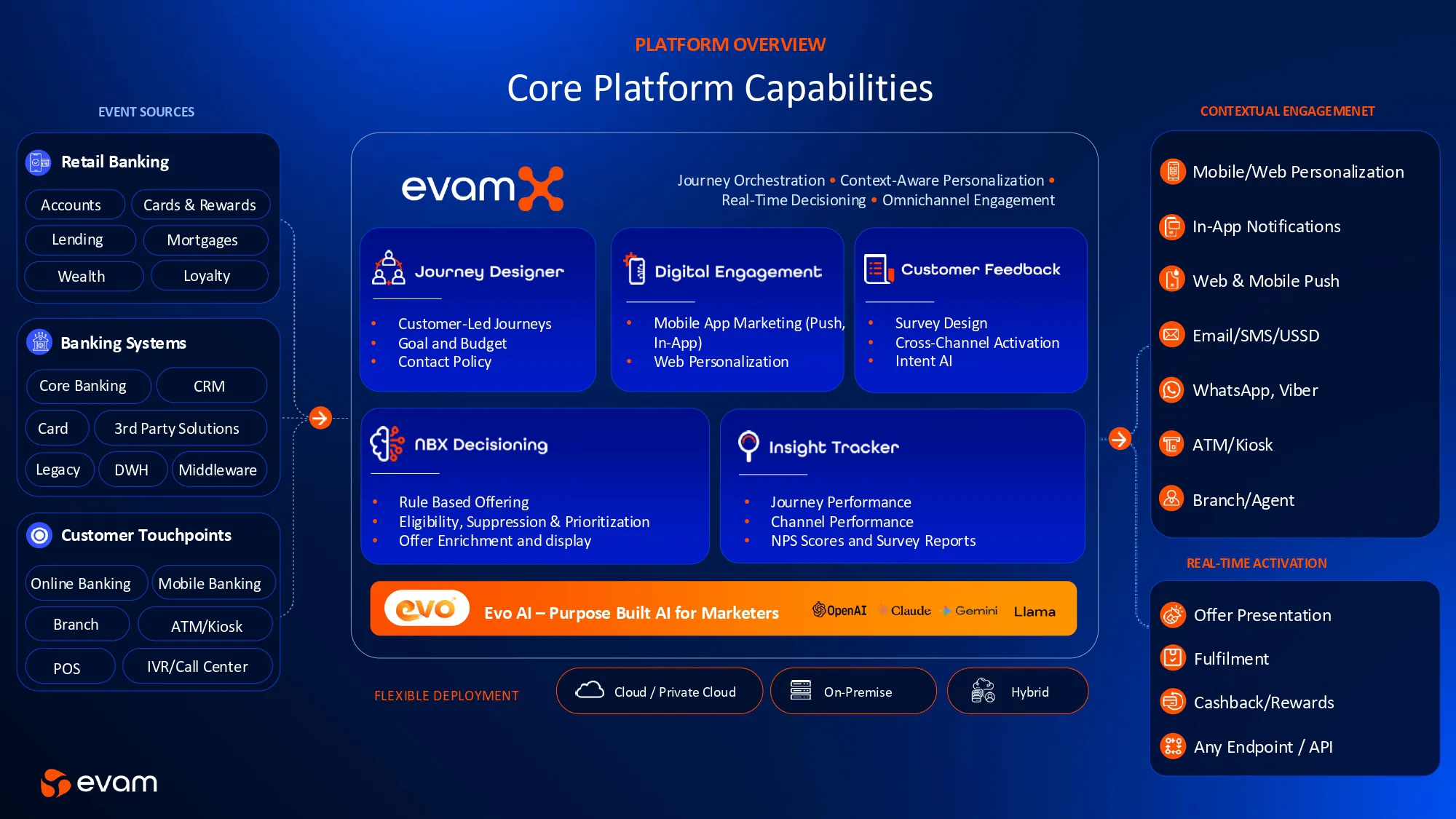
These moments are generated across the entire banking ecosystem, core banking, card transactions, lending flows, mobile apps, call centers, even branch interactions. Each produces a signal, but on its own, an incomplete one. evamX's job is connecting all of it into a single decision layer.
evamX continuously captures events from across the banking environment into one orchestration layer, so a payment attempt, a loan inquiry, or a failed transaction is evaluated in context rather than in isolation. The NBX decisioning engine turns that context into a decision in milliseconds, and the action isn't limited to a single channel, it can run instantly across mobile app, push, SMS, email, ATM, or call center. For teams that need to launch or adjust these journeys without waiting on engineering capacity, Journey Designer gives business users that control directly, and Evo AI lets teams describe a journey in plain language and get a working draft to refine, rather than building every trigger and suppression rule by hand.
This is also where the compliance side matters. Banking decisions need to be explainable, and evamX's architecture keeps decision logic separate from execution, so banks retain full control over their own risk and eligibility models while evamX handles the orchestration layer that turns those decisions into action at the speed banking actually requires. For a broader view of where this fits in the wider shift happening across the industry, see our piece on AI in banking.
See It Running Today
The banks named here aren't case studies from a pitch deck. They're running this in production, at volumes in the millions, and publishing the results.
If you want to see what real-time journey orchestration looks like for your own bank, you can walk through the Product Demo Hub or reach out through our contact page directly.