
Share Post
Table of Contents
- What Marketing Intelligence Actually Means Today
- The Problem with Insight That Arrives Too Late
- What Separates a Real-Time Marketing Intelligence Platform
- The Three Capabilities That Define Effective Marketing Intelligence Tools
- Intelligence That Spans the Entire Organization
- What AI Adds and What It Cannot Replace
- evamX: Marketing Intelligence That Acts in Real Time


Summarize with AI


Most marketing teams are not short on data. They are short on the ability to act on it before the moment it describes has already passed.
This is the defining tension in modern marketing intelligence: the gap between knowing what a customer is doing and responding to it while it still matters. Dashboards can surface a pattern. Reports can confirm a trend. But neither of these things is the same as acting on a signal in the second it is generated, and in customer engagement, that second is often the only second that counts.
Marketing intelligence tools have evolved significantly over the past decade. What once meant batch reporting and campaign analytics has expanded to encompass predictive modeling, behavioral scoring, intent detection, and AI-driven decisioning. But the most important evolution is not in what these tools can analyze. It is in how quickly they can move from analysis to action, and whether that movement happens automatically, at scale, without requiring a human to bridge the gap.
What Marketing Intelligence Actually Means Today
The term "marketing intelligence" is used broadly enough to cover almost anything that involves data and marketing in the same sentence. For the purposes of building a competitive strategy, a more useful definition is this: marketing intelligence is the ability to understand what customers are doing, predict what they are likely to do next, and take the most relevant action, automatically, in real time, at scale.
Each part of that definition matters. Understanding customer behavior is table stakes; almost every platform does this. Predicting next actions is where machine learning and AI begin to differentiate platforms. But the third element, taking action automatically, in real time, is where most marketing intelligence implementations fall short, and where the real competitive distance between platforms is created.
The reason is architectural. Most marketing intelligence tools were built as analytical systems first. They were designed to answer questions, not to execute decisions. Connecting insight to action required a separate campaign management layer, a separate channel delivery system, a separate set of manual interventions. The intelligence and the activation lived in different places, synchronized on a batch schedule that introduced hours or days of lag between signal and response.
A modern marketing intelligence platform closes this gap by design, treating data capture, AI decisioning, and omnichannel execution as a single continuous loop rather than three separate systems that need to be connected after the fact.
The Problem with Insight That Arrives Too Late
There is a specific failure mode in marketing intelligence that rarely appears in platform marketing materials but consistently shows up in how campaigns actually perform: insight latency.
A telecom operator identifies through behavioral analysis that a segment of subscribers shows early churn signals, reduced app engagement, declining data consumption, no interaction with the last three campaigns. This is valuable intelligence. But if this insight is delivered in a weekly report, acted on in the following planning cycle, and reaches the customer as a push notification ten days after the signal was first detected, the intervention is arriving into a relationship that has already deteriorated further. The intelligence was correct. The timing made it irrelevant.
The same pattern appears across industries. A bank detects a spending behavior that suggests a customer is comparing mortgage rates, a high-intent signal with a short window. A retailer's app registers that a user has viewed the same product four times in a single session, peak purchase intent, fading by the minute. In each case, marketing intelligence that cannot activate instantly is marketing intelligence that cannot deliver its full value.
This is why the architecture of a marketing intelligence platform matters as much as the sophistication of its models. A more accurate prediction delivered too late is worth less than a timely response to a live signal.
What Separates a Real-Time Marketing Intelligence Platform
The distinction between a marketing intelligence tool and a marketing intelligence platform is not primarily about features. It is about whether the system is built to close the loop between insight and action, and how fast it can do it.
A genuine real-time marketing intelligence platform is built on event streaming at its core. Customer signals, app interactions, transactions, behavioral events, lifecycle changes, are ingested as they occur, not exported in batches at scheduled intervals. This means the data available to the decisioning layer reflects what is happening now, not what happened yesterday.
On top of this streaming foundation sits an AI decisioning layer that evaluates each event in context. Not just what happened, but who it happened to, what their history looks like, what offers they are eligible for, what channel they are most likely to respond on, and what action is most likely to drive the outcome the business cares about. This evaluation happens in milliseconds, fast enough to personalize an in-app experience before the user has finished loading the screen.
The final component is autonomous execution: the ability to act on the AI's decision across the appropriate channel without human intervention. An in-app notification, a personalized screen element, a proactive SMS, a prompt on an agent's screen, whatever the right response is, it is delivered automatically, at the moment the signal was detected, not hours later when the next campaign run fires.
What makes this genuinely difficult at enterprise scale is keeping all three layers, capture, decide, act, synchronized under real workload conditions: hundreds of millions of events per day, tens of millions of customers, across complex data environments that were built over decades for different purposes.
The Three Capabilities That Define Effective Marketing Intelligence Tools
When evaluating marketing intelligence tools, three capabilities tend to separate platforms that deliver measurable impact from those that remain primarily analytical.
1. Business User Autonomy
In most enterprise environments, the people who understand customer behavior best, the marketing and CRM teams, cannot directly modify the rules and logic that govern how the system acts. Every change to a trigger, a segment definition, or an offer eligibility rule requires an IT ticket, a development cycle, and a deployment window. This bottleneck is not a minor inconvenience; it is a structural limit on how responsive marketing intelligence can ever be. Platforms that enable business users to build, modify, and launch journeys without engineering dependency remove this ceiling entirely.
2. Closed-Loop Learning
Most marketing intelligence tools analyze campaign performance after campaigns have ended. The insight from one campaign informs the next one, weeks later. A real-time closed loop means that campaign performance is tracked as it happens, results feed back into AI models in real time, and the system continuously refines its decisions without waiting for a manual review cycle. The platform gets smarter with every interaction, not just every planning cycle.
3. Experience-Level Personalization
Sending a targeted push notification is a message-level intervention. Dynamically changing what a customer sees when they open an app, the featured offers, the navigation priorities, the content surfaces, is an experience-level intervention. The latter requires the marketing intelligence layer to be integrated directly with the customer-facing front end, not just connected to a messaging gateway. The difference in customer impact is significant.
Intelligence That Spans the Entire Organization
One of the persistent failures of marketing intelligence implementations is that they are treated as a marketing department capability rather than an organizational one. The data that makes intelligence genuinely powerful, transaction records, service interactions, operational events, real-time network or infrastructure signals, lives outside the marketing team's systems. And the actions that produce the most meaningful customer outcomes, provisioning changes, loyalty adjustments, service escalations, fulfillment triggers, are executed by systems that marketing does not control.
A marketing intelligence platform that operates only within marketing's own data and channel stack is a platform with an artificially limited view of the customer and an artificially constrained set of possible responses. The most impactful implementations connect the intelligence layer to the full breadth of customer-facing systems, from core banking or billing platforms, to CRM, to operational back-office processes, so that both the signals feeding into decisions and the actions those decisions can trigger reflect the complete picture.
This is the difference between intelligence that helps marketing run better campaigns and intelligence that helps the organization deliver better customer experiences.
What AI Adds and What It Cannot Replace
Artificial intelligence has materially changed what marketing intelligence platforms can do. Predictive models can identify churn risk before it becomes visible in behavioral signals. Recommendation engines can surface relevant offers across millions of customers simultaneously. Intent detection can read behavioral sequences and infer what a customer is looking for before they have explicitly expressed it. Generative AI can translate a natural-language description of a campaign into an executable journey flow, segment logic, channel sequencing, timing rules, and content, in minutes rather than days.
But AI does not resolve the architectural problem of insight latency. A more sophisticated model running on a batch foundation still delivers its output too late to act on in the moment. The value of AI in marketing intelligence is fully realized only when it operates within a real-time architecture, when the models are evaluating live data, making decisions on streaming events, and feeding their outputs directly into execution without a human handoff in between.
This is the combination that defines where marketing intelligence is heading: AI sophisticated enough to make decisions a human team could not scale, embedded in an architecture fast enough to act on those decisions before the moment has passed.
evamX: Marketing Intelligence That Acts in Real Time
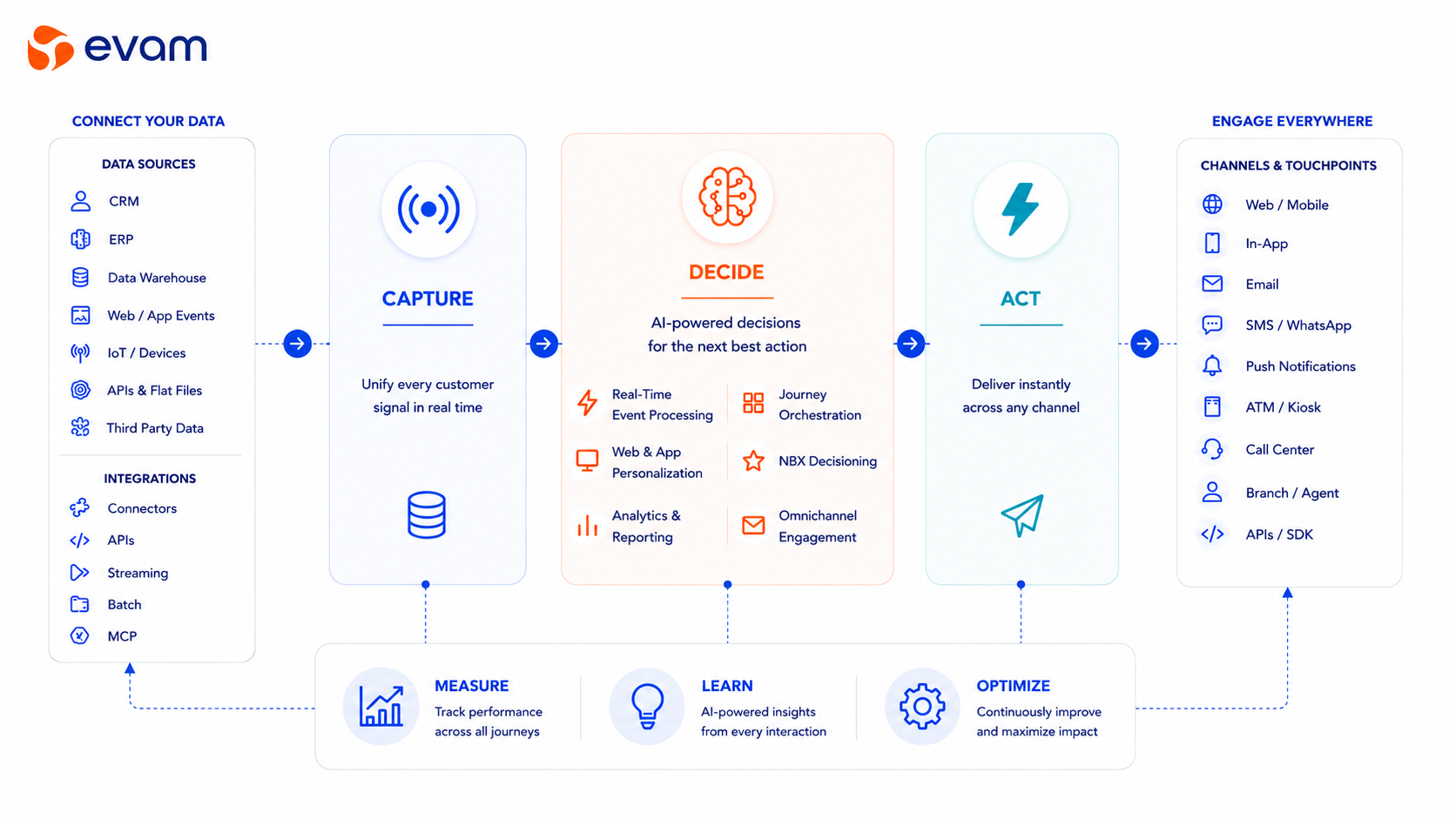
evamX is built as a real-time marketing intelligence platform, combining event streaming, AI decisioning, and omnichannel execution in a single continuous architecture. Customer signals from mobile apps, core systems, and digital touchpoints are captured as they occur, with no batch lag and no data duplication.
Evo AI, evamX's intelligence layer, continuously evaluates live customer context using intent detection, predictive models, and the NBX (Next Best Experience) engine, selecting the most relevant action for each customer in each moment, in sub-second decisioning cycles. Specialized AI agents, including the Maker Agent for journey creation, the Creator Agent for contextual content, and the Journey Summarizer for operational clarity, enable marketing teams to move from insight to live execution without IT dependency.
The result is a closed loop where every customer interaction feeds back into the intelligence layer, every decision is made on current data, and every action reaches the customer at the moment it is most likely to matter.
Trusted by global enterprises across financial services, telecommunications, and retail, processing tens of millions of events daily across four continents.