
Share Post
Table of Contents
- What Next-Best-Action Software Is Actually Supposed to Do
- What to Look For, If You Work in Banking or Telecom
- How the Major Platforms Compare
- Inside evamX: How a Decision Actually Gets Made
- Where to Go Next


Summarize with AI


Next-best-action software has become a crowded category, and most of it was built for the same use case: a marketing team picking the next email or push notification to send from a fixed content calendar. That's a legitimate job. It is not the job banking and telecom actually need done.
A bank deciding whether to intercept a large withdrawal with a retention offer, or a telecom operator deciding whether a data-cap warning should trigger an upgrade offer instead of a generic alert, needs a decision made in the time it takes a screen to load, evaluated against real eligibility rules, compliance constraints, and a live picture of that specific customer. Most platforms marketed as "next-best-action" software can recommend a segment-level message. Far fewer can make a compliant, explainable decision in real time and act on it across every channel a bank or telecom actually operates.
What Next-Best-Action Software Is Actually Supposed to Do
Strip the category down to what it needs to do well, and three things matter more than any individual feature list.
It has to decide in the moment, not on a schedule. A next-best-action engine that only refreshes its recommendation once a day is really a segmentation tool with a better name. The value of a next-best action comes from how closely it tracks what the customer is doing right now.
It has to apply real business rules, not just a predictive score. In banking and telecom specifically, a recommendation has to respect eligibility, regulatory constraints, and suppression logic, not just rank offers by predicted click-through rate. A technically well-targeted offer that a customer isn't actually eligible for isn't a next best action. It's a compliance problem.
It has to execute across every channel the customer might be in, not just the one the tool was built for. A next-best-action decision made for email doesn't help if the moment that matters happens on a call with the contact center, at an ATM, or inside a mobile app.
What to Look For, If You Work in Banking or Telecom
Generic marketing platforms are usually evaluated on channel breadth and ease of use for marketing teams, reasonable criteria for a retail or media brand. Banking and telecom buyers need a different lens, because the stakes and constraints are different.
Decisioning speed matters more than dashboard polish. Ask whether the platform evaluates and acts on a signal in milliseconds, or whether "real-time" actually means an hourly or daily refresh cycle labeled as real time.
Industry-specific eligibility and compliance logic matters more than generic segmentation. A platform built primarily for retail and e-commerce often lacks native support for the eligibility, suppression, and regulatory rules banking and telecom require as a baseline, not an add-on.
Deployment flexibility matters more than it does for a typical SaaS marketing tool. Banks in particular often need private cloud or on-premise deployment options for data residency and regulatory reasons that a pure multi-tenant SaaS platform can't always accommodate.
Business-user autonomy matters for total cost of ownership. A platform that requires an engineering ticket for every new trigger or rule change costs far more over time than the license fee suggests, regardless of how sophisticated the underlying model is.
How the Major Platforms Compare
| Platform | Real-Time Decisioning | Banking & Telecom Depth | Deployment Options | Business-User Control |
| Evam (evamX) | Sub-second, event-driven decisioning via the NBX engine | Purpose-built for banking, telecom, and retail, with native eligibility, suppression, and compliance logic | Cloud, private cloud, on-premise, and hybrid | Journey Designer and Evo AI let business teams build and adjust journeys without engineering tickets |
| Pegasystems | Strong decisioning heritage, historically built around case management and rules engines | Broad enterprise reach across financial services and telecom, often paired with wider BPM deployments | Hosted, private cloud, on-premise | Powerful but typically requires more technical configuration for complex rule changes |
| Salesforce | Decisioning capabilities layered on top of a CRM-first architecture | Broad horizontal reach across industries rather than banking or telecom-specific depth | Multitenant SaaS | Strong no-code tooling for marketers, though real-time decisioning depth varies by add-on module |
| Braze | Built for fast, cross-channel messaging with growing AI-driven decisioning features | Strong in retail, media, and app-first brands, less specialized in regulated banking and telecom compliance needs | Multitenant SaaS | Marketer-friendly, geared toward campaign and lifecycle messaging rather than deep eligibility logic |
| SAS | Deep analytics and decisioning heritage, historically stronger in batch and near-real-time scoring than sub-second execution | Long-standing presence in banking risk and analytics, less focused on omnichannel real-time engagement | Hosted, private cloud, on-premise | Powerful for data science teams, typically requires more specialized skills than a marketing-led setup |
This isn't a claim that any of these platforms are weak. Each is a credible, widely used vendor in its own right. The differences that matter are about fit: a platform built primarily for retail campaign management and a platform built for sub-second, compliant decisioning inside a bank's core systems are solving genuinely different problems, even when both get called "next-best-action software." For a deeper look at what next-best-action actually means as a concept before comparing vendors, our piece on how AI decides the next best action in milliseconds breaks down the four layers a real NBA system needs. Our piece on next-best-action marketing covers the strategic side of putting this to work once you've picked a platform.
Inside evamX: How a Decision Actually Gets Mad
evamX is built around three pillars that map directly to what banking and telecom actually need from a next-best-action engine: AI-powered decisioning, an ecosystem-ready platform that connects to existing core systems rather than replacing them, and business-owned orchestration that doesn't require an engineering team for every change.
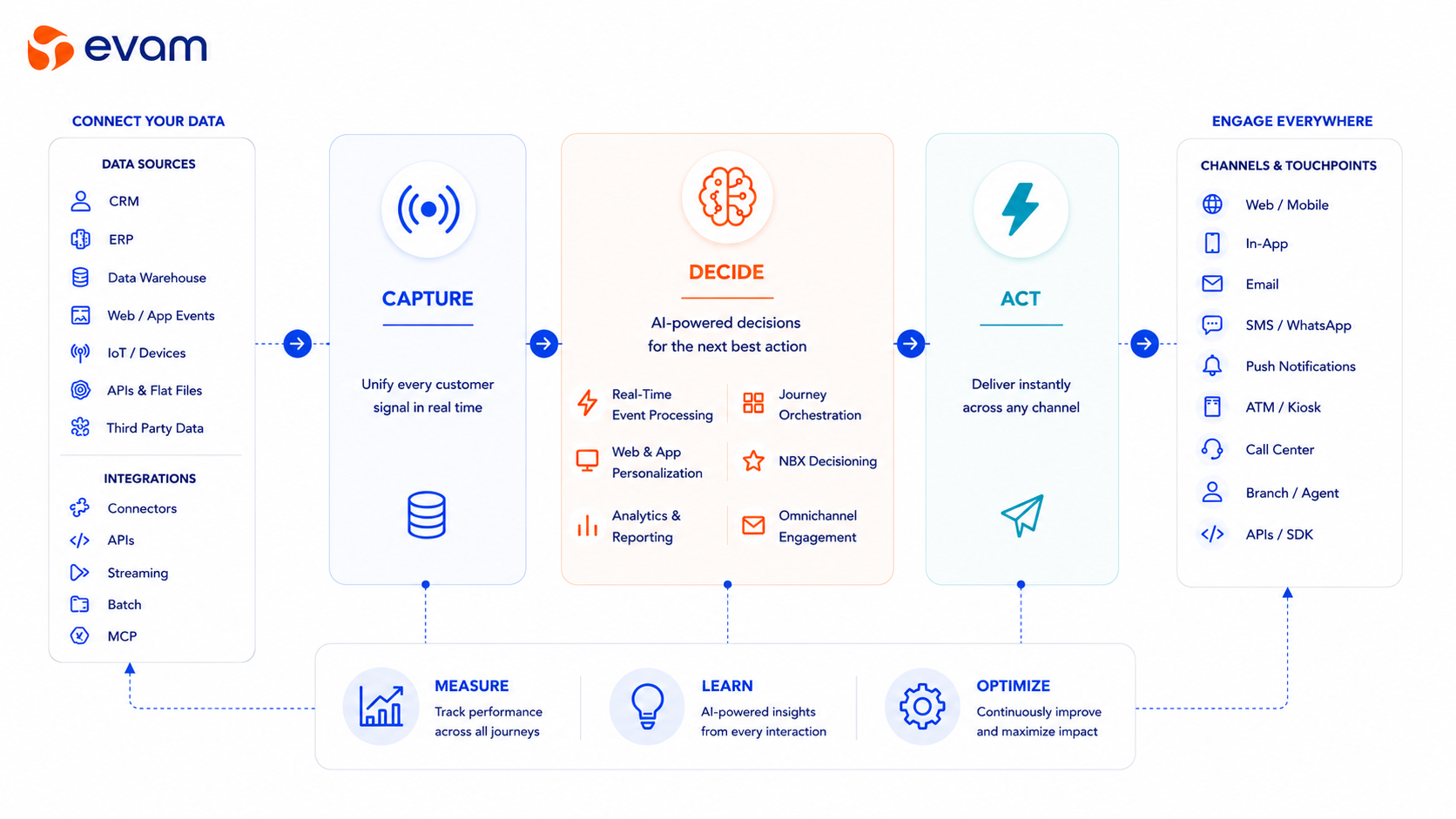
In practice, a decision moves through three stages. Capture pulls in streaming events from any source system, core banking, card transactions, CDRs, DPI, CRM, call center and IVR interactions, web and mobile apps, without duplicating data or waiting on a batch job. Decide is where the NBX engine evaluates that event in context: real-time intent capture, contextual and behavioral decisioning, offer catalog matching, and suppression logic, all resolved in sub-second time. Act delivers the decision across whichever channel the customer is actually in, email, SMS, USSD, WhatsApp, Viber, in-app, push, IVR, or agent screen, so the same decision reaches the customer no matter where they show up next.
A concrete version of this shows up constantly in telecom. A customer checks their data balance and sees they're close to their cap. NBX captures that moment in real time and evaluates it alongside recent usage patterns and eligibility, rather than waiting for a nightly batch job to flag the account. Instead of a generic low-data alert, NBX recommends a top-up bundle sized to that customer's actual usage pattern, delivered the moment the balance check happens, through the same app the customer is already looking at.
Where to Go Next
The honest answer to "what's the best next-best-action software" depends on what you're deciding and how fast that decision needs to happen. If the moment that matters is a marketing email going out on a weekly cadence, several platforms on this list will serve you well. If the moment that matters is a declining balance, a failed payment, or a customer about to churn, and it needs a compliant, explainable decision inside milliseconds, that's specifically the problem evamX was built to solve.
See real scenarios for your industry in the Product Demo Hub, or reach out through our contact page to walk through what this would look like against your own systems.