
 Evo AI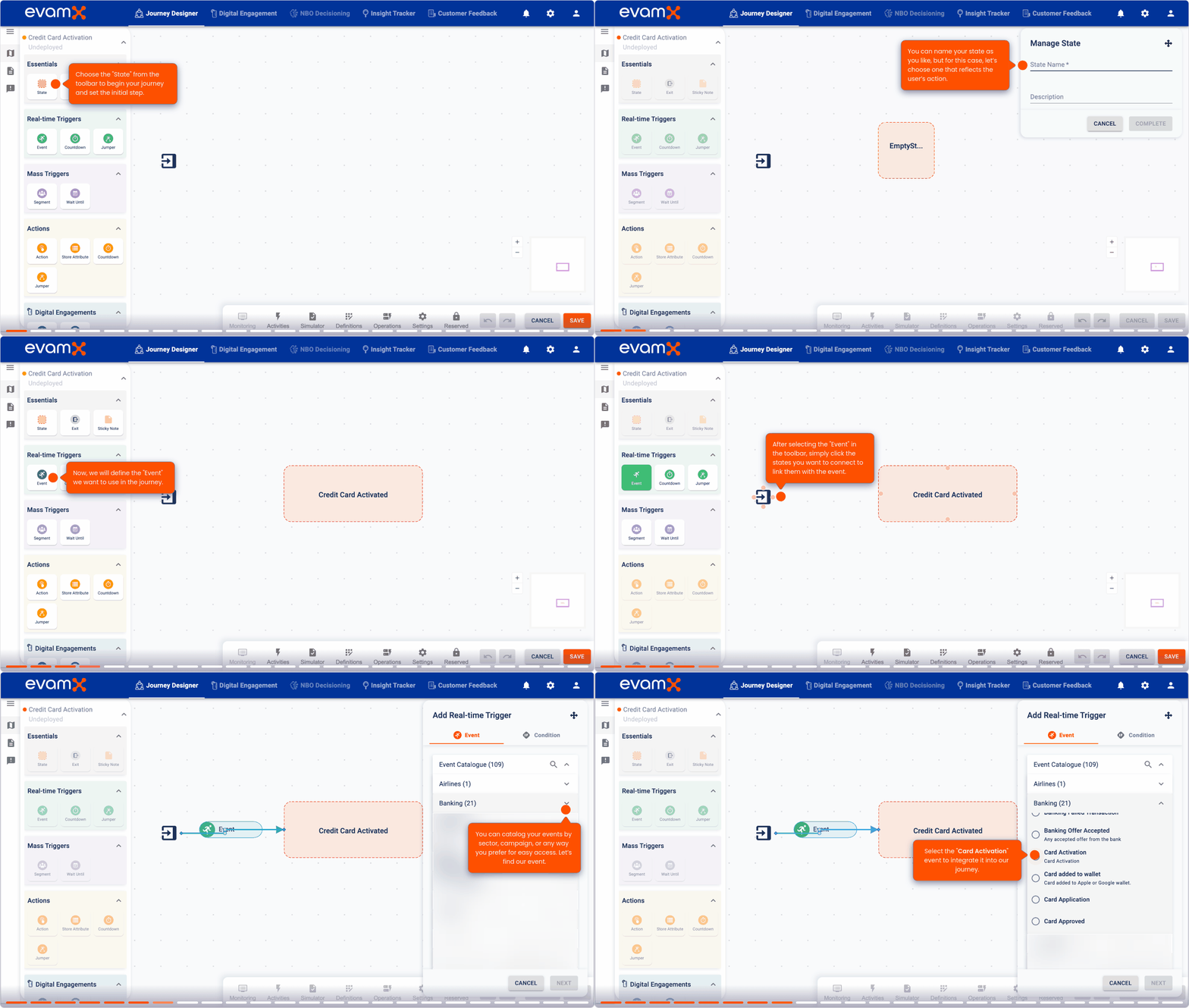
Share Post
Table of Contents
- What Next Best Action Marketing Actually Means
- Why Traditional Campaign Logic Falls Short
- Next Best Action vs. Next Best Offer: An Important Distinction
- What Next Best Action Marketing Looks Like in Practice
- Why Implementation Is Harder Than It Looks
- How evamX Powers Next Best Action Marketing
- The Question Worth Asking


Summarize with AI


Most marketing systems are built to answer one question: what should we send next?
Next best action marketing is built to answer a different one: what should we do next, for this specific customer, in this specific moment, given everything we know about them right now?
The distinction sounds subtle. The revenue difference is not.
A system optimized for "what to send" produces campaigns. A system optimized for "what to do" produces decisions. And in a world where customer intent peaks for minutes, not days, the difference between a campaign and a decision is often the difference between a conversion and a missed opportunity.
What Next Best Action Marketing Actually Means
Next best action (NBA) marketing is a decisioning approach that determines the most relevant action for an individual customer at a specific moment, based on their current behavior, history, preferences, lifecycle stage, and real-time context, rather than on which segment they belong to or which campaign is scheduled to run.
The "action" in next best action is deliberately broad. It could be an offer. It could be a service recommendation. It could be a proactive support message. It could be a retention intervention. It could be no contact at all, because the system determined that silence is the right decision for this customer at this moment.
This breadth is what separates NBA from traditional offer optimization. Offer optimization selects the best product from a catalog. NBA decisioning asks a more fundamental question: given everything about this customer right now, what is the single most valuable thing we can do?
Why Traditional Campaign Logic Falls Short
To understand why next best action marketing exists, it helps to understand what it is replacing.
Traditional marketing operates on a batch-and-broadcast model. A segment is defined, customers who haven't purchased in 90 days, subscribers approaching a plan limit, users who abandoned a cart. A message is designed for that segment. It is scheduled and sent. The team measures open rates and conversions and moves on to the next campaign.
This model is not without value. It scales. It is predictable. It is easy to plan and report on.
But it has a structural limitation that no amount of creative optimization can fix: it treats customers as members of a group rather than as individuals, and it acts on a schedule rather than in response to what is actually happening.
The customer who abandoned a cart at 11 PM on a Tuesday is not the same as the one who abandoned a cart at 9 AM on a Friday. The subscriber who is checking their data balance for the third time today is not in the same moment as one who hasn't opened the app in two weeks. The banking customer who just browsed fixed deposit rates after checking their savings balance is signaling something specific that no segment definition captures.
Batch campaigns reach these customers eventually. Next best action marketing reaches them in the moment the signal is strongest, which is often the only moment the action has a meaningful chance of working.
The Four Components of a Next Best Action System
NBA marketing is not a single tool. It is an architecture, one that requires four components working together in real time.
1. Signal Capture Across Every Touchpoint
Next best action decisions are only as good as the signals that inform them. A system that can only see app behavior is making decisions with incomplete information. A system that sees app behavior, transaction history, call center interactions, web sessions, email engagement, and offline touchpoints is making decisions with the full picture.
The critical requirement is that signal capture happens in real time, not in a nightly batch export to a data warehouse. A customer's behavioral signal from three minutes ago is still actionable. A behavioral signal from yesterday's batch run is historical context, useful for background but not sufficient for in-the-moment decisioning.
2. Contextual Decisioning in Milliseconds
This is the core of NBA: taking all available signals about a customer and determining the best possible action in the time it takes for a page to load.
The decisioning layer evaluates multiple inputs simultaneously: the customer's current behavior, their historical patterns, their lifecycle stage, their channel preferences, current offer eligibility, suppression rules, business constraints, and predictive model outputs. It produces not just an offer, but a ranked set of possible actions, with the top action selected based on what is most likely to be valuable for the customer and the business at this specific moment.
True NBA decisioning evaluates offer, channel, timing, and content together, not sequentially. A system that picks the best offer and then decides the channel is not doing NBA. It is doing offer optimization with channel selection bolted on.
3. Omnichannel Orchestration From a Single Layer
The action selected by the decisioning layer needs to reach the customer immediately, on the channel they are most likely to respond to, without re-queuing through a separate tool.
This requires that all channels, push notification, in-app, SMS, email, web, call center, branch, are orchestrated from the same decisioning layer. Not connected via API with delays and context loss at each handoff. The same layer that made the decision delivers the action.
When a customer contacts the call center mid-journey, the agent sees live context. When a push notification fails to deliver, the system routes intelligently to SMS. When a customer converts, every other pending action for that customer is updated instantly. This is omnichannel orchestration, not multichannel broadcasting from a single platform.
4. Closed-Loop Learning
NBA systems that do not learn from outcomes are static. They get smarter only when someone manually updates a model or a rule.
Closed-loop learning means that every customer response, a conversion, an ignore, a complaint, a churn, feeds back into the decisioning models in real time, adjusting propensity scores, updating offer rankings, and improving the accuracy of the next decision. The system compounds. Each interaction makes the next one sharper.
Next Best Action vs. Next Best Offer: An Important Distinction
These two terms are often used interchangeably. They are not the same thing, and the difference matters for how you build and measure your system.
Next best offer (NBO) selects the most relevant product or promotion from a catalog for a given customer. It is primarily a revenue optimization tool, designed to increase conversion rates and ARPU by matching offers to customer propensity.
Next best action (NBA) is a superset. It includes offers, but also includes service actions, retention interventions, educational content, proactive support, loyalty rewards, and the decision to make no contact at all. NBA asks what the business should do, not just what it should sell.
In practice, the distinction shows up in outcomes. A pure NBO system optimizes short-term conversion. An NBA system optimizes the full customer relationship, which sometimes means not making an offer, because the right action is to resolve a service issue or simply let the customer complete what they were doing without interruption.
The most effective NBA implementations combine both: offer decisioning as one input into a broader action selection framework, balanced against relationship, lifecycle, and suppression logic.
What Next Best Action Marketing Looks Like in Practice
Across industries, the pattern is consistent. The signal exists. The intent is real. The outcome depends entirely on whether the system can respond before the moment closes.
In telecommunications, a prepaid subscriber checking her data balance for the third time in a week is signaling low-balance intent. An NBA system reads her wallet activity, her streaming behavior, and her recharge history simultaneously, and delivers a one-tap top-up bundle that includes the streaming pack she already uses, at the moment she is most receptive. She converts. ARPU lifts. Churn risk drops.
In financial services, a banking customer who browses fixed deposit rates immediately after checking their savings balance is signaling investment intent within a narrow window. An NBA system identifies the moment, evaluates the customer's balance, product eligibility, and channel preference, and delivers a contextual offer, not in tomorrow's campaign, but in the 90 seconds while the intent is active. Conversion rates at this moment are 3–5x higher than for the same offer sent via a scheduled campaign.
In retail, a customer who returns to the same product page three times in a single session is one decision away from purchasing. An NBA system evaluates that behavior in context, what else are they browsing, what is their purchase history, what price sensitivity signals exist, and delivers the right nudge at the right moment. The same offer delivered 24 hours later, when the customer has moved on, converts at a fraction of the rate.
In omnichannel environments, a customer who starts a purchase on mobile, pauses, and then calls the contact center is not starting over. They are continuing a journey. An NBA system ensures the agent sees exactly where the customer is in that journey, what they were looking at, what offers they have seen, what hesitations they have expressed, and surfaces the most relevant action for that agent to take.
The Metrics That Next Best Action Marketing Changes
Organizations that shift from campaign-led to NBA-led marketing consistently report changes in the same set of metrics.
Conversion rate increases because actions are delivered at peak intent rather than on a schedule. The timing advantage alone, independent of message quality, produces measurable lift.
Contact frequency decreases because NBA systems apply suppression logic that prevents over-messaging. Customers receive fewer, more relevant communications. Opt-out rates fall. Engagement rates rise.
Customer lifetime value increases because NBA optimizes for the full relationship, not just the next transaction. Customers who receive consistently relevant actions stay longer, spend more, and refer more.
Operational efficiency improves because NBA systems automate the decisioning work that previously required manual campaign planning. Marketing and CVM teams spend less time building campaigns and more time setting strategy.
Revenue per interaction, the clearest measure of NBA effectiveness, rises as the system learns. Early in deployment, the system makes good decisions. Over time, as the closed-loop learning compounds, it makes better ones.
Why Implementation Is Harder Than It Looks
NBA marketing is well understood as a concept. The implementation gap between theory and production is real, and it is worth being specific about where it lives.
Data fragmentation. NBA requires a unified, real-time view of the customer. Most organizations have customer data spread across CRM, transactional systems, digital analytics, call center logs, and offline touchpoints. Connecting these sources in real time, without a data warehouse copy that introduces lag, is an architectural challenge most organizations underestimate.
Latency in the decisioning layer. A decisioning system that takes 800 milliseconds to produce an action is not doing real-time NBA. In practice, many platforms marketed as NBA tools are running decisioning logic on pre-computed segments or batch-refreshed scores. True sub-second decisioning requires a purpose-built architecture.
Channel fragmentation. Executing the NBA decision across every channel, push, in-app, SMS, email, web, call center, from a single orchestration layer is harder than it sounds. Most organizations have channel-specific tools that each require their own data feed, logic configuration, and reporting. The handoffs between these tools introduce both latency and context loss.
Business user dependency on IT. NBA systems that require engineering support to update rules, add suppression logic, or launch new journeys are too slow for the rate at which customer behavior changes. The operational model needs to match the speed of the technology.
How evamX Powers Next Best Action Marketing
evamX is built around the NBX (Next Best Experience) engine, an evolution of NBA decisioning that evaluates offer, channel, timing, and content simultaneously, rather than optimizing each dimension independently.
For organizations implementing NBA marketing, evamX delivers:
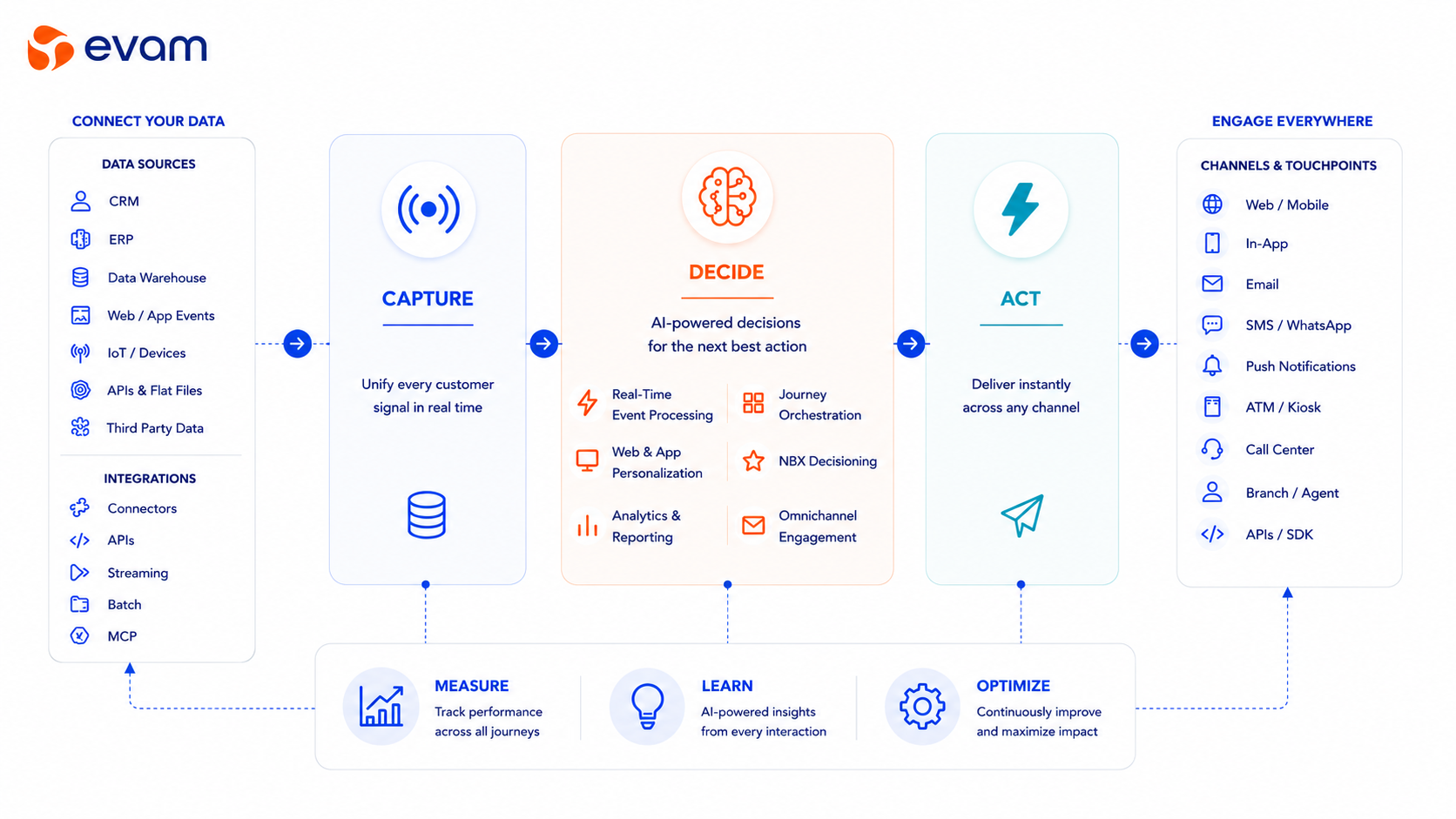
Real-time signal capture from every touchpoint, digital, transactional, call center, offline, with no batch lag and no data duplication required
Sub-second NBX decisioning that integrates natively with existing ML models, so organizations do not need to rebuild predictive infrastructure they have already built
Single-layer omnichannel orchestration across push, in-app, SMS, email, web, IVR, and agent screen, every decisioning output reaches the customer consistently, regardless of channel
Closed-loop learning that updates propensity models and offer rankings continuously, compounding the accuracy of every decision over time
Business-owned journey management through Journey Designer and Evo AI, marketing and CVM teams configure, launch, and modify NBA journeys without IT dependency, at the speed customer behavior changes
evamX processes over 600 million personalized interactions daily across 70 global brands in banking, telecom, retail, and aviation. Operators running NBX-powered journeys consistently report 3–5x cross-sell conversion uplift, 30–40% churn reduction in multi-service relationships, and a measurable shift from campaign spend to decisioning efficiency.
The Question Worth Asking
Every organization running campaigns today has customers generating intent signals that their current system cannot act on in time. A balance check. A pricing page visit. A session that ended without a purchase. A call that resolved without an upsell.
These are not missed opportunities because the offer was wrong. They are missed opportunities because the response arrived after the moment had passed.
Next best action marketing is the architecture that closes that gap. Not by sending more messages, but by sending the right one, to the right customer, through the right channel, at the moment the signal is still live.
The campaign asks: who should we target this week?
The NBA system asks: what does this customer need right now?
That question, answered at scale and in real time, is where the revenue difference lives.