
 Evo AI
Share Post
Table of Contents
- Why More Tools Has Stopped Meaning More Capability
- The Question That Actually Matters: What Holds the Stack Together
- Where Agentic AI Fits Into the Stack
- Why This Matters More in Regulated, Complex Environments
- What to Evaluate When Assessing a Marketing Technology Stack
- evamX: The Connective Layer for the Marketing Stack


Summarize with AI


Most marketing technology stacks look complete on paper. A CDP for data. A CRM for relationships. An email platform for campaigns. A push notification tool for mobile. An analytics suite for measurement. Each tool does its job well in isolation.
The problem is what happens between the tools, not within them. A customer's behavior changes in the CRM, but the email platform doesn't know for another six hours. The push notification tool sends an offer the CDP would have suppressed if the two systems actually talked to each other in real time. The analytics suite reports on what happened last week, by which point three more campaigns have already gone out built on outdated assumptions.
This is the defining failure mode of modern marketing technology stacks: not a lack of tools, but a lack of connection between them. And it is becoming more visible as customer expectations for relevance and timing continue to rise.
Why More Tools Has Stopped Meaning More Capability
The martech landscape has expanded dramatically. Most enterprise marketing teams now manage a stack with a dozen or more distinct tools, each addressing a specific function: segmentation, content management, journey orchestration, predictive analytics, social engagement, SMS, push, email, in-app messaging.
For years, the assumption was that adding capability meant adding tools. A new channel emerged, a new point solution was acquired to address it. The result, across much of the industry, is a stack that has grown wide but not necessarily strong: many specialized tools, each operating on its own data refresh cycle, its own customer profile, its own decisioning logic, stitched together by integrations that were built after the fact rather than designed in from the start.
This architecture creates a specific and costly limitation. Each tool can only act on the data it has access to, refreshed at the interval its own pipeline allows. When a customer's situation changes, that change has to propagate through every connected tool before the stack as a whole reflects reality. In practice, this propagation rarely happens in real time. It happens in batches, on schedules, with lag measured in hours rather than seconds.
The cost of this lag is not abstract. It is the offer that arrives after the customer has already churned. The campaign that ignores a service complaint logged twenty minutes earlier. The personalization that recommends a product the customer purchased that same morning through a different channel. Each of these is a stack failure, not a tool failure. The individual tools are working as designed. The architecture connecting them is not.
The Question That Actually Matters: What Holds the Stack Together
Evaluating a marketing technology stack by counting its tools misses the question that determines whether the stack delivers results: what serves as the connective layer between them.
A stack without a unifying architecture is a collection of point solutions, each with a partial view of the customer, acting on whatever data happened to reach it most recently. A stack with a genuine connective layer behaves differently. Every tool draws from the same live customer context. Every decision reflects what is happening now, not what happened at the last data sync. Every channel, regardless of which specific tool is executing the message, acts on the same understanding of the customer.
This connective layer is built on three capabilities that most individual point solutions were never designed to provide.
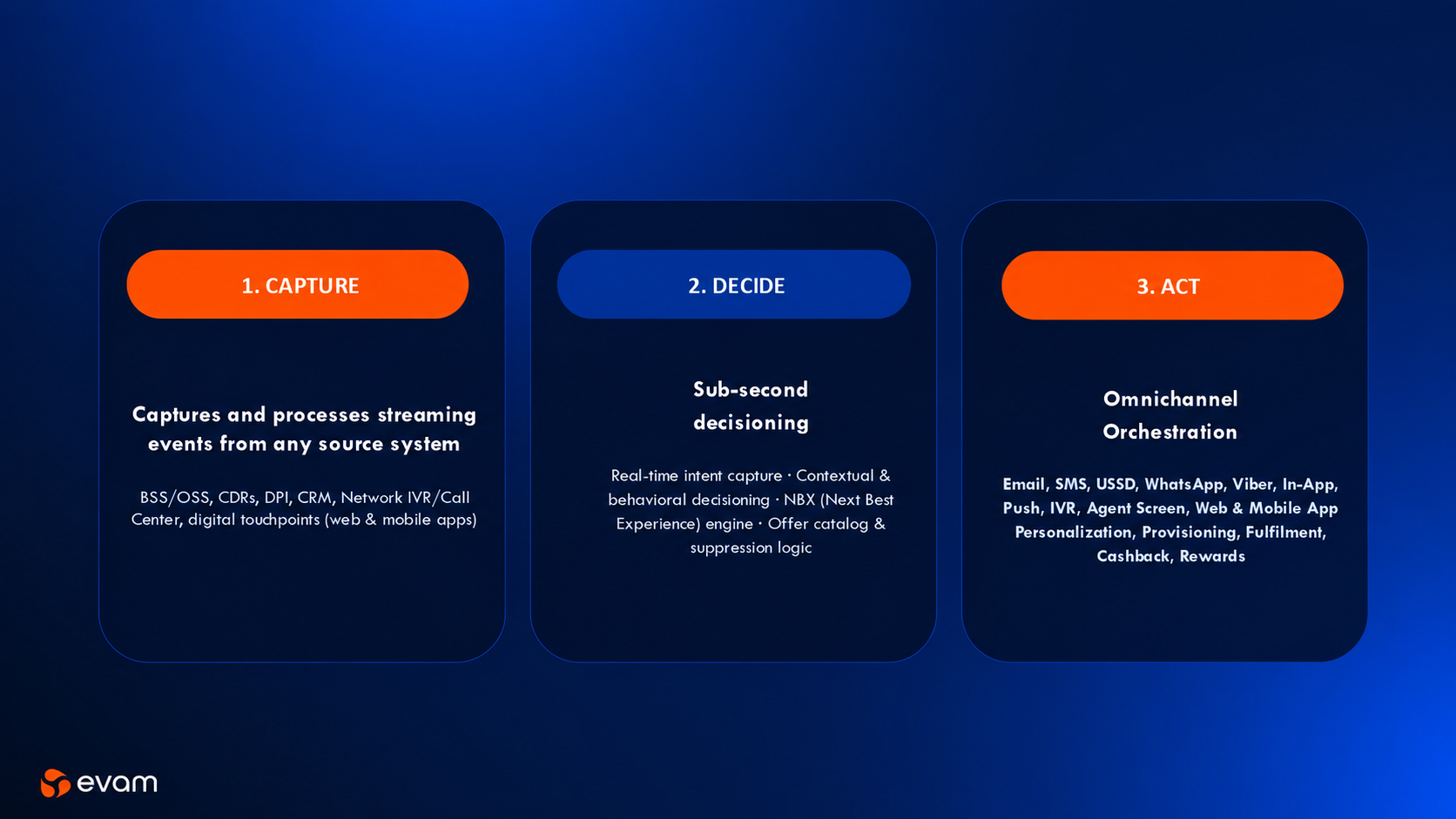
The first is event streaming as the data foundation. Rather than each tool pulling data from a warehouse on its own schedule, a connected stack ingests behavioral, transactional, and operational events as they occur, from every source system, and makes them available to every connected tool simultaneously. No tool is working from a stale snapshot while another works from current data.
The second is centralized real-time decisioning. In a fragmented stack, each tool makes its own decisions independently: the email platform decides what to send based on its own logic, the push tool decides separately, often without visibility into what the other has already done. A connected stack centralizes the decision: a single engine evaluates eligibility, suppression, and priority across the full customer context, and that decision is what every channel acts on. This is what prevents a customer from receiving the same offer twice through different channels, or receiving a promotional message while a service issue is actively being resolved.
The third is unified execution across channels. Even with good decisioning, value is lost if the channels themselves do not share state. A connected stack ensures that when a customer responds on one channel, that response is reflected everywhere else immediately: a conversion closes the offer in every pending queue, a complaint pauses promotional activity across every channel, a preference update applies instantly rather than after the next scheduled sync.
Where Agentic AI Fits Into the Stack
The newest layer being added to marketing technology stacks is agentic AI: systems that do not just analyze data or recommend actions, but autonomously execute multi-step marketing tasks with limited human intervention.
This represents a meaningful shift from how AI has typically been used in martech. Earlier generations of AI in marketing stacks were primarily assistive: a model would score a lead, predict a churn risk, or recommend a next-best-offer, and a human would decide what to do with that information. Agentic AI extends this further: an AI agent can build a journey from a natural-language brief, generate and test content variants, monitor a campaign's performance in real time, and adjust targeting or messaging autonomously based on what is working, all without a human manually executing each step.
The value of agentic AI in a stack is directly tied to the connective architecture beneath it. An AI agent operating on top of a fragmented stack can only act on the fragment of data the specific tool it lives in can see. An AI agent operating on top of a connected stack, with access to the full live customer context across every channel and system, can make decisions and take actions that reflect the complete picture. This is the difference between an AI agent that optimizes one channel in isolation and one that can genuinely orchestrate across the entire customer relationship.
This is also where the limitations of a tool-by-tool approach to AI become most visible. Adding an AI feature to each individual point solution in a fragmented stack produces a set of AI agents that are each smart in isolation but blind to what the others are doing, replicating the same coordination problem that AI was meant to solve.
Why This Matters More in Regulated, Complex Environments
The cost of stack fragmentation scales with the complexity of the environment it operates in. For a direct-to-consumer retail brand with a relatively contained set of systems, a loosely connected stack of best-of-breed tools may function adequately. For organizations operating in telecommunications, banking, and other regulated, infrastructure-heavy industries, the stakes are considerably higher.
In these environments, the customer touchpoints a marketing stack needs to connect to extend well beyond typical martech: core banking or billing systems, card and account platforms, ATM and branch networks, IVR and call center infrastructure, legacy systems that were never designed for real-time integration. A marketing stack that only connects to modern, API-first systems leaves out a substantial portion of where customer interactions actually happen.
This is also where the question of deployment flexibility becomes material. Many enterprise marketing teams in regulated sectors cannot simply route customer data through a third-party cloud platform without significant compliance review. A stack that only operates as a fully managed SaaS product, with no option for private cloud, on-premise, or hybrid deployment, is a stack that many regulated organizations cannot fully adopt regardless of its technical capabilities.
The organizations succeeding with marketing technology in these environments are not the ones with the most tools. They are the ones whose stack architecture was designed from the start to connect to complex, legacy-heavy infrastructure without requiring that infrastructure to be replaced first.
What to Evaluate When Assessing a Marketing Technology Stack
For marketing and technology leaders reviewing their current stack or evaluating new investments, a useful framework is to ask not what each tool does, but how the tools relate to each other.
Does data flow between systems in real time, or does it move on batch schedules that introduce hours of lag between an event and the stack's awareness of it? Is decisioning centralized, with a single source of truth for eligibility and priority, or does each tool make independent decisions that can conflict? Does a customer action on one channel immediately affect what happens on every other channel, or does that propagation take time? Can AI agents operating within the stack access the full customer context, or are they confined to whatever data the specific tool they live in happens to have?
And for organizations in regulated or infrastructure-heavy industries: does the stack connect natively to core systems, legacy infrastructure, and offline touchpoints, or does it assume a green-field, cloud-native environment that does not reflect the reality of the organization's technology landscape?
These questions matter more than any individual feature comparison. A stack with fewer tools but a genuinely connected architecture will consistently outperform a stack with more tools and no connective layer between them.
evamX: The Connective Layer for the Marketing Stack
evamX is built as the connective architecture a modern marketing technology stack requires, not as another point solution to add to an already fragmented set of tools.
At its foundation is event-based streaming that ingests live data from message brokers, APIs, mobile and web SDKs, and legacy system connectors, enabling sub-second decisioning the moment something happens anywhere in the customer journey. This includes native connectivity to core banking and telecom systems, CRM, card platforms, legacy infrastructure, and third-party data sources, without requiring data migration or custom ETL pipelines.
The platform centralizes decisioning through the NBX engine, evaluating eligibility, suppression, and priority across the full customer context in milliseconds, so every channel acts on the same decision rather than operating independently. Evo AI, evamX's purpose-built AI layer for marketers, includes agentic capabilities such as the Maker Agent for journey creation and the Creator Agent for content generation, each with access to the complete connected customer context rather than a fragment of it.
evamX deploys on cloud, private cloud, on-premise, or hybrid infrastructure, built specifically for the compliance and integration requirements of regulated, infrastructure-heavy environments like telecommunications and banking.