
Share Post
Table of Contents
- The Batch-Segment Trap
- Reframe the Problem: Signals, Not Segments
- The Silent Churn Pattern in iGaming
- Segmentation That Lives, Not Segmentation That's Refreshed
- Compliance Isn't the Cost of This: It's Built In
- From Insight to Action: Inbound and Outbound, Working Together
- What This Requires Architecturally
- How evamX Supports Real-Time Player Retention in iGaming


Summarize with AI


A player who churns loudly is easy to spot: they hit the withdrawal button, close the app, maybe even email support. Those players are already gone, and no retention campaign will bring most of them back.
The players actually worth saving don't do any of that. They log in a little less often. Their average stake creeps down. They stop touching the casino tab and only place the occasional match-winner bet. Three weeks later, they haven't formally left; they've just stopped being profitable, and stopped showing up in anyone's dashboard as a problem.
By the time a weekly or monthly "at-risk" report flags them, the moment to intervene has already passed. This is the uncomfortable truth behind most iGaming retention programs today: the tooling reports on churn after the fact, when what operators actually need is to catch the behavioral drift while it's still happening.
The Batch-Segment Trap
Most customer engagement platforms serving iGaming operators (including the CRM and marketing-automation tools built for the vertical) still run on a familiar rhythm: data is collected throughout the day, segments are recomputed overnight, and campaigns go out against yesterday's picture of the player. For a retail business, a day of lag is a rounding error. For iGaming, it isn't.
Betting behavior is a real-time signal by nature. A player's engagement with a live match, an in-play market, or a casino session tells you more about their current state than three months of historical deposit history. A segment that says "VIP, sports bettor, low churn risk," built last night, can already be wrong by kickoff.
This is why so many retention campaigns feel a step behind: not because the offer is wrong, but because the moment has already passed by the time the offer arrives.
Reframe the Problem: Signals, Not Segments
The fix isn't a better segment. It's a different question. Instead of asking "which static group does this player belong to," the question becomes: "what is this player's behavior telling us right now, and what should happen in response, in the next few seconds rather than the next batch cycle?"
That distinction, historical data versus live context, is the difference between a reporting tool and a decisioning system. A report tells you who a player has been. A real-time decisioning layer tells you what's happening right now: a shortened session, a smaller stake, a missed login window, a deposit pattern that's stretching out. Those are decision-moment attributes, and they carry information a quarterly churn score never will.
The Silent Churn Pattern in iGaming
This pattern has already been proven in a different regulated, high-frequency vertical: telecom. The strongest retention response to early churn signals was never a discount: discount-led saves generate short-term wins with poor lifetime value, and heavy players quickly learn to wait for the next bonus rather than staying engaged for the product itself. The response that actually worked was a second anchor: a second reason to stay, introduced before the churn signal hardened into a decision to leave.
The same pattern maps cleanly onto iGaming player behavior. The early warning signals aren't hidden, they're just rarely acted on in time. A player who logged in five times a week drifts down to two. The same player is still betting, just with a smaller average stake each time. A player who used to move between sportsbook, casino, and live dealer narrows to just one vertical. The gap between deposits quietly stretches out, and offers that used to convert start getting ignored. None of these signals, on their own, is dramatic enough to trigger a manual review. Together, and detected in real time, they're exactly the pattern that precedes a quiet exit.
Picture a player, call him Marco, who has been a solid mid-value sports bettor for eight months, mixing football accumulators with the occasional live in-play bet. Over three weeks, his weekly logins drop from six to three, his average stake shrinks by a third, and he hasn't touched the casino lobby he used to browse after every match. Nothing about Marco's account looks alarming in a weekly report: he's still active, still depositing, still technically "retained." But the shape of his behavior has already changed, and by the time a monthly churn model flags him, if it ever does, he may already be splitting his activity with a competitor operator, or have stopped altogether. The window to act was three weeks ago, not this Friday's campaign send.
The intervention that works is not another blanket bonus. It's introducing the specific product most aligned with that player's behavioral profile: a live-dealer feature for a sports bettor whose in-play engagement is fading, a same-game parlay for a casino player who used to bet on football, or a loyalty milestone reframed around the game type they still play, delivered at the next moment they show up, not in tomorrow's campaign batch. That's the difference between reactive retention and proactive retention, and it's a difference measured in relationship depth, not just in bonus spend.
Segmentation That Lives, Not Segmentation That's Refreshed
A behavioral segment worth acting on isn't a label recomputed nightly. It's a live definition built from multiple sources (uploaded lists, warehouse data, and a player's real-time position inside an active journey) combined with layered logic, so "at-risk VIP sports bettor with fading casino cross-play" can be a segment that updates itself continuously, not a query someone re-runs every Monday.
That matters operationally as much as technically. It means a marketer, not just a data engineer, can define, adjust, and launch against a behavioral segment without waiting on a development cycle, and can see, in near real time, how many players are moving into and out of each risk state.
Compliance Isn't the Cost of This: It's Built In
There's a version of this playbook that raises an obvious concern in a regulated, multi-market industry like iGaming: more automated, more frequent, more personalized outreach sounds like more risk of over-messaging a player who's supposed to be on a cool-off period, or contacting someone on a self-exclusion list, or breaching a jurisdiction's marketing quiet hours.
That risk is real, but it's an argument for better architecture, not less automation. The same orchestration layer that decides when to re-engage a fading player can enforce frequency capping, silent periods, and hard exclusion lists at the moment of send, checked against whatever rules are currently in force rather than the rules that were true when the campaign was designed weeks earlier. In a business operating across multiple licensing regimes at once, each with its own responsible-gambling and marketing-consent rules, that distinction, compliance evaluated at send time rather than design time, is what makes real-time retention operationally safe to run rather than a growing audit liability.
This matters even more for operators running across several markets at once, which is increasingly the norm rather than the exception in iGaming. A UK-facing brand, a Malta-licensed entity serving several EU markets, and an operator entering a newly regulated market like Brazil are each bound by a different definition of an acceptable contact window, a different consent standard, and a different marketing restriction on bonus language. A single global "send at 6pm" rule breaks the moment it crosses a border. Guardrails that are configuration, evaluated per player, per journey, against the ruleset live in that player's jurisdiction, scale across that fragmentation in a way a hard-coded campaign calendar never will.
From Insight to Action: Inbound and Outbound, Working Together
Catching a behavioral drift signal is only half the job; the other half is doing something about it, consistently, across every channel a player might be on.
That's really two connected problems. One is inbound: the moment a fading player does log back in, checking their balance or opening the app out of habit, what's the single best thing to show them right then, informed by their live context rather than their three-month-old segment? The other is outbound: if they don't log in at all, what proactive sequence reaches out on their behalf (wait, check for a response, follow up on a different channel if there's none) without a human having to script and monitor that sequence manually for every at-risk player individually? Handled as one connected system rather than two disconnected tools, this is what turns a churn signal into a saved relationship: the inbound decision and the outbound journey pointing at the same behavioral profile, updated by the same real-time event stream, governed by the same compliance rules.
What This Requires Architecturally
Delivering retention strategies that operate on live behavioral signals rather than scheduled batch segments requires the same architectural foundation that real-time engagement requires more broadly: continuous event capture from wherever player behavior lives (the betting engine, the wallet, the app), a decisioning layer that evaluates each signal against the player's full context the moment it occurs, and execution that can reach the player through push, in-app messaging, SMS, or another channel immediately, not at the next campaign cycle. Our broader breakdown of how these layers work together is covered in our guide to building a real-time decisioning architecture for regulated industries.
This does not require replacing an operator's entire CRM or analytics stack at once. The highest-leverage starting point is usually the single moment where disengagement is most detectable and most recoverable, often a fading session pattern or a specific in-play behavior that reliably precedes a quiet exit. Proving the value of real-time intervention in that one moment, with the compliance guardrails for one jurisdiction encoded correctly, typically builds the case for expanding the approach further.
How evamX Supports Real-Time Player Retention in iGaming
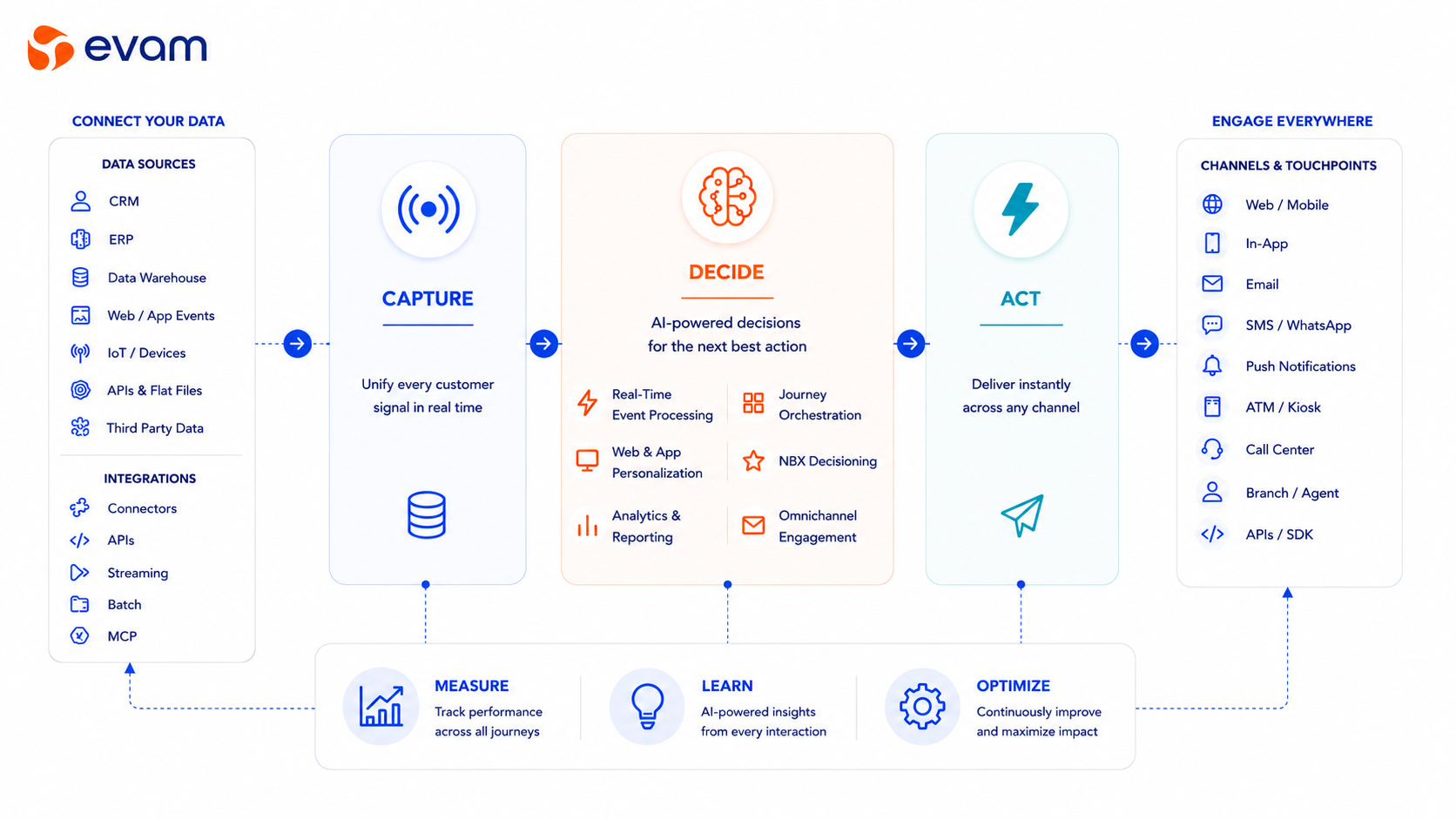
evamX captures player behavioral signals as they occur, from session frequency and stake patterns to game-type shifts and deposit intervals, and the NBX decisioning engine evaluates each signal against the player's full context, including the responsible-gambling and marketing-consent rules live in that player's jurisdiction, to determine whether and how to intervene, in milliseconds rather than at the next scheduled analysis.
This means a fading session, a shrinking stake, or a stalled cross-vertical pattern can trigger a relevant, individually calibrated response, delivered through push notification or in-app messaging, while the player is still reachable and the moment is still relevant. Journey Designer then carries that same response proactively outbound, with frequency capping, silent periods, and exclusion lists enforced automatically at send time, if the player doesn't return on their own. For a closer look at how this compliance model works across regulated industries, see our piece on the compliance architecture of real-time outbound orchestration.
Request a Demo to see how evamX turns early churn signals into retention, before the relationship is lost.