
 Evo AI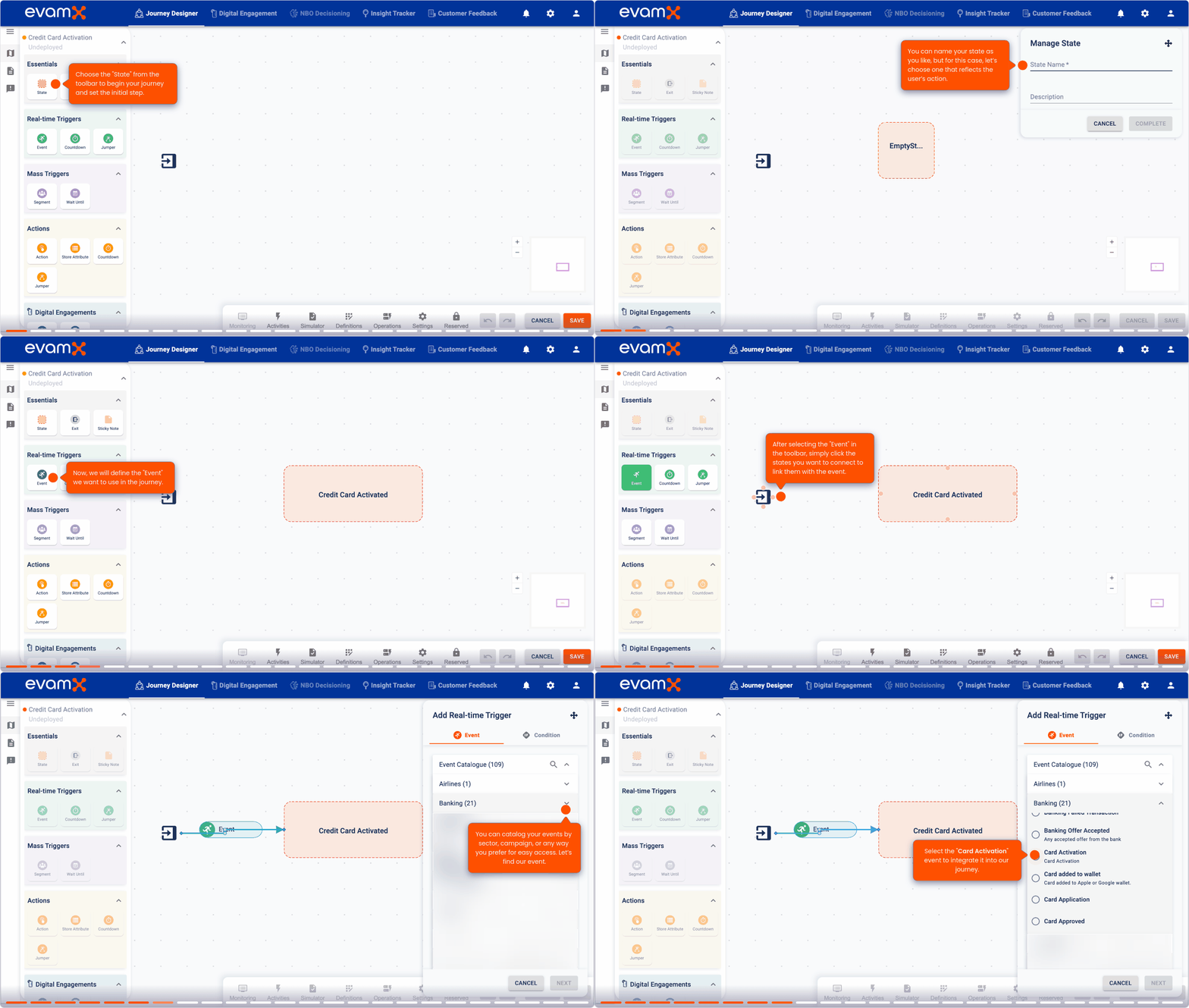
Share Post
Table of Contents
- What Streaming Analytics Actually Means for Customer Experience
- Where Streaming Analytics Creates the Most Value
- From Insight to Action: Why Analytics Alone Isn't Enough
- How evamX Powers Streaming Analytics for Customer Experience


Summarize with AI


Search "streaming analytics" and most of what comes back is written for data engineering teams: architecture comparisons, throughput benchmarks, infrastructure choices. That's a legitimate conversation, and it's not this one. This is about what streaming analytics means for the team deciding what a customer sees, hears, or gets offered next, and why that decision depends on data that's still in motion rather than data that's already settled into a report.
What Streaming Analytics Actually Means for Customer Experience
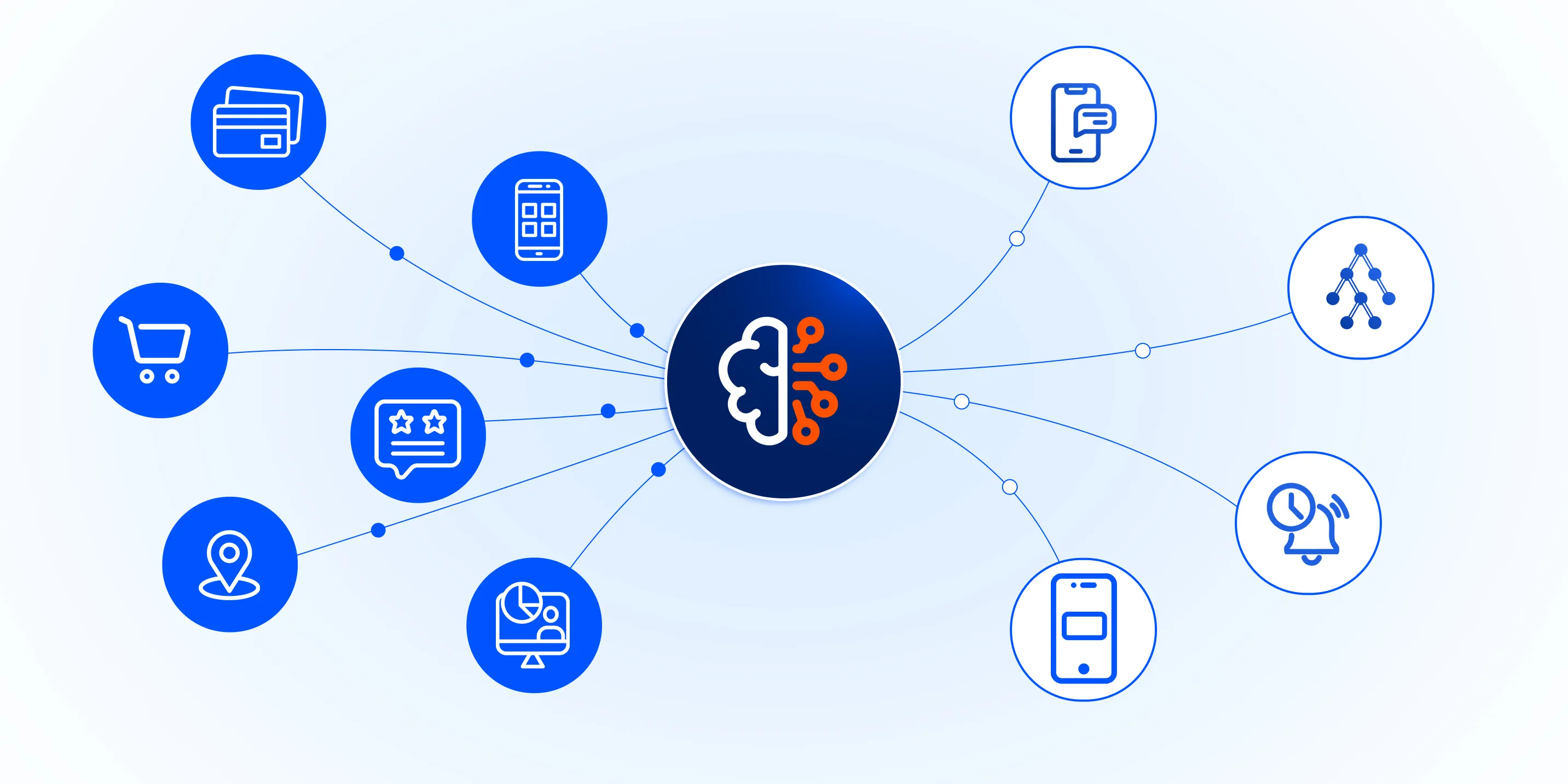
Streaming analytics is the analysis of data while it's still happening, a transaction, a click, a dropped call, a support interaction, rather than after it's been collected, stored, and processed into a report. The distinction matters less for its technical elegance and more for what it makes possible: noticing a customer problem or opportunity while there's still time to do something about it.
Most customer data infrastructure was built the other way around. Events get logged, batched, and analyzed on a schedule, daily, sometimes hourly. That's genuinely useful for understanding trends over time. It's the wrong tool for the moment a specific customer is having a specific experience right now, because by the time that moment shows up in a report, it's already over.
Where Streaming Analytics Creates the Most Value
The pattern holds across industries: the highest-value use cases are the ones where a short window closes fast, and being early is what makes the response useful at all.
In telecom, a dropped call or a regional network issue is a moment that needs a response measured in seconds, not the next incident report. Operators using streaming analytics can detect a connection failure as it happens and reroute affected users before the disruption spreads across millions of subscribers, turning what would be a mass outage complaint into an issue most customers never notice.
In financial services, fraud and unusual transaction patterns are the clearest case for streaming over batch. A suspicious transaction flagged the next morning has already cost money and trust. The same pattern flagged in the seconds after it happens can be stopped before it completes.
In retail and travel, the value shows up as timing rather than detection. A customer showing signs of high purchase intent, or a subscriber whose behavior signals they're about to travel internationally and rack up roaming charges, is a moment where a well-timed, relevant offer, a roaming bundle, a limited-time incentive, has a real chance of changing the outcome. The same offer delivered from a batch process the next day usually arrives after the decision has already been made elsewhere.
Across all three, the underlying question streaming analytics answers is the same: what is happening right now that we'd only discover tomorrow if we were still working from a batch report.
From Insight to Action: Why Analytics Alone Isn't Enough
Detecting a signal in real time is only half the value. Streaming analytics that stops at a dashboard, even a live-updating one, still requires a person to notice it, decide what it means, and manually trigger a response, which reintroduces exactly the delay the streaming architecture was supposed to eliminate.
The organizations getting real value from streaming analytics connect it directly to a decisioning and execution layer, so a detected signal doesn't just update a chart, it triggers eligibility and suppression checks and an actual customer-facing action automatically. A fraud pattern doesn't just get flagged for someone to review, it can hold a transaction immediately. A churn signal doesn't just raise a score in a model, it can trigger a retention offer while the customer is still reachable. The analytics layer's job is to notice. The decisioning layer's job is to act. Skipping the second one is the most common reason streaming analytics investments don't show up in customer experience metrics.
Batch data still has a role here, understanding trends, planning strategy, evaluating what worked over a quarter. It just can't be the layer standing between a live signal and a customer-facing response, because a customer experiencing a problem right now doesn't benefit from a trend that gets reviewed next month.
How evamX Powers Streaming Analytics for Customer Experience
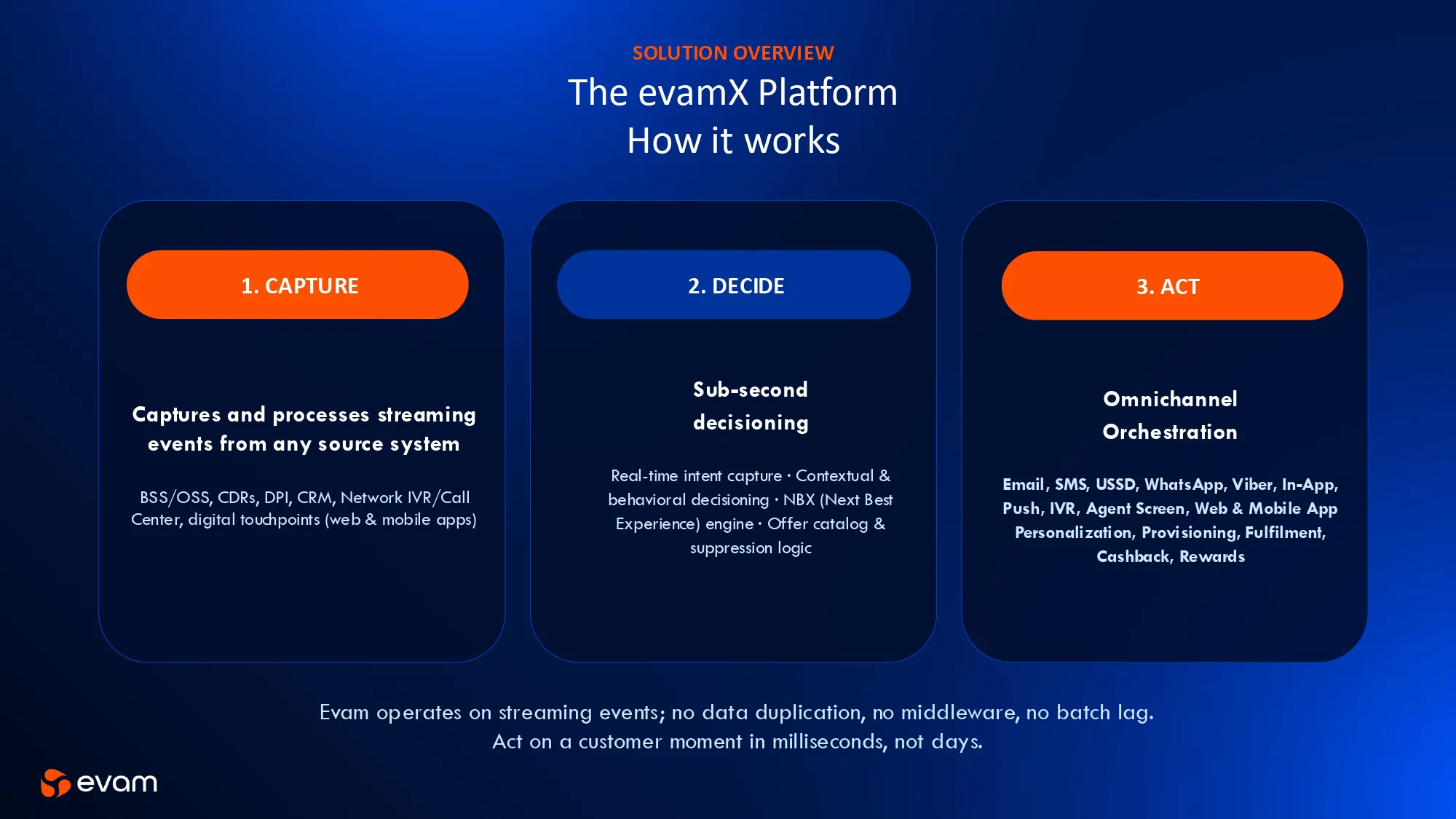
evamX captures streaming data directly from the sources that matter, transactions, clicks, network events, support interactions, app usage, and evaluates each signal as it arrives rather than in a batch cycle. This is where the analytics and decisioning layers meet: a detected signal doesn't stop at a dashboard, it flows directly into the NBX decisioning engine, which checks eligibility and business rules and determines the right response in milliseconds.
For customer experience and marketing teams specifically, that means the same infrastructure powering fraud detection or network monitoring underneath also powers customer-facing engagement, coordinated through Journey Designer so a detected signal, a churn risk, a service issue, a moment of intent, can trigger a real-time, omnichannel response without an engineering team building a custom pipeline for every new use case. This is what separates streaming analytics as an infrastructure capability from streaming analytics as something a CX or marketing team can actually put to work.
If you want to see what this looks like against your own streaming data, our team is glad to walk through it with you. Reach out through our contact page or explore the Product Demo Hub directly.