
 Evo AI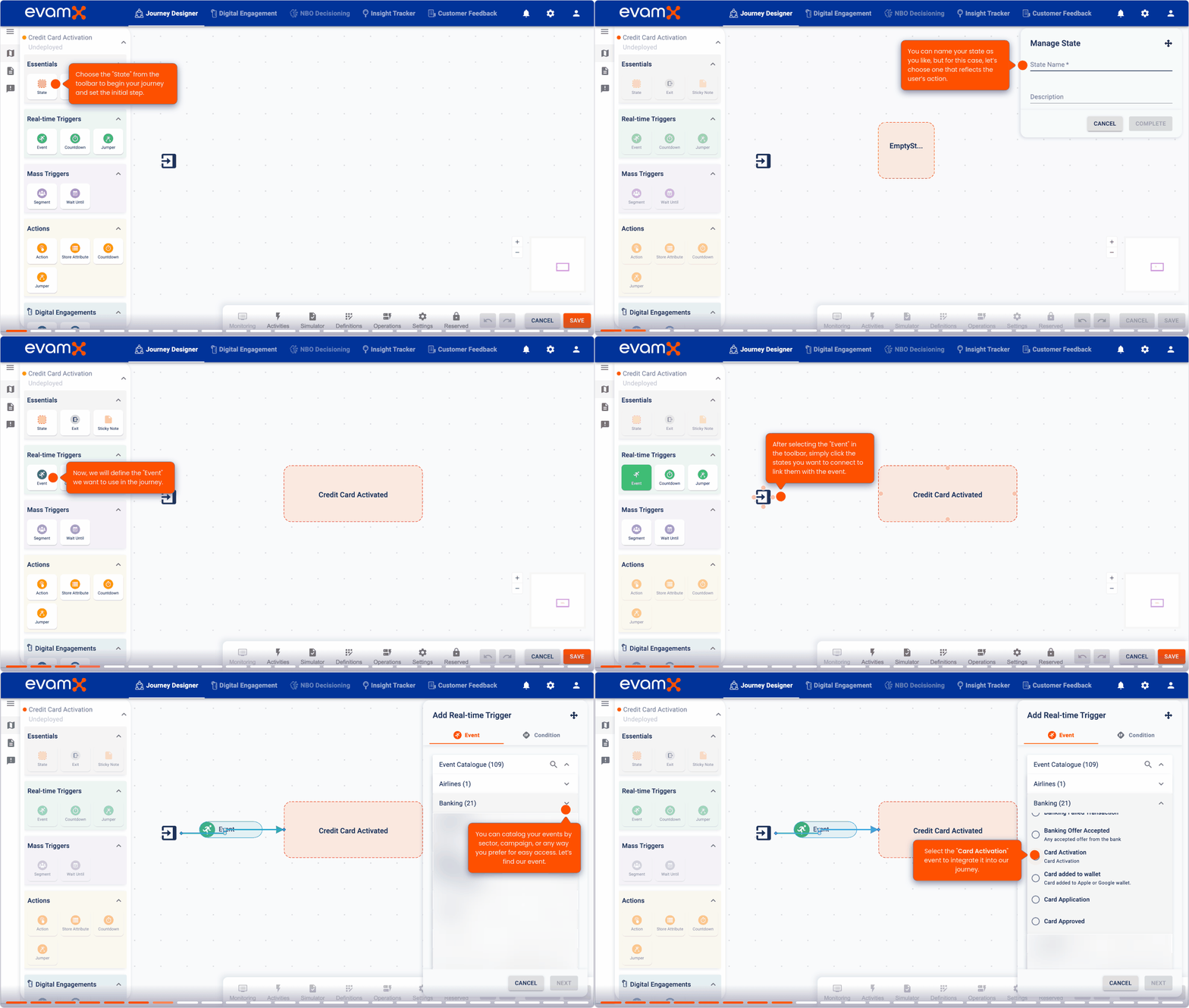
Share Post
Table of Contents
- What Event Triggered Marketing Means
- Why Timing Is the Entire Argument
- The Architecture Behind Effective Event Triggered Marketing
- Event Triggered Marketing Across Industries
- What Good Trigger Based Marketing Looks Like
- How evamX Powers Event Triggered Marketing
- The Shift That Makes It Work


Summarize with AI


A customer tops up their mobile data for the third time this week. Another visits a pricing page, closes it, and opens it again twenty minutes later. A third completes a wallet payment at an airport. A fourth abandons a cart with three items at 11 PM.
Each of these is a signal. Each one carries intent. And each one has a window, sometimes minutes, sometimes hours, during which a relevant response can change what happens next.
Event triggered marketing is the practice of detecting these signals and responding to them automatically, in real time, with a personalized action calibrated to what the customer just did. Not what segment they belong to. Not what campaign is scheduled for this week. What they did, right now, and what that behavior most likely means.
The difference between responding in the moment and responding in the next campaign cycle is not a marginal improvement. For high-intent moments, it is often the entire conversion opportunity.
What Event Triggered Marketing Means
Event triggered marketing is a marketing approach in which customer actions, events, automatically initiate a personalized response. The trigger is the event itself: a transaction, a behavioral pattern, a lifecycle milestone, a channel interaction, a usage threshold crossed.
When a trigger fires, the system evaluates the customer's context, their history, preferences, lifecycle stage, current behavior, and eligibility, and delivers the most relevant action through the most appropriate channel, automatically and without manual intervention.
This is what separates event triggered marketing from scheduled campaigns. Scheduled campaigns act on a calendar. Event triggered marketing acts on behavior. The timing is determined by the customer, not the marketing team.
The scope of "events" is broader than most implementations recognize. It includes:
Transactional events, a purchase completed, a payment made, a balance threshold crossed, a subscription renewed or lapsed
Behavioral events, a page visited, a feature used, a session abandoned, a product viewed multiple times
Lifecycle events, a first purchase, a loyalty tier reached, a period of inactivity, an anniversary
Channel events, an email opened but not clicked, a push notification dismissed, an inbound call completed
External events, a location change, a device switch, a network usage pattern, a time-of-day signal
Each event type carries a different kind of intent and a different action window. Understanding both is what separates effective trigger based marketing from automated noise.
Why Timing Is the Entire Argument
The case for event triggered marketing rests on a single observation: customer intent is not evenly distributed over time.
A customer who has just completed a wallet payment at an airport is, at that specific moment, the most receptive audience in the world for a roaming pack offer. An hour later, they are on the plane. The next day, the offer is irrelevant. A scheduled campaign that reaches them on Thursday, when the trip is already in progress, converts at a small fraction of the rate it would have at the moment of the airport transaction.
A retail customer who abandons a cart is not permanently lost. They are in a decision state, actively weighing whether to complete the purchase. A triggered re-engagement that arrives within 15 minutes reaches a customer who is still in that state. One that arrives the next morning reaches a customer who has moved on, made a different decision, or found the product elsewhere.
This is why event triggered marketing consistently outperforms scheduled campaigns on conversion metrics, not because the messages are more creative or the offers are more generous, but because the timing is better. The customer's attention is already focused on the relevant topic. The trigger is the proof.
Research consistently shows that event triggered emails and messages generate significantly higher open rates, click-through rates, and conversion rates than broadcast campaigns. The lift is not marginal. Triggered messages routinely outperform scheduled sends by 3–5x on conversion, because the moment of delivery matches the moment of intent.
The Architecture Behind Effective Event Triggered Marketing
Event triggered marketing sounds straightforward, detect an event, send a message. In practice, the difference between a basic implementation and an effective one comes down to three architectural decisions.
1. Real-Time Event Processing vs. Batch Detection
The most common failure mode in trigger based marketing is latency. A system that detects events in real time but processes them in hourly or daily batches is not doing event triggered marketing. It is doing delayed response marketing, which is better than no response, but far short of the conversion potential of genuine real-time execution.
Effective event triggered marketing requires that events are captured, evaluated, and acted upon within the same interaction, in seconds or milliseconds. A customer who checks their data balance and receives a relevant offer before they leave the screen is in a fundamentally different state than one who receives the same offer six hours later.
2. Contextual Decisioning, Not Just Rule Matching
A rule that says "if customer checks data balance, send top-up offer" is the simplest form of event triggered marketing. It works. But it treats every customer who checks their balance as identical, and they are not.
A prepaid customer who checks their balance and has a history of streaming consumption is a different proposition than one who checks their balance and primarily uses data for messaging. The first needs a bundle with streaming included. The second needs a straightforward data top-up. The rule delivers the same offer to both. Contextual decisioning delivers the right offer to each.
Effective trigger based marketing evaluates the event alongside everything known about the customer, their behavioral history, product usage, lifecycle stage, channel preferences, offer eligibility, and predictive model outputs, and selects the action that is most likely to be relevant for that specific customer, not just for customers who triggered that event in aggregate.
3. Omnichannel Execution From a Single Layer
Event triggered marketing that fires on one channel while ignoring others creates inconsistency that erodes trust. A customer who triggers a cart abandonment response receives a push notification, but then opens their email and finds no reference to the abandoned cart. They call customer service and the agent has no context. Each channel is responding independently to its own view of the customer.
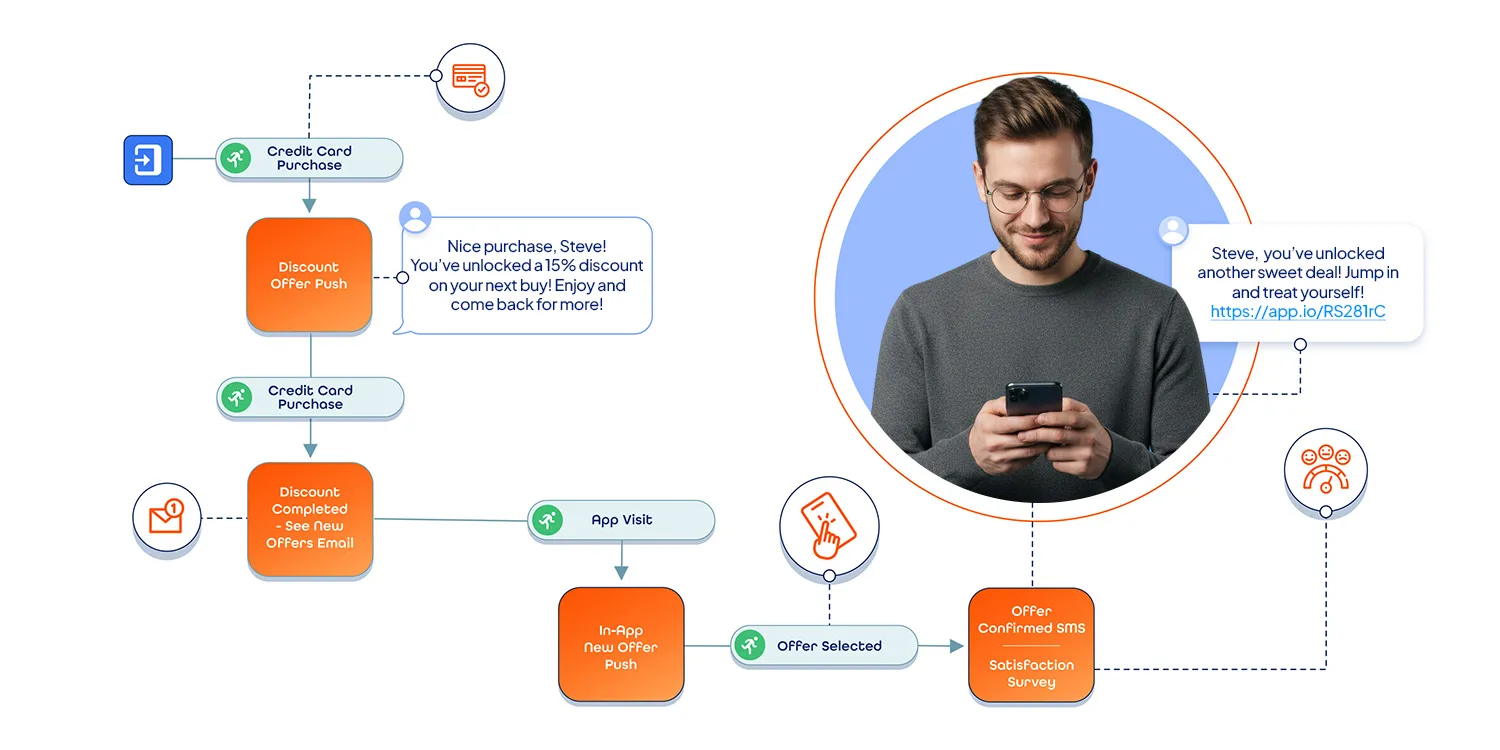
Effective event triggered marketing orchestrates the response across all relevant channels from a single decisioning layer. The push notification, the follow-up email, the in-app message, and the agent screen all reflect the same context and the same decision. If the customer converts on one channel, every other pending trigger for that journey is resolved immediately.
Event Triggered Marketing Across Industries
The mechanics of event triggered marketing are consistent. What changes across industries is the event vocabulary, the specific signals that carry the most intent in each context.
In telecommunications, the richest event triggers are usage-based. A data balance check that reveals low remaining allowance. A streaming session that consistently runs past the point where data is depleted. A roaming connection detected in a foreign network. A competitor SIM card identified on a household account. Each of these is a spend-triggered signal, an event generated by how the customer is using their service, that creates a specific, time-sensitive opportunity to deliver relevant value.
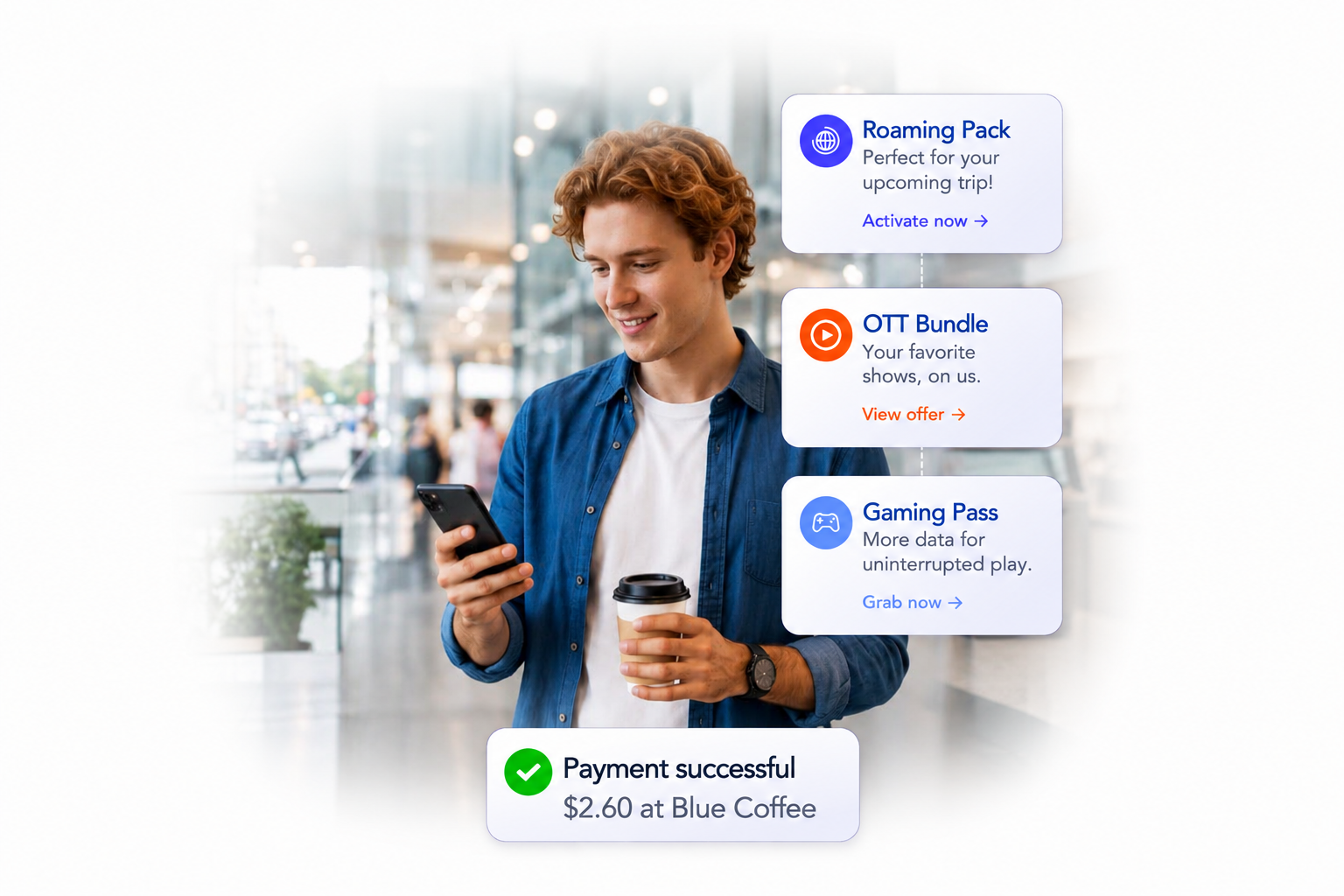
A mobile operator running spend-triggered offer journeys can turn a single wallet transaction into a personalized ecosystem engagement: a coffee shop payment triggers a cashback reward; an airport purchase triggers a roaming pack; a streaming subscription payment triggers an OTT bundle upgrade; a gaming purchase triggers a data pack tailored to gaming usage patterns. Each response is contextually relevant, delivered at the moment of highest intent, and connected to a broader journey rather than a one-off message.
In financial services, transactional events are the most powerful triggers. A large deposit followed by browsing for investment products signals a specific intent window that closes within hours. A missed payment creates a service intervention opportunity that, handled well, strengthens the relationship rather than straining it. A first transaction on a newly activated card is the highest-leverage moment for establishing spending habits that benefit both the customer and the bank.
In retail and e-commerce, behavioral events dominate. Cart abandonment is the most widely implemented trigger, but it is far from the only one. A product page visited three times without a purchase. A search for a specific item that is currently out of stock. A loyalty points balance that is close to a reward threshold. Each of these signals an intent state that a triggered response can move forward.
In subscription businesses, lifecycle events carry disproportionate weight. The first week after sign-up, when habits are forming and the customer's perception of value is being established. The approach of a renewal date, when the customer is implicitly evaluating whether to continue. The first sign of disengagement, a login frequency drop, a feature that stops being used, which is the earliest detectable signal of eventual churn.
What Good Trigger Based Marketing Looks Like
The best event triggered marketing implementations share a set of characteristics that go beyond the technical architecture.
They define the event vocabulary deliberately. Not every customer action is a useful trigger. Effective trigger based marketing starts by identifying the specific events that carry the strongest intent signals for the business, and building the trigger library around those, rather than attempting to trigger on everything.
They match the response to the action window. A cart abandonment trigger that fires after 48 hours is optimized for the wrong metric. A low-balance trigger that fires after a 12-hour batch cycle misses the moment entirely. Effective implementations map each trigger to its realistic action window, the period during which a response can still influence the customer's next decision.
They apply suppression logic rigorously. A customer who has already converted should not continue to receive conversion triggers. A customer who has explicitly declined an offer should not receive the same offer again the next day. A customer who is in a high-value service resolution journey should not receive a promotional message that undermines the relationship. Suppression is not a limitation on trigger based marketing. It is what makes it sustainable.
They treat triggers as journey entry points, not one-off messages. The most effective event triggered marketing does not end with the first response. A triggered message that generates a click enters the customer into a journey, one where each subsequent interaction is informed by how the customer responded to the previous one. This is the difference between trigger based marketing and triggered broadcast: the journey adapts, the relationship deepens, and the system learns.
How evamX Powers Event Triggered Marketing
evamX is built for the event-driven architecture that effective trigger based marketing requires. Every customer interaction, a transaction, a usage event, a channel touchpoint, a behavioral signal, is captured as a live event and processed in real time, without batch lag and without data duplication.
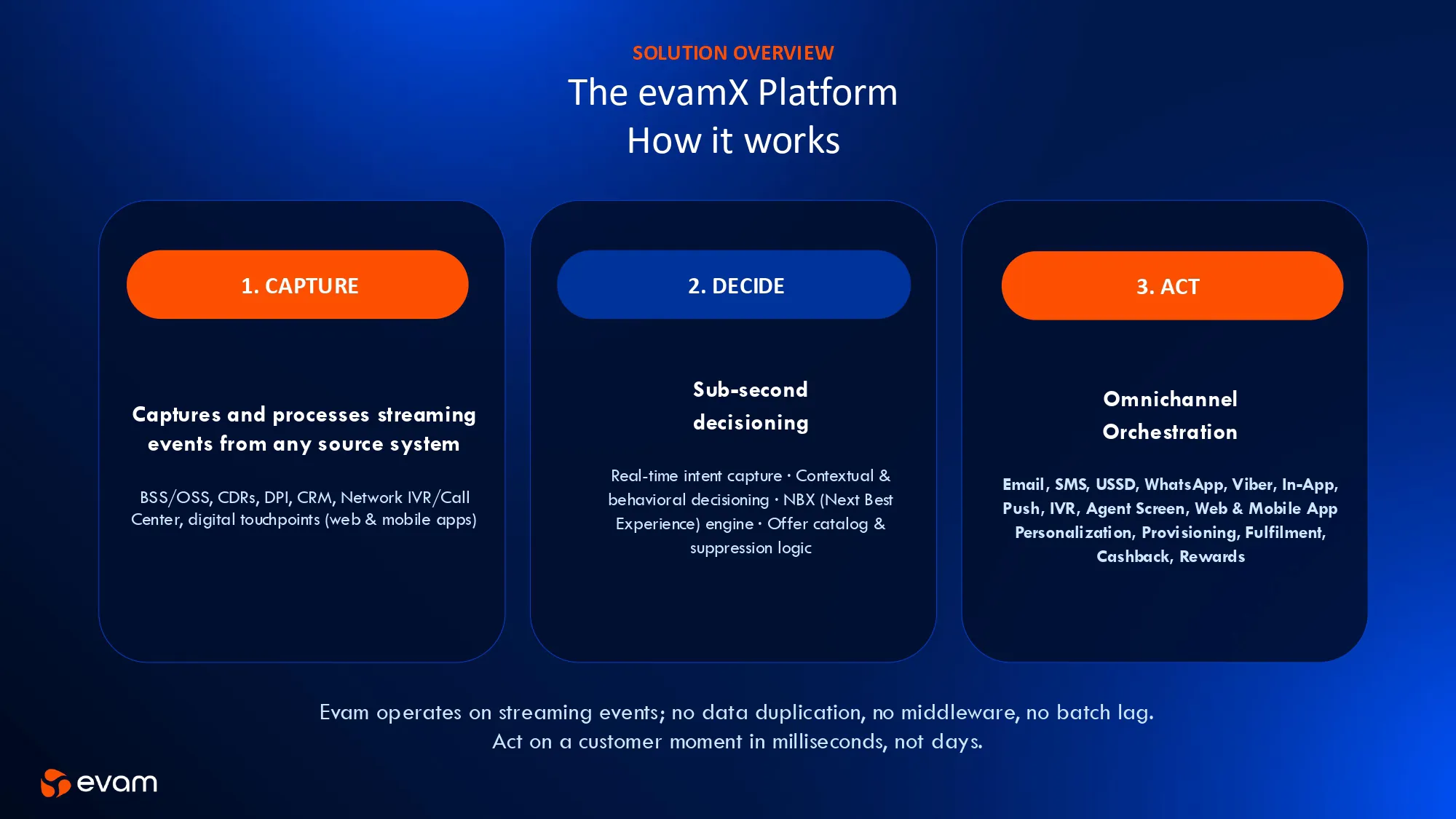
The NBX decisioning engine evaluates each event in full customer context, behavioral history, lifecycle stage, product usage, channel preferences, predictive model outputs, and business rules, and selects the most relevant action in milliseconds. The response is delivered immediately through the appropriate channel, from a single orchestration layer that spans push, in-app, SMS, email, web, IVR, and agent screen.
For marketing and CVM teams, Journey Designer provides a no-code environment for building, launching, and modifying event triggered journeys without IT dependency. Triggers can be configured around any event type, transactional, behavioral, lifecycle, or usage-based, with branching logic, suppression rules, and channel fallback built in. Evo AI adds a continuous optimization layer, surfacing which triggers are converting, which journeys are underperforming, and what adjustments are most likely to improve outcomes.
evamX processes over 600 million personalized interactions daily across 70 global brands, with event-to-action latency measured in milliseconds. Brands running event triggered journeys on evamX consistently report 3–5x conversion uplift on triggered interactions versus scheduled campaigns, and a measurable reduction in contact frequency alongside an increase in engagement depth, fewer messages, more relevance, stronger relationships.
The Shift That Makes It Work
Event triggered marketing is not difficult to understand. The customer does something. You respond to it. The response is relevant because it is connected to what they just did.
What makes it difficult is the infrastructure gap between detecting an event and acting on it in the moment it still matters. Most marketing stacks were not built for this. They were built for campaigns, for planning, scheduling, and broadcasting. The event triggered layer was added later, often as an integration rather than a foundation.
Organizations that have rebuilt around an event-first architecture, where every customer moment generates a signal and every signal is eligible for a real-time response, consistently describe the shift the same way. The campaigns did not disappear. But they became a smaller part of the revenue story. The larger part became the responses: the triggered moments, the contextual decisions, the interactions that happened because a customer did something and the system was ready to answer.
That readiness, to detect, decide, and deliver before the moment closes, is what event triggered marketing is actually about.
See how evamX powers event triggered marketing at scale: