
Share Post
Table of Contents
- Why the Connectivity Growth Model Is Running Out of Road
- The Three-Layer Shift in Telecom Digital Transformation
- What Ecosystem Digital Transformation Looks Like in Practice
- The Metrics That Define Successful Telecom Digital Transformation
- The 90-Day Path to Ecosystem CVM
- How evamX Powers Telecom Digital Transformation
- The Transformation That Actually Compounds


Summarize with AI


For most of the last two decades, digital transformation in telecom meant one thing: modernizing the infrastructure behind the product. Moving from 3G to 4G to 5G. Migrating billing systems to the cloud. Digitizing the customer service interface. Building an app.
These were necessary investments. But they were not transformation. They were renovation, improving the delivery mechanism for the same core product.
The operators that are posting the strongest revenue growth today have moved past renovation. They are not asking how to deliver connectivity better. They are asking how to build an ecosystem around connectivity, and how to orchestrate every customer moment across that ecosystem in real time.
That is what digital transformation in telecom actually looks like in 2026. Not a technology upgrade. A fundamental change in how operators create, capture, and compound customer value.
Why the Connectivity Growth Model Is Running Out of Road
The economics of connectivity-led growth are well understood, and increasingly constrained.
Penetration rates in most mature markets are at or near saturation. The average revenue per user for core connectivity has been under pressure for years, squeezed by competitive pricing, regulatory intervention, and the commoditization of mobile data. New subscriber growth is largely a zero-sum game: one operator's gain is another's loss.
The infrastructure investments that powered the last decade of growth, 4G rollout, fiber expansion, network virtualization, delivered real value. But they also raised the cost baseline across the industry simultaneously. Every operator got faster. Every operator got more reliable. The differentiation that infrastructure investment once created has largely been competed away.
This is the structural reality that makes digital transformation in telecom urgent rather than aspirational. The next era of revenue growth will not come from selling more gigabytes or adding more subscribers. It will come from deepening the value of existing relationships, by expanding the number of services a customer uses, the number of interactions that generate insight, and the number of moments the operator can respond to with something genuinely relevant.
The operators that have understood this are not waiting for the infrastructure investment cycle to unlock growth. They are building ecosystem businesses on top of the connectivity foundation they already have.
The Three-Layer Shift in Telecom Digital Transformation
Modern telecom digital transformation operates across three layers simultaneously. Each layer reinforces the others, but each also requires a different kind of change.
1. The Business Model Layer: From Single-Service to Ecosystem
The first and most fundamental shift is in what telecom operators are selling.
A connectivity-centric business model sells one product, a plan, and defends it against churn. Revenue is bounded by plan price and subscriber count. Customer value is a function of how long the subscriber stays and how much they pay per month.
An ecosystem business model sells a relationship. Revenue comes from connectivity, wallet and payments, digital lifestyle services, entertainment, smart home, partner platforms, and the data and attention that flow across all of them. Customer value is a function of how many services the household uses, how deeply they are embedded, and how many adjacent revenue streams the operator can activate.
The economics are structurally different. A single-service subscriber generating €20 per month is a retention problem. A multi-service household generating €65 per month across connectivity, broadband, wallet, and OTT is an asset, one that churns at 30–40% lower rates and generates 2–4x higher margin contribution per customer.
The super app strategy that leading telco operators are pursuing is the clearest expression of this shift. Rather than running separate digital products in disconnected silos, operators are building unified platforms where connectivity, financial services, entertainment, commerce, and partner ecosystems coexist in a single customer interface, and where every interaction across that interface generates a signal the platform can use.
2. The Decisioning Layer: From Batch Campaigns to Real-Time Orchestration
The second layer of transformation is in how operators respond to customer behavior.
Traditional telecom marketing operates on a batch logic. Segments are defined from last month's data. Campaigns are designed, approved, and scheduled weeks in advance. Execution happens on a calendar, not in response to what customers are actually doing.
This model produces results in a world where customer intent moves slowly. It fails in a world where a subscriber's decision to switch operators can happen in an afternoon, triggered by a single bad service experience, a competitor's promotional offer, or a friend's recommendation.
Real-time decisioning changes the operating model at its foundation. Instead of asking "which campaign should we run this month?", operators ask "what is the best action for this specific customer in this specific moment?", and the answer is evaluated and delivered in milliseconds, not weeks.
The business impact is measurable. Operators that have moved from batch to real-time decisioning consistently report 3–5x cross-sell conversion uplift, 30–40% reduction in churn among multi-service households, and 2–4x higher margin contribution per customer. The signals were always there. The difference is whether the system could act on them before they expired.
3. The Operating Model Layer: From IT-Led to Business-Owned
The third layer is the one most often underestimated, and the one that most frequently determines whether transformation actually happens.
Digital transformation initiatives in telecom have historically been IT-led. A new platform is selected. A long implementation cycle begins. When the platform is live, marketing and CVM teams submit requests for new journeys, new rules, and new campaign logic, and wait for engineering capacity to deliver them.
In a market where customer behavior changes weekly and competitive offers emerge overnight, this model is too slow. The operators that are winning on digital transformation have shifted to a business-owned operating model: marketing and CVM teams can configure, launch, and modify customer journeys without IT dependency. A new retention offer can go live in hours, not months. A response to a competitor's promotional campaign can be orchestrated the same day.
This is not just a technology question. It requires deliberate organizational design, clear ownership of journey logic, governance frameworks that enable speed without sacrificing control, and platforms that are genuinely built for non-technical users.
What Ecosystem Digital Transformation Looks Like in Practice
The shift from connectivity-centric to ecosystem-centric is not theoretical. It is visible in the journeys that leading operators are running today.
A prepaid subscriber checking her data balance for the third time this week is not just a low-balance event. It is an intent signal, one that a real-time ecosystem platform reads alongside her wallet activity, her streaming behavior, and her recharge history to deliver a one-tap top-up bundle that includes the streaming pack she already uses, priced for her segment. She converts. ARPU lifts. Churn risk drops. The next decision becomes sharper than the last.
A broadband household with multiple devices and no mobile lines on the account is not just an upsell opportunity. It is a convergence signal, one that the platform detects from shared home Wi-Fi usage and multi-device patterns, then orchestrates a family bundle offer across push notification, SMS, and the next inbound call. The household moves from a single-service relationship to a multi-service one. Retention depth increases structurally.
A subscriber whose gaming sessions run for three hours every evening is not just a heavy data user. They are a gamer persona, one the platform builds in real time from network and behavioral signals, then activates with a premium gaming bundle at peak engagement moments. Gaming ARPU lifts. Household ARPU lifts with it.
A customer whose app engagement has been declining for 30 days is not just a churn risk. They are a relationship depth opportunity, one the platform identifies before the churn model flags them, adds a second anchor product, and transforms a fragile single-service relationship into a durable multi-service one. Retention becomes portfolio-led rather than discount-led.
In each case, the revenue was already there in the signals. The transformation is in the platform's ability to read them in real time and respond before the moment closes.
The Metrics That Define Successful Telecom Digital Transformation
Telecom digital transformation is often measured by the wrong things: number of digital channels launched, percentage of interactions handled digitally, NPS scores. These metrics capture the renovation layer, the improvement of existing operations, not the transformation layer.
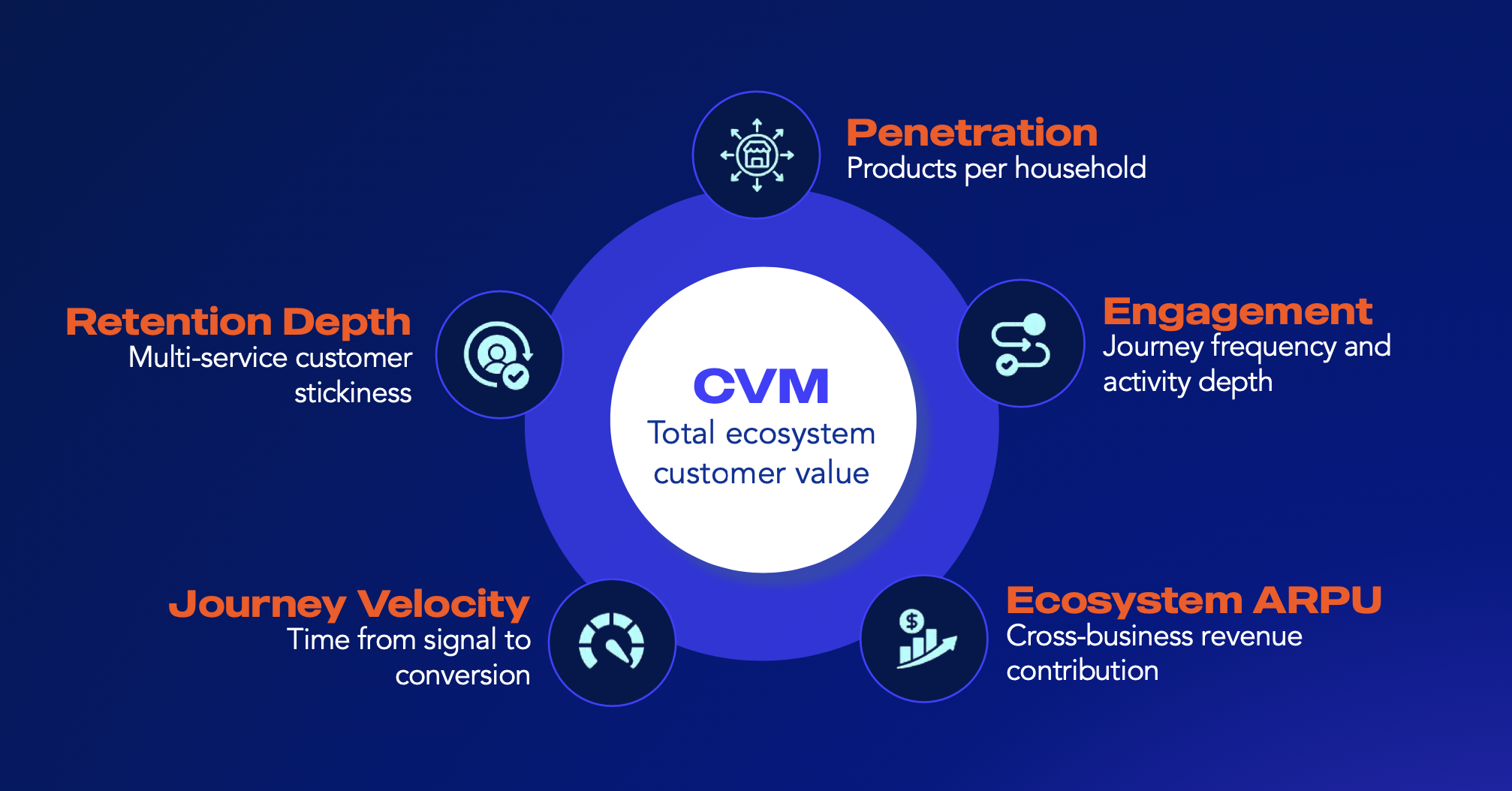
The metrics that define successful ecosystem transformation are different.
Ecosystem Product Penetration, average products per household. The leading indicator of transformation progress. Operators moving from 1.2 to 3.2 average products per household are not just growing revenue. They are building structural churn resistance.
Ecosystem ARPU, cross-business revenue contribution per customer. Moves the conversation from plan price to total wallet share. The gap between connectivity ARPU and ecosystem ARPU is the most direct measure of how far transformation has progressed.
Journey Velocity, time from signal to conversion. Measures how quickly the platform can move from detecting intent to delivering an action. In a real-time CVM environment, this is measured in milliseconds. Operators still running batch logic measure it in days.
Cross-Category Conversion Rate, the percentage of customers who move from one service to an adjacent one through an orchestrated journey. Top-performing operators with mature real-time CVM capabilities run at 18–27%. Operators on batch logic run at 5–8%.
Wallet Usage Frequency, for operators running embedded financial services, average transactions per active wallet user per month. The depth of the financial relationship is one of the strongest predictors of overall ecosystem stickiness.
The 90-Day Path to Ecosystem CVM
The gap between understanding ecosystem transformation and operationalizing it can feel large. The operators that move fastest do not attempt full-stack transformation at once. They identify one or two journeys with strong signal availability and measurable business value, run a structured pilot, measure uplift against a control group, and scale what proves value.
A proven 90-day structure:
Days 1–30: Identify the right ecosystem journeys. Prioritize use cases where signals are already captured and business value is directly measurable. Wallet activation and unified inbound offer management are common starting points, both use signals that operators already have, and both show measurable uplift within weeks.
Days 31–60: Launch pilots and measure impact. Activate triggers, decisioning logic, and orchestrated journeys. Establish control groups from day one. The comparison between journeys with real-time decisioning and those without is typically the most compelling internal proof point. Measure uplift across conversion, ARPU, activation, and retention.
Days 61–90: Scale what proves value. Expand successful journeys across adjacent ecosystem services. Operationalize governance and reusable decisioning models. Build a repeatable framework — not a collection of one-off campaigns.
Each successful journey strengthens the data foundation, the engagement signals, and the decisioning accuracy for the next. Transformation does not require a five-year roadmap. It requires a first journey, executed well.
How evamX Powers Telecom Digital Transformation
evamX is designed for the architecture that ecosystem transformation requires. Not as a set of features added to an existing campaign tool, but as a platform built from the ground up for real-time signal capture, AI-powered decisioning, and omnichannel orchestration across the full telco ecosystem.
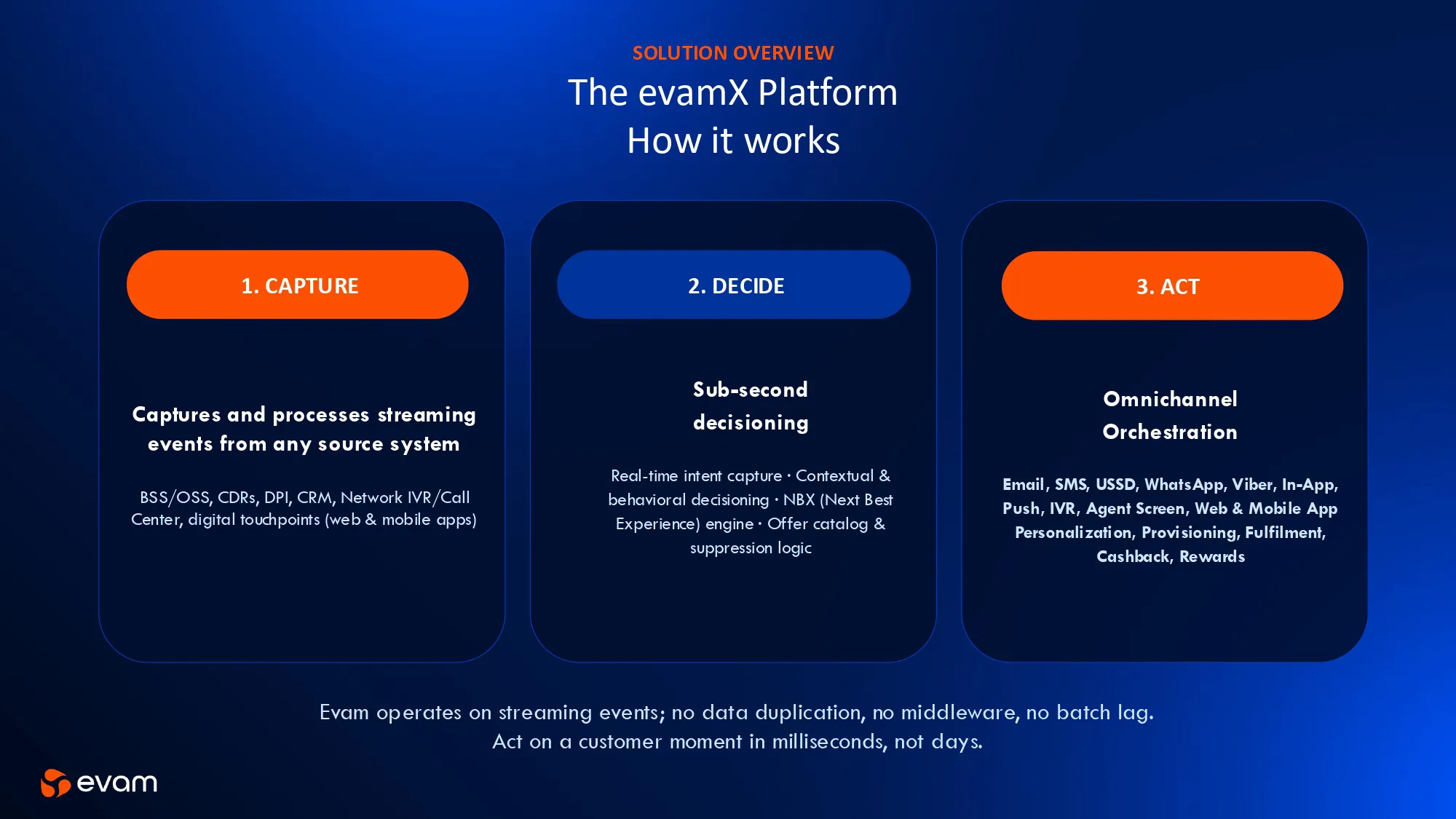
For operators executing digital transformation, evamX delivers:
Unified event capture from network systems, billing platforms, app behavior, wallet activity, call center, branch, and partner ecosystems, with no batch lag and no data duplication
NBX decisioning engine that evaluates offer, channel, timing, and context simultaneously in milliseconds, integrating natively with existing ML models so operators do not rebuild what they have already built
Single-layer omnichannel orchestration across push, SMS, in-app, web, IVR, agent screen, and partner surfaces, so every decisioning output reaches the customer consistently, regardless of channel
Evo AI for GenAI-powered journey automation, CVM and marketing teams build, modify, and launch journeys from natural language inputs, without IT dependency
Proven telco scale, billions of events processed daily across operators including Vodafone, Turkcell, T-Mobile, Ooredoo, and Jazz
Flexible deployment, cloud, private cloud, and on-premise options for operators with data residency or regulatory requirements
The operators that have run ecosystem transformation with evamX describe the outcome consistently: fewer campaigns, more decisions. Less time scheduling sends, more time responding to what customers are actually doing. Less revenue left in signals that expired before the system could act.
The Transformation That Actually Compounds
Digital transformation in telecom has been discussed for a decade. The infrastructure layer, cloud migration, 5G rollout, digital channels, is largely done. The operators that are still calling it transformation are renovating. The ones that are actually transforming are building ecosystems.
The difference is not in the technology stack. Every major operator has access to capable AI, cloud infrastructure, and digital channels. The difference is in the operating model, whether the platform can connect a customer signal to a relevant action in the moment it occurs, across every service the operator provides, without waiting for a batch cycle or an IT ticket.
That is the transformation that compounds. Each interaction that is responded to in real time generates a signal that makes the next decision sharper. Each service added to a household relationship deepens the switching cost. Each moment of genuine relevance builds the kind of loyalty that a discount program never could.
The connectivity era produced operators. The ecosystem era will produce platforms. The question is which operators are building them.