
Share Post
Table of Contents
- What Customer Value Management Actually Means
- Why the Old CVM Model Is No Longer Enough
- The Strategic Shift: From Single-Product to Ecosystem CVM
- What Ecosystem CVM Looks Like in Practice
- The Metrics That Modern CVM Teams Track
- Six Ecosystem Journeys Operators Are Activating Today
- How to Get Started: The 90-Day Ecosystem CVM Playbook
- How evamX Powers Ecosystem CVM for Telecom Operators
- The CVM Question Worth Asking


Summarize with AI


For most of the last decade, telecom operators measured success the same way. ARPU. Churn rate. Net additions. These metrics told a clear story about a simple business: sell a connectivity plan, keep the customer on it as long as possible, and repeat.
That model still works. But it no longer grows.
The operators posting the strongest revenue numbers today are not the ones with the lowest churn or the highest plan prices. They are the ones that have figured out how to turn a single connectivity relationship into a multi-service household, and how to orchestrate every customer moment across that relationship in real time.
That is what customer value management in telecom has become. Not a retention function. Not a campaign tool. A growth operating model.
What Customer Value Management Actually Means
Customer value management (CVM) is the practice of maximizing the long-term value a customer delivers to a business, by understanding their behavior, anticipating their needs, and responding with the right offer, service, or intervention at the right moment.
In telecom, CVM has traditionally meant three things: acquiring customers at a reasonable cost, keeping them from leaving, and occasionally upselling them to a higher plan. The KPIs were single-service by design: plan revenue, contract renewal rate, call center resolution time.
This worked in an era when telecom was a single-product business. A subscriber bought a mobile plan. The operator's job was to keep that subscriber satisfied enough not to switch.
That era is ending, not because customers are leaving, but because they are staying and expecting more. The same subscriber who once had a mobile contract now has broadband, a digital wallet, an OTT subscription, smart home services, and a family bundle. Each of these represents a relationship, a revenue stream, and a set of behavioral signals that a modern CVM system can use.
The operators that recognize this shift are redefining what CVM means: not the management of a single customer relationship, but the orchestration of a customer's entire value journey across the ecosystem.
Why the Old CVM Model Is No Longer Enough
The limitations of traditional CVM show up in a specific and recurring way: operators know a lot about their customers in aggregate, but very little about them in the moment.
A customer who is about to churn looks like a normal subscriber until the week they port their number. A customer who is ready to upgrade their plan looks identical to one who has no interest in doing so, until the moment they check the pricing page for the third time in a week. A household that is one conversation away from adding a second line gives no signal to a batch-processing system until the opportunity has already passed.
Traditional CVM was built to understand what happened. Campaigns were designed based on last month's behavioral data, delivered to segments defined last quarter, and measured against goals set last year. This produces results, but it systematically misses the highest-value moments, because those moments do not wait for the next campaign cycle.
There are three structural forces making this gap more expensive by the year.
More interactions. Customers now engage across more services, platforms, and touchpoints than at any point in telecom history. Each interaction is a potential signal. Batch systems capture the data but cannot act on it while it is still relevant.
More intent signals. Real-time behavioral signals, a data balance check, a competitor app opened, a gaming session that runs for three hours every evening, create opportunities to deliver relevant value at peak intent. These signals have a half-life measured in minutes, not days.
More value moments. Customers who are anchored across multiple services generate higher ARPU, lower churn, and higher lifetime value. Research consistently shows multi-service households churn at 30–40% lower rates than single-service subscribers. The value is there. The question is whether the CVM system can identify and activate it in time.
The Strategic Shift: From Single-Product to Ecosystem CVM
Modern CVM is built around a different unit of analysis. Not the plan. Not the subscriber. The household ecosystem relationship.
This shift changes three things simultaneously.
The business model shifts from single-service monetization to ecosystem value growth. Instead of selling one product and defending it against churn, operators build multi-product households where wallet, content, connectivity, and partner services reinforce each other. Cross-business engagement replaces product-led campaigns. Relationship-based monetization replaces single-service ARPU.
The decisioning model shifts from batch campaigns to real-time orchestration. Instead of static segments and scheduled sends, CVM teams work with live customer signals, AI-driven next best action logic, and cross-channel coordination that responds to what a customer is doing right now. The question is no longer "which campaign should we run this week?" It becomes: "what is the best action for this customer in this moment?"
The operating model shifts from IT-led deployments to business-owned agility. The pace at which customer behavior changes, and fraud patterns evolve, and competitive offers emerge, means that CVM teams cannot wait for engineering capacity to update their journeys. Modern CVM platforms are built for business user autonomy: marketing and CVM teams configure, launch, and modify journeys without IT dependency.
What Ecosystem CVM Looks Like in Practice
The clearest way to understand modern CVM is through the moments it creates, and the revenue those moments represent.
A prepaid subscriber checks her data balance for the third time this week. A traditional system logs the event. A modern CVM system reads her wallet activity, her streaming behavior, and her low-balance pattern in milliseconds, and delivers a one-tap top-up bundle that includes the streaming pack she already uses, priced for her segment. She converts. ARPU lifts. Her churn signal drops.
A broadband customer's household has multiple devices sharing the home Wi-Fi, but no mobile lines on the account. A batch system has no way to connect these signals. A real-time CVM system detects the multi-device household pattern, identifies competitor SIM usage, and orchestrates a family bundle offer across push notification, SMS, and the next inbound call, consistently, from a single decisioning layer. ARPU per household grows.
A subscriber's app engagement has been declining for 30 days. Their recharge rhythm is weakening. They hold only one product. A discount-led retention system waits for a churn trigger. An ecosystem CVM system identifies the shallow penetration, adds a second anchor product, wallet, OTT, or smart home, before price-led churn crystallizes. The strongest retention play is not a discount. It is a broader relationship.
In each case, the value was already there in the signals. The difference is whether the CVM system could read them in time and respond before the moment closed.
The Metrics That Modern CVM Teams Track
Single-product KPIs measured the old game. Ecosystem CVM requires a different measurement framework — one that captures relationship depth, not just plan retention.
Ecosystem Product Penetration, average products per household. The leading indicator of churn resistance and ARPU growth. Top-performing operators are moving toward 3+ products per household as the benchmark for a "retained" customer.
Ecosystem ARPU, cross-business revenue contribution per customer. Moves the conversation from plan price to total wallet share. A customer generating €20/month on connectivity alone is a different asset than one generating €45/month across connectivity, wallet, and content.
Retention Depth, multi-service customer stickiness. Measures how much of a customer's ecosystem is anchored with the operator, not just whether they are on contract. Operators with high retention depth experience structural churn resistance that discounting cannot replicate.
Journey Velocity, time from signal to conversion. Measures how quickly the CVM system can move from detecting intent to delivering an action. In real-time CVM, this is measured in milliseconds for automated journeys. Slower velocity means more moments missed.
Wallet Usage Frequency, average transactions per active wallet user per month. For operators running embedded financial services, this metric captures the depth of the financial relationship and its contribution to ecosystem stickiness.
Cross-category conversion rates, the percentage of customers who move from one service to an adjacent one through an orchestrated journey, typically run at 18–27% for operators with mature real-time CVM capabilities, compared to 5–8% for those still operating on batch logic.
Six Ecosystem Journeys Operators Are Activating Today
Understanding the shift in CVM theory is useful. Seeing where it creates measurable impact is more useful.
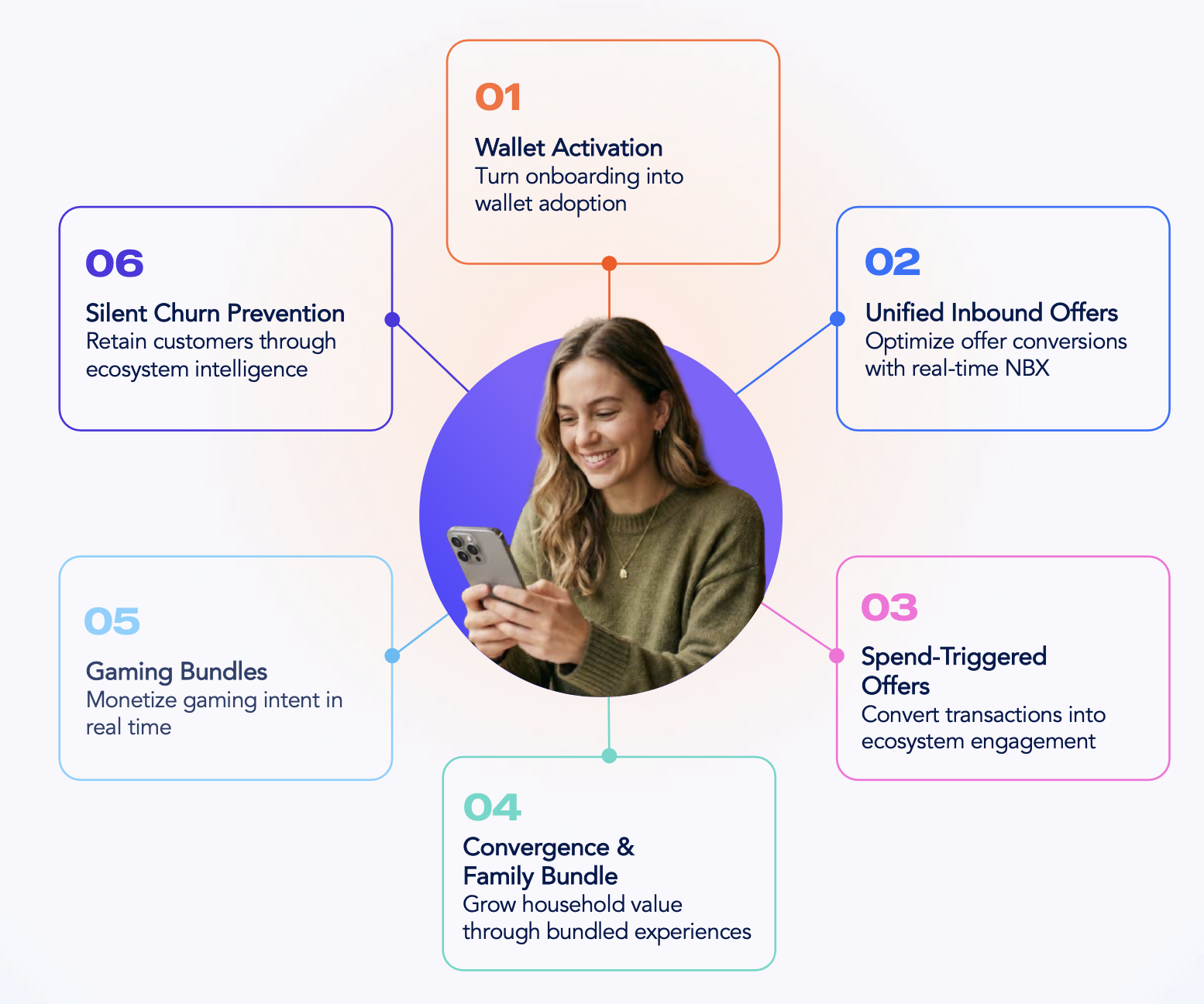
These are the six ecosystem journeys delivering the clearest results for telco operators building toward modern CVM:
Wallet activation. Turning high-frequency prepaid users into long-term wallet users, and unlocking the ecosystem monetization that follows. Triggers: frequent top-ups, high app engagement, digital self-care activity. Journey: active wallet → first transaction → habit reinforcement → ecosystem expansion.
Unified inbound offer management. Ensuring that every inbound customer contact, web, app, store, IVR, call center, receives the same personalized offer, determined in real time by a single NBX decisioning layer. No more disconnected channel experiences. No more agent recommending a plan the app already declined.
Spend-triggered ecosystem offers. Converting wallet transactions into personalization signals. A coffee shop payment triggers a cashback offer. An airport purchase triggers a roaming pack. A streaming subscription triggers an OTT bundle upgrade. Every transaction is an intent signal with a short action window.
Convergence and family bundling. Identifying single-line households with broadband and no mobile lines or households using competitor SIMs, and orchestrating family bundle offers at the right moment, across the right channel. Outcome: higher ARPU per household, more lines per roof, stronger CLTV.
Persona-driven gaming bundles. Building gamer personas in real time from network and behavioral signals, then delivering premium bundle offers at peak gaming engagement moments. Gaming ARPU and household ARPU both lift.
Silent churn prevention through ecosystem depth. Detecting the early warning signals, declining app visits, weaker recharge rhythm, decreasing anchor service interaction, and adding a second product before price-led churn crystallizes. Retention becomes portfolio-led, not discount-led.
For a complete breakdown of these six ecosystem journeys, along with a 90-day rollout framework, see our full guide, Telco CVM Guide: AI-Driven Ecosystem Monetization.
How to Get Started: The 90-Day Ecosystem CVM Playbook
The gap between understanding modern CVM and operationalizing it can feel large. In practice, operators that move fastest do not try to transform everything at once. They identify one or two journeys with strong signal availability and measurable business value, run a pilot, measure uplift, and scale what works.
A proven 90-day structure:
Days 1–30: Identify the right ecosystem journeys. Prioritize use cases where signals are already available and business value is measurable. Align channel ownership, KPIs, and operational stakeholders. Start with journeys that minimize integration complexity, wallet activation and unified inbound offers are common starting points because they use signals that operators already capture.
Days 31–60: Launch pilots and measure impact. Activate triggers, decisioning logic, and orchestrated engagement journeys. Establish control groups from day one, the comparison between journeys with real-time decisioning and those without is typically the most compelling data point for internal buy-in. Measure uplift across conversion, ARPU, activation, and retention.
Days 61–90: Scale what proves value. Expand successful journeys across adjacent ecosystem services. Operationalize governance and reusable decisioning models. Build a repeatable framework rather than a collection of one-off campaigns.
Each successful journey strengthens the data, engagement, and decisioning foundation for the next. Operators do not need to transform their entire CVM stack to see results. They need to start with one moment, decide it well, and build from there.
How evamX Powers Ecosystem CVM for Telecom Operators
evamX is built specifically for the architecture that modern CVM requires: real-time event processing from every touchpoint across the ecosystem, AI-powered NBX decisioning that evaluates offer, channel, timing, and context simultaneously, and omnichannel orchestration from a single platform layer.
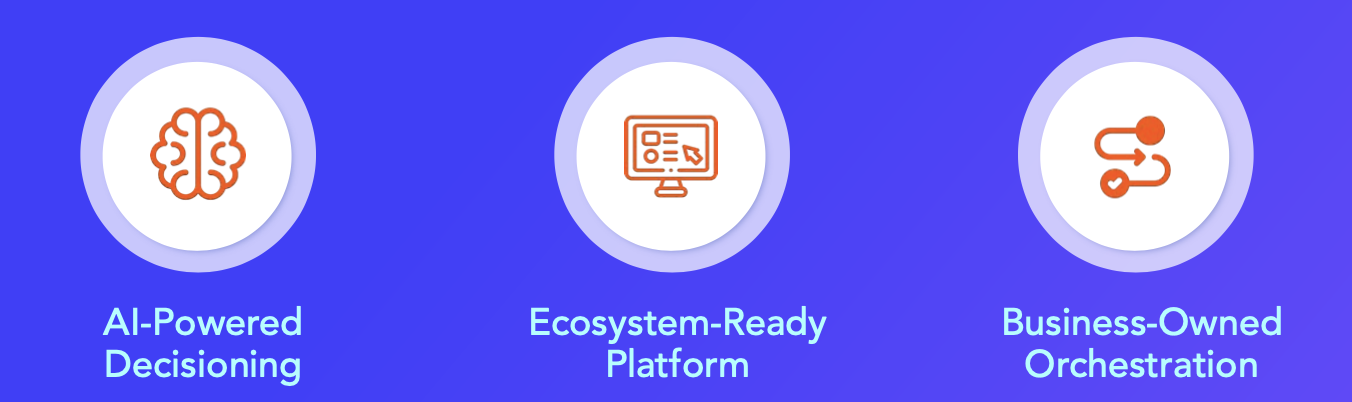
For telecom operators, this means:
Unified signal capture from network events, billing systems, app behavior, wallet activity, call center, and partner platforms, with no batch lag and no data duplication
NBX engine that evaluates live customer context against predictive models and business rules in milliseconds, producing a next best experience, not just a next best offer
Single-layer omnichannel delivery across push, SMS, in-app, web, IVR, and agent screen, so the same decision reaches the customer consistently, regardless of which channel they are on
Business-owned journey management through Journey Designer and Evo AI, CVM teams launch and modify journeys without IT tickets
Proven telco scale billions of events processed daily, across operators including Vodafone, Turkcell, T-Mobile, Ooredoo, and Jazz
The operators that have moved to ecosystem CVM with evamX describe the shift the same way: less time managing campaigns, more time orchestrating decisions. Fewer missed moments. More revenue from signals that were always there.
The CVM Question Worth Asking
Every telecom operator has customers generating intent signals right now. A balance check. A competitor app opened. A streaming session that just ended. A household with three devices and one account.
The question is not whether the value is there. It is whether the CVM system is fast enough, integrated enough, and intelligent enough to act on it while the moment is still open.
That is the shift modern CVM is built around. And for operators that make it, the metrics, ecosystem ARPU, retention depth, journey velocity, tell the story clearly.
Explore how evamX helps telecom operators build modern CVM: