
Share Post
Table of Contents
- What Marketing Automation Was Built to Do
- What Customer Journey Orchestration Actually Means
- Where the Architectures Diverge in Practice
- The Data Question That Separates Them
- Why "Journey Features" in Automation Platforms Are Not the Same Thing
- When Each Approach Is the Right Choice
- The Organizational Shift That Journey Orchestration Requires
- evamX: Customer Journey Orchestration Built for Real-Time Engagement


Summarize with AI


The two terms appear together so frequently that they have started to blur into each other. Marketing automation platforms now advertise journey capabilities. Journey orchestration vendors describe their products as the evolution of automation. The result is a market where the language has become almost useless for evaluation purposes: everything claims to do everything, and the actual differences only become visible after a platform is deployed and the gaps start showing up in campaign performance.
The difference between customer journey orchestration and marketing automation is not a matter of degree. It is a matter of design philosophy. Understanding it clearly changes how you evaluate technology, how you structure your team's capabilities, and ultimately how well your organization can respond to customers in the moments that drive revenue and retention.
What Marketing Automation Was Built to Do
Marketing automation emerged as a solution to a specific and genuine problem: the manual effort required to execute marketing communications at scale. Before automation, sending a personalized welcome email to every new subscriber, triggering a follow-up message after a specific action, or running a lead nurturing sequence required significant human coordination. Automation replaced that coordination with rules and schedules.
The core architecture of marketing automation is campaign-centric. A marketer defines a campaign: the audience, the message, the channel, the timing, and the conditions that move a contact from one step to the next. The platform executes this definition reliably across thousands or millions of contacts. It is a fundamentally linear model: designed to move people through a pre-planned sequence, with conditional branches for anticipated variations.
This architecture was a significant advance over manual execution. It enabled consistency, scale, and a degree of personalization that was previously impossible. It also came with a structural constraint that was less visible when customer expectations were lower: the system can only do what it was explicitly told to do in advance. Every scenario must be anticipated. Every branch must be pre-built. When a customer's behavior falls outside the planned sequence, the system either forces them back onto the nearest path or loses them entirely.
What Customer Journey Orchestration Actually Means
Customer journey orchestration starts from a different premise: that customer behavior is not a sequence to be managed, but a series of moments to be responded to. The distinction sounds philosophical but has concrete architectural implications.
In a journey orchestration system, the journey is not defined in advance and then executed. It is assembled in real time, step by step, based on what the customer actually does. Each interaction generates a signal. The system evaluates that signal against the customer's full context: their history, their current behavior, their product relationships, their predicted next actions, and determines the best response for this specific customer at this specific moment. The next step in the journey is the output of that evaluation, not a step in a pre-built flowchart.
This means that two customers who begin in the same place will often experience entirely different journeys, not because a marketer built two separate flows for them, but because their behavior diverged and the system responded to each divergence differently. A customer who completes an action quickly moves in a different direction than one who hesitates. A customer who contacts support in the middle of a journey gets a different next step than one who does not. The journey adapts to the customer rather than requiring the customer to fit the journey.
The implications are significant. A journey orchestration system can handle scenarios that were never explicitly anticipated, because it is not executing a script, it is making decisions based on current context. It can respond to events that happen outside the marketing stack: a failed transaction, a service complaint, a product usage change, because it integrates with the broader customer data environment rather than operating on a marketing database in isolation.
Where the Architectures Diverge in Practice
The gap between these two approaches is most visible in specific scenarios that every organization with a large customer base encounters regularly.
Consider a customer who is halfway through an onboarding journey in a marketing automation system when they call the contact center with a complaint. In a standard automation setup, the complaint is logged in the CRM. The onboarding journey continues on its scheduled path. The customer receives a promotional message two days after a frustrating support interaction because the automation system has no visibility into what happened in the contact center. The systems are not connected. Each is doing its job correctly. The customer experience is the unintended casualty.
In a journey orchestration system, the contact center interaction is an event. It enters the orchestration layer in real time. The system evaluates it: this customer has an open complaint, which means the promotional message scheduled for tomorrow should be suppressed, and a service recovery action should be prioritized instead. No human made this decision. No rule was written specifically for this scenario. The system evaluated the context and responded accordingly.
The same pattern appears in financial services when a customer's transaction behavior shifts unexpectedly, in telecommunications when a subscriber's data usage drops sharply, in retail when a browsing session indicates high purchase intent. In each case, a marketing automation system responds to what was planned for. A journey orchestration system responds to what is actually happening.
The Data Question That Separates Them
The architectural difference between marketing automation and journey orchestration is ultimately a data question: where does the customer data live, how current is it, and what can the system do with it?
Marketing automation systems typically operate on a marketing database: a subset of customer data that has been extracted, transformed, and loaded into the platform on a periodic schedule. This data is clean, consistent, and available. It is also, by definition, a snapshot from the past. The freshness of the data depends on how frequently the synchronization runs: hourly, daily, or in some cases weekly. Decisions made on this data reflect who the customer was at the last sync, not who they are right now.
Journey orchestration systems are built on event streaming. Rather than extracting data into a marketing database on a schedule, they listen to live event streams from every relevant source: transactional systems, CRM, product usage, customer support, offline touchpoints, as events occur. The data available to the decisioning layer reflects the present state of the customer, not a historical snapshot. A transaction that happened thirty seconds ago is available to the next decision. A contact center call that ended five minutes ago changes what happens next.
This is not a minor technical difference. It is the mechanism by which journey orchestration can respond to the customer in the moment, and marketing automation structurally cannot. The decision speed of both systems may be comparable. The data currency is not.
Why "Journey Features" in Automation Platforms Are Not the Same Thing
Many marketing automation platforms have added what they call journey builders or customer journey features. These additions are real and represent genuine product development. They are not, however, the same as purpose-built journey orchestration.
The distinction lies in where the journey capability sits within the platform's architecture. When a marketing automation platform adds a journey builder, it typically builds a more sophisticated flowchart tool on top of the same underlying data model and execution infrastructure. The journeys are more visually complex and the branching logic is more powerful, but the fundamental constraints remain: the data is still refreshed on a schedule, the decisions are still based on pre-defined conditions, and the system still cannot respond to events it was not explicitly programmed to handle.
Purpose-built journey orchestration is not a feature added to an existing architecture. It is a different architecture. The event streaming foundation, the centralized decisioning layer, the real-time context evaluation: these are not additions to a campaign execution system. They are the system. The journey capability is the product, not a module within a product designed for something else.
This distinction matters practically when evaluating platforms. A demo of a journey builder in a marketing automation platform can look identical to a demo of a purpose-built orchestration system. The difference emerges in the questions you ask about what happens when the data changes between steps, how the system handles events from outside the marketing stack, and whether the decisioning is genuinely real-time or whether "real-time" means something more like "within the hour."
When Each Approach Is the Right Choice
Marketing automation and journey orchestration are not in direct competition for all use cases. The choice between them depends on the complexity of the customer relationship you are managing and the speed at which customer context changes.
For organizations with relatively simple, linear customer lifecycles, where the primary goal is executing campaigns consistently at scale and the customer relationship is largely transactional, marketing automation may be entirely sufficient. The scenarios it handles well are the ones where a pre-planned sequence reliably produces the desired outcome, because customer behavior is predictable enough that anticipating it in advance is feasible.
For organizations managing complex customer relationships across multiple products, channels, and touchpoints: where customer context changes rapidly, where events from outside the marketing system regularly affect what the right next action is, and where the cost of a mistimed or irrelevant interaction is measurably high, journey orchestration is not a luxury. It is the infrastructure that makes the engagement strategy actually executable.
Financial services and telecommunications are the clearest examples of the latter. A banking customer's situation can change significantly within a single day based on transactions, balance movements, and service interactions. A telecom subscriber's engagement with the brand is affected by network performance, billing events, and competitor activity that marketing automation has no visibility into. In these environments, the gap between what automation can deliver and what orchestration can deliver maps directly to business outcomes.
The Organizational Shift That Journey Orchestration Requires
Implementing journey orchestration is not simply a technology change. It requires a shift in how marketing teams think about their work.
In a marketing automation world, the team's primary activity is building campaigns: defining audiences, creating content, setting up flows, and analyzing results. The campaign is the unit of work. Success is measured campaign by campaign.
In a journey orchestration world, the team's primary activity is configuring decisioning logic: defining what signals matter, what responses are appropriate in what contexts, and what outcomes indicate the system is working. The customer moment is the unit of work. Success is measured across the aggregate of individual customer interactions, not campaign by campaign.
This is a more demanding operating model in some ways and a more efficient one in others. More demanding because it requires a deeper understanding of customer context and more sophisticated configuration of decisioning rules. More efficient because well-configured orchestration logic handles a wider range of scenarios without requiring a new campaign to be built for each one.
The organizations that successfully make this shift are typically the ones that invest in both the technology and the operating model simultaneously: that treat journey orchestration not as a platform to deploy but as a capability to build.
evamX: Customer Journey Orchestration Built for Real-Time Engagement
evamX is purpose-built for customer journey orchestration at enterprise scale. Its foundation is event streaming that captures signals from mobile and web apps, core banking and billing systems, CRM, card platforms, ATM networks, IVR, and contact center infrastructure as they occur, with no batch lag and no data duplication.
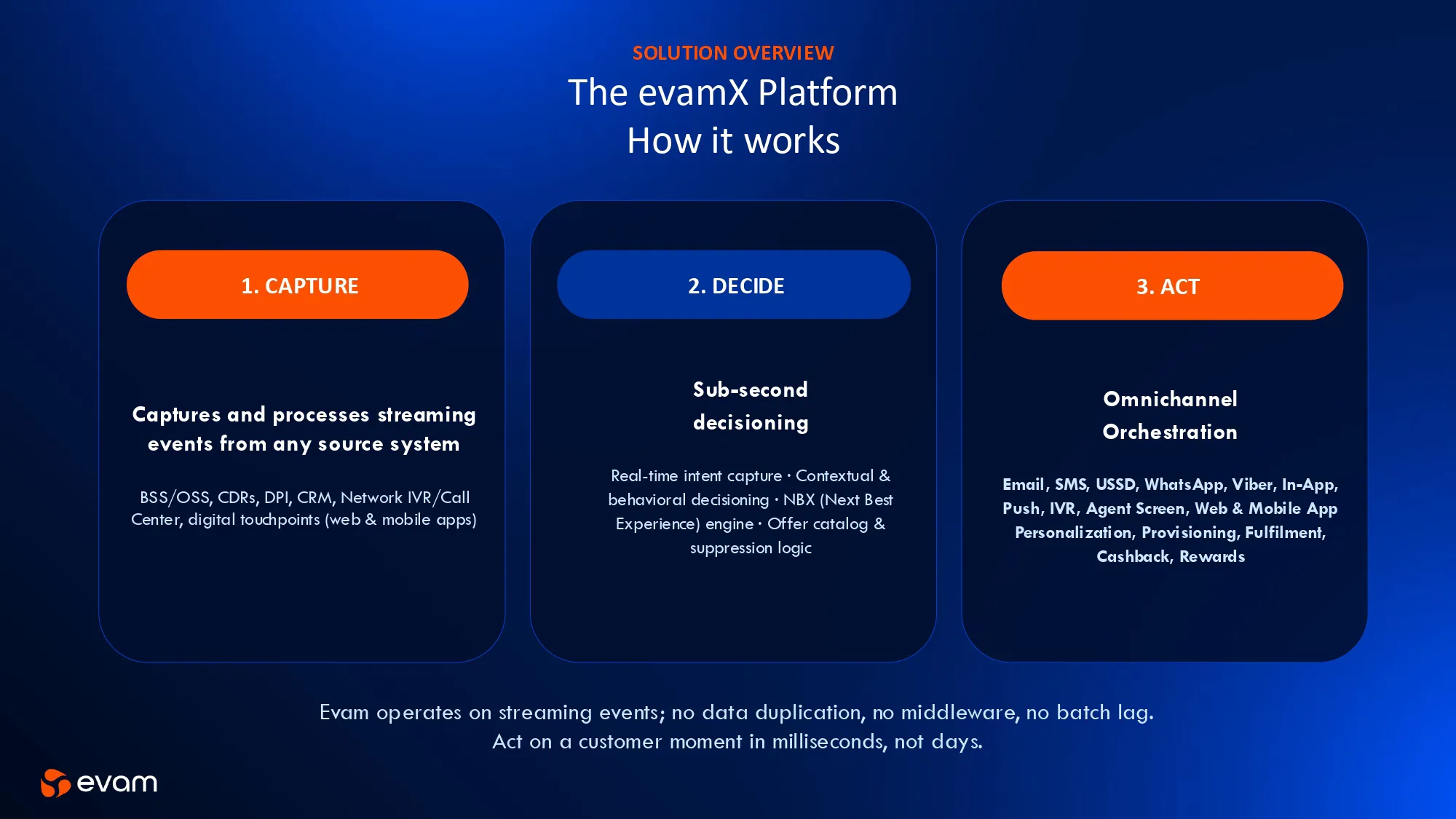
The NBX decisioning engine evaluates each customer event against full live context in milliseconds: active journeys, product holdings, behavioral history, predictive model scores, eligibility rules, and suppression logic. The output is the next best action for this specific customer at this specific moment, delivered immediately through whatever channel they are currently using, from a single orchestration layer.
When a customer raises a complaint, the promotional journey pauses. When a customer converts, every related pending action closes simultaneously. Every channel reflects the same decision because every channel connects to the same decisioning layer, not to a separate campaign system with its own data refresh cycle.
Business teams build and modify journey logic through a visual Journey Designer without IT dependency. Maker Agent translates natural-language campaign briefs into fully configured journey logic in minutes. Evo AI monitors performance continuously and surfaces where adjustments will improve outcomes without waiting for a manual review cycle.
evamX connects to existing enterprise infrastructure through pre-built connectors and a zero-copy streaming layer, with deployment options across cloud, private cloud, on-premise, and hybrid environments.