
 Evo AI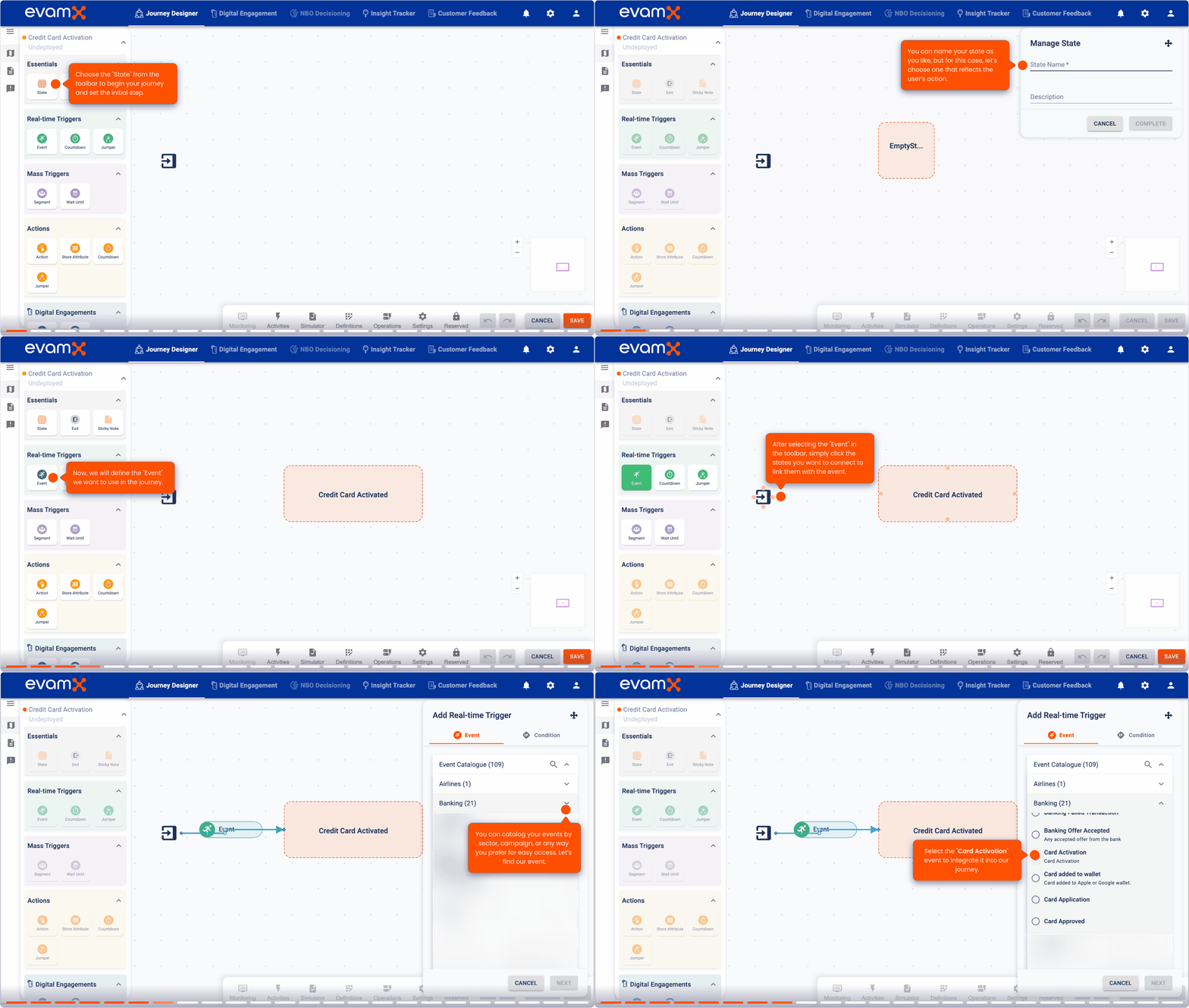
Share Post
Table of Contents
- Why "AI-Powered" Doesn't Mean the Same Thing Twice
- What a Real AI Decisioning Engine Actually Does
- How Seven Platforms Compare
- How Seven Platforms Compare on AI Decisioning
- Where Evam Fits, and Where It Doesn't
- Where to Go Next


Summarize with AI


Every customer journey orchestration platform now claims AI. Open any vendor's homepage and the word appears within the first screen, usually paired with a proprietary-sounding name. That branding exercise has made the category harder to evaluate, not easier, because two platforms can both say "AI-powered" while doing almost nothing alike underneath.
The real question is not whether a platform has AI. It is what that AI is actually deciding. Some platforms use AI to predict the best time to send a message a marketer already built. Others use AI to decide, in real time, what the next action should be at all. Those are different jobs, and for a bank or telecom operator managing high-volume, compliance-sensitive decisions, the difference determines whether the platform can do the work or just schedule around it.
What a Real AI Decisioning Engine Actually Does
A real-time decisioning engine evaluates a live customer signal and picks the next action within milliseconds, based on rules and models that run at the moment of interaction, not a batch job from the night before. It typically works through a few checks in sequence: is this customer eligible for an offer, should any active suppression rule block it, which eligible option has the highest priority right now, and through which channel should it actually be delivered.
Predictive AI, the kind most orchestration platforms ship today, does something narrower. It looks at historical patterns to guess when a customer is most likely to open a message, which channel they respond to best, or which audience segment they belong to. That is genuinely useful for timing and targeting, but it is not the same as deciding what happens next from a live event. A churn-risk score computed overnight is not a decision made in the moment a customer abandons a transaction.
The industries that feel this gap most are the ones with the least room for a delayed decision. A retail brand coordinating email sends can usually tolerate an hour of lag. A bank evaluating a loan offer during a live session, or a telecom operator responding to a dropped call in real time, cannot.
How Seven Platforms Compare
| Platform | Named AI Layer | What It Actually Optimizes | Live or Predictive | Best For |
| Evam (evamX) | NBX decisioning engine, EVO AI Hub | What the next action should be, decided from a live event, plus AI-assisted journey building in plain language | Live, sub-second, event-driven | Regulated, high-volume industries that need live decisioning and a business team that can adjust it without engineering |
| Braze | Predictive AI | When to send and which channel to use for a message already built | Mostly predictive | Consumer app and media brands running high-volume cross-channel messaging |
| Salesforce | Einstein AI | Scoring, segmentation, and predictions layered on CRM data | Mostly predictive, depth varies by module | Teams building journeys on top of an existing Salesforce CRM |
| Adobe Journey Optimizer | Adobe Sensei | Automated decision logic for content and offer selection | Live for some flows, mainly content and offer choice | Enterprises already standardized on Adobe Experience Cloud |
| InsiderOne | Sirius AI | Content generation, segment creation, send-time and test optimization | Predictive | Marketing teams that want an AI co-pilot across content and campaign tasks |
| Iterable | Predictive AI optimization | Send-time and channel prediction for existing campaigns | Mostly predictive | Lifecycle marketing teams optimizing timing and channel at scale |
| MoEngage | Sherpa AI | Predictive engagement scoring | Predictive | Mobile-first growth teams scaling app engagement in emerging markets |
Six of these seven platforms use AI mainly to predict and optimize around a journey a person already designed. That is a real capability, and for a brand whose decisions can wait a few minutes, it is often enough. It is a different capability from deciding the action itself, live, from an event that just happened.
Where Evam Fits, and Where It Doesn't
Evam's NBX engine is built to make that live decision, not just time or target around one. It runs the eligibility, suppression, priority, and delivery sequence on a live signal, in milliseconds, across channels a typical marketing-first platform does not prioritize: ATM, IVR, call center, and core banking or telecom systems, alongside the standard app, web, and messaging channels. EVO AI Hub sits on top of that engine as a conversational workspace, so a marketing or CVM team can build and adjust journeys, segments, and messages in plain language instead of filing an engineering ticket.
That combination is a genuine strength for banking, telecom, and retail operators running high-volume, real-time decisions, and it is a mismatch for a brand whose orchestration needs stop at predictive send-time optimization for app push and email. A team in that position is usually better served by one of the platforms above built specifically for that job.
Our customer journey orchestration platform page covers the full NBX architecture, and our pieces on how a real-time decisioning engine actually works and building a live journey in EVO AI Hub go deeper on each half of this comparison.
How evamX Supports AI-Native Decisioning
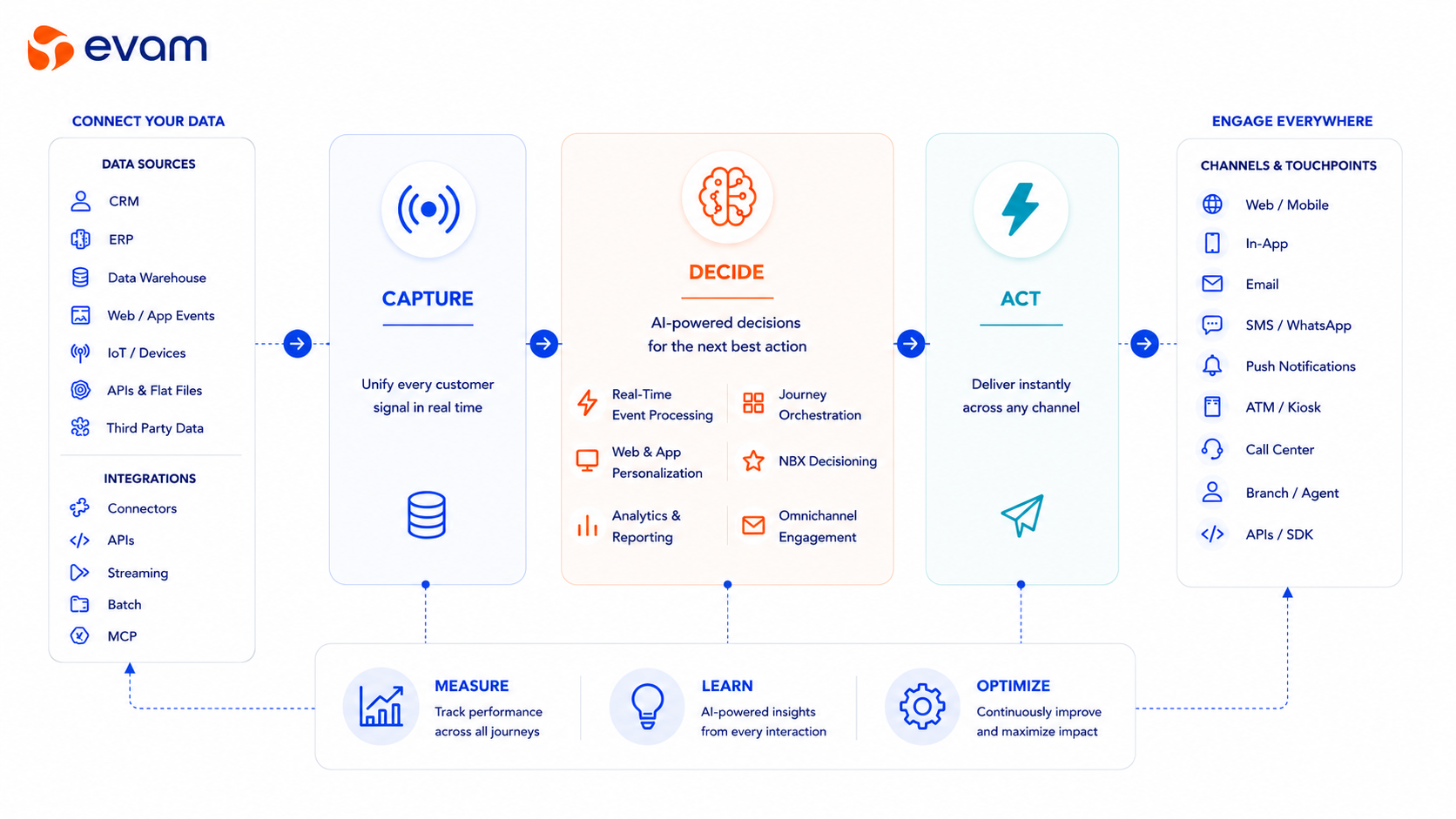
Most of the platforms compared above apply AI after a journey is already designed, to decide when and where to send it. evamX applies AI before that point, to decide what the next action should be in the first place.
The NBX engine is the part of evamX that makes this decision. For every live customer event, it runs four checks in sequence. Eligibility confirms the customer actually qualifies for a given offer or message. Suppression blocks anything that conflicts with a compliance rule, a recent contact, or another active journey. Priority ranks the eligible, non-suppressed options against each other so only the single best one survives. Delivery picks the channel, whether that is app, web, SMS, email, ATM, IVR, or call center, and executes the decision. All four checks run on the live event itself, not on a schedule, which is what makes the decisioning real-time rather than predictive.
EVO AI Hub is where a business team works with that engine without needing an engineer. Inside it, a CVM or marketing manager can describe a journey or a rule change in plain language, get it drafted, and adjust the logic that NBX runs, including eligibility and suppression conditions and channel priority. Journey Designer on top of EVO AI Hub lets that same team assemble the broader, multi-step journey the decisioning engine operates inside.
For a bank or telecom operator, this means the AI in the platform is not a layer that guesses when to send a campaign someone already built. It is the layer deciding, event by event, whether to act at all, what to offer, and where to deliver it, while staying inside the eligibility and suppression rules a regulated business has to enforce.
Where to Go Next
The honest way to tell these platforms apart is not by reading their homepage. It is by asking what their AI is actually deciding: a send time and a channel for a message a person built, or the action itself, live, from an event that just happened.
If you want to see how real-time AI decisioning performs against your own customer data, our team is glad to walk through it with you. Reach out through our contact page.