
Share Post
Table of Contents
- What Customer Journey Automation Actually Means
- Where Pre-Planned Journeys Break Down
- The Role of AI in Journey Automation
- What Journey Orchestration at Scale Actually Requires
- The Organizational Impact of Genuine Automation
- evamX: Customer Journey Automation Built for Real-Time Engagement


Summarize with AI


Most customer journey automation is not actually automated. It is pre-planned.
A marketing team sits down, maps a sequence of interactions: welcome email on day one, follow-up SMS on day three, push notification if no response by day five, and programs that sequence into a platform. The platform executes it reliably, at scale, across thousands or millions of customers simultaneously. That is a real capability, and it is genuinely valuable. But it is not automation in any meaningful sense of the word. It is scheduled delivery with conditional branching.
The distinction matters because the gap between pre-planned journey execution and genuine journey automation is where most of the unrealized value in customer engagement sits. Pre-planned journeys are designed around anticipated scenarios. Real customer behavior is rarely so cooperative. Customers do not always follow the path the journey assumes. They act at unexpected moments, in unexpected contexts, with needs that no planning session fully anticipated. A pre-planned journey can handle the scenarios it was designed for. Genuine customer journey automation can handle the ones that were not.
What Customer Journey Automation Actually Means
Genuine customer journey automation has three characteristics that distinguish it from scheduled campaign execution.
The first is event-driven triggering. Rather than a journey beginning because a date has been reached or a segment has been refreshed, it begins because something happened. A customer opened the app. A transaction was declined. A subscription renewal date is approaching and engagement has dropped. A product was browsed three times in a single session. Each of these events carries intent information, and a genuinely automated journey system responds to that intent in real time, without waiting for the next scheduled run.
The second is dynamic path determination. In a pre-planned journey, the path is fixed: step A leads to step B unless condition C is met, in which case it leads to step D. The logic is explicit and static. In a genuinely automated journey, the next step is determined at the moment the customer arrives at it, based on their current context, not based on logic written weeks ago. A customer who has changed significantly since the journey began, who has made a purchase, raised a complaint, upgraded their plan, or simply shifted their behavior, is routed differently than a customer whose context remains the same. The journey adapts to the customer rather than requiring the customer to fit the journey.
The third is continuous learning. A pre-planned journey performs the same way on the thousandth execution as it did on the first, unless a human manually reviews the performance data and updates the logic. A genuinely automated journey system learns from outcomes: which paths converted, which messages drove engagement, which timing windows performed better than others. This learning feeds back into future decisions automatically, improving performance without requiring a new planning cycle.
These three characteristics, event-driven triggering, dynamic path determination, and continuous learning, are what separate customer journey automation from customer journey scheduling. Most platforms offer the latter while marketing it as the former.
Where Pre-Planned Journeys Break Down
The failure modes of pre-planned journey execution tend to cluster around the same underlying problem: the journey was designed for a customer who no longer exists at the moment the journey reaches them.
A telecommunications operator designs a churn prevention journey triggered when a subscriber's engagement score drops below a threshold. The journey is well-crafted: a personalized retention offer, followed by a service quality check, followed by a loyalty reward if neither of the first two interactions produced a response. The problem is that the engagement score is computed weekly, the journey trigger evaluates it on Monday morning, and by the time the first message reaches the customer on Tuesday, their situation has changed. They called the contact center on Monday afternoon. They had a frustrating interaction. A retention offer arriving Tuesday morning does not feel like the brand understanding their needs. It feels like a coincidence.
The same failure mode appears in banking. A customer begins a pre-planned cross-sell journey for a savings product after showing interest on the mobile app. Three days into the journey, they make a large unexpected transfer that suggests financial stress. The journey continues on its scheduled path, delivering a savings promotion to a customer who is currently managing a cash flow problem. The message is not wrong for the customer in the abstract. It is wrong for this customer right now, in this specific context. A pre-planned journey cannot know the difference. A genuinely automated journey can.
The cost of these failures is not just a missed conversion. It is the gradual erosion of a customer's confidence that the brand understands them, and the compounding effect of that erosion on long-term engagement and retention.
The Role of AI in Journey Automation
Artificial intelligence changes what customer journey automation can do in two distinct ways.
The first is intelligence at the decisioning layer. AI enables the journey system to evaluate each step for each customer individually, drawing on predictive models, behavioral signals, and contextual data that no rule set could fully encode. Rather than asking "does this customer meet the condition for step B," an AI-driven system asks "given everything we know about this customer right now, what is the next interaction most likely to produce the outcome we want?" This produces meaningfully different results in the scenarios that matter most: the edge cases, the customers whose context has shifted, the situations that no planning session anticipated.
The second is intelligence at the creation layer. This is where the shift is most recent and most significant. Building a customer journey has traditionally required substantial technical and strategic effort: defining segments, mapping conditional logic, configuring channel integrations, setting timing rules, and testing the result before activation. For most marketing teams, this process takes days and requires coordination across multiple teams and systems.
AI changes this by making journey creation itself a conversation. A marketer describes what they want to achieve: "re-engage subscribers who have not opened the app in 30 days, starting with a personalized offer based on their last active product, and escalating to a call center prompt if there is no response within 48 hours", and the AI translates this into an executable journey configuration: segment logic, timing rules, channel sequence, message parameters, escalation conditions. What previously required a workflow design session and a development ticket can now be done in minutes.
This shift does not remove the need for human judgment. The marketer still decides the strategy. The AI handles the translation from intent to execution, and does so at a speed and consistency that fundamentally changes how frequently marketing teams can iterate.
What Journey Orchestration at Scale Actually Requires
Customer journey automation that works at the scale of enterprise telecommunications and banking operations requires more than a good interface and a capable AI model. The foundation beneath the journey layer determines whether the automation delivers on its promise.
The data foundation must be event-driven. If the journey system is drawing from a data warehouse that refreshes on a nightly or hourly schedule, the "real-time" triggers it responds to are only as current as the last refresh. A customer who just made a qualifying transaction will not enter a journey triggered by that transaction until the data pipeline catches up. In high-volume environments where customer situations change rapidly, this lag is not a minor inconvenience. It is the mechanism by which the system systematically misses the moments that matter.
The decisioning layer must be centralized. When multiple journeys are active for the same customer simultaneously, a churn prevention journey, an active service escalation, a promotional campaign, the system needs a single layer that understands all of them and ensures they do not conflict. A customer in an active service recovery journey should not receive a promotional push notification from a separate campaign running in parallel. Preventing this requires centralized journey orchestration, not independent journeys running in separate tools.
The execution layer must be truly omnichannel. A journey that can only deliver through the channels the marketing tool natively supports is a journey with artificial limits. Enterprise customer engagement spans mobile push, in-app messaging, SMS, WhatsApp, email, ATM and kiosk screens, IVR, and call center agent prompts. A genuinely automated journey system can route the same customer through different channels based on their real-time context and response, using whichever channel is most likely to be effective at each step, from a single orchestration layer.
The Organizational Impact of Genuine Automation
The shift from pre-planned journey execution to genuine customer journey automation has an organizational dimension that is at least as significant as the technical one.
When building a journey requires days of cross-functional coordination, the number of journeys an organization can maintain at any given time is limited. Most enterprise marketing teams operate with a relatively small set of active journeys, each designed to cover a broad scenario. The result is a personalization architecture that is coarse-grained: customers are routed into one of several broad journeys based on their segment, rather than into a journey that reflects their individual situation.
When building a journey takes minutes, this constraint disappears. Marketing teams can maintain many more journeys, each designed for a more specific scenario. The personalization becomes more granular because the cost of granularity has dropped. Teams can iterate faster, test more hypotheses, and respond to changing customer behavior without waiting for the next planning cycle.
This is the organizational impact that genuine customer journey automation delivers: not just faster execution of the same strategy, but the ability to operate a fundamentally more sophisticated and responsive engagement strategy than was previously feasible given the team's capacity.
evamX: Customer Journey Automation Built for Real-Time Engagement
evamX brings together the event-driven data foundation, AI decisioning layer, and omnichannel execution that genuine customer journey automation requires, in a single connected architecture.
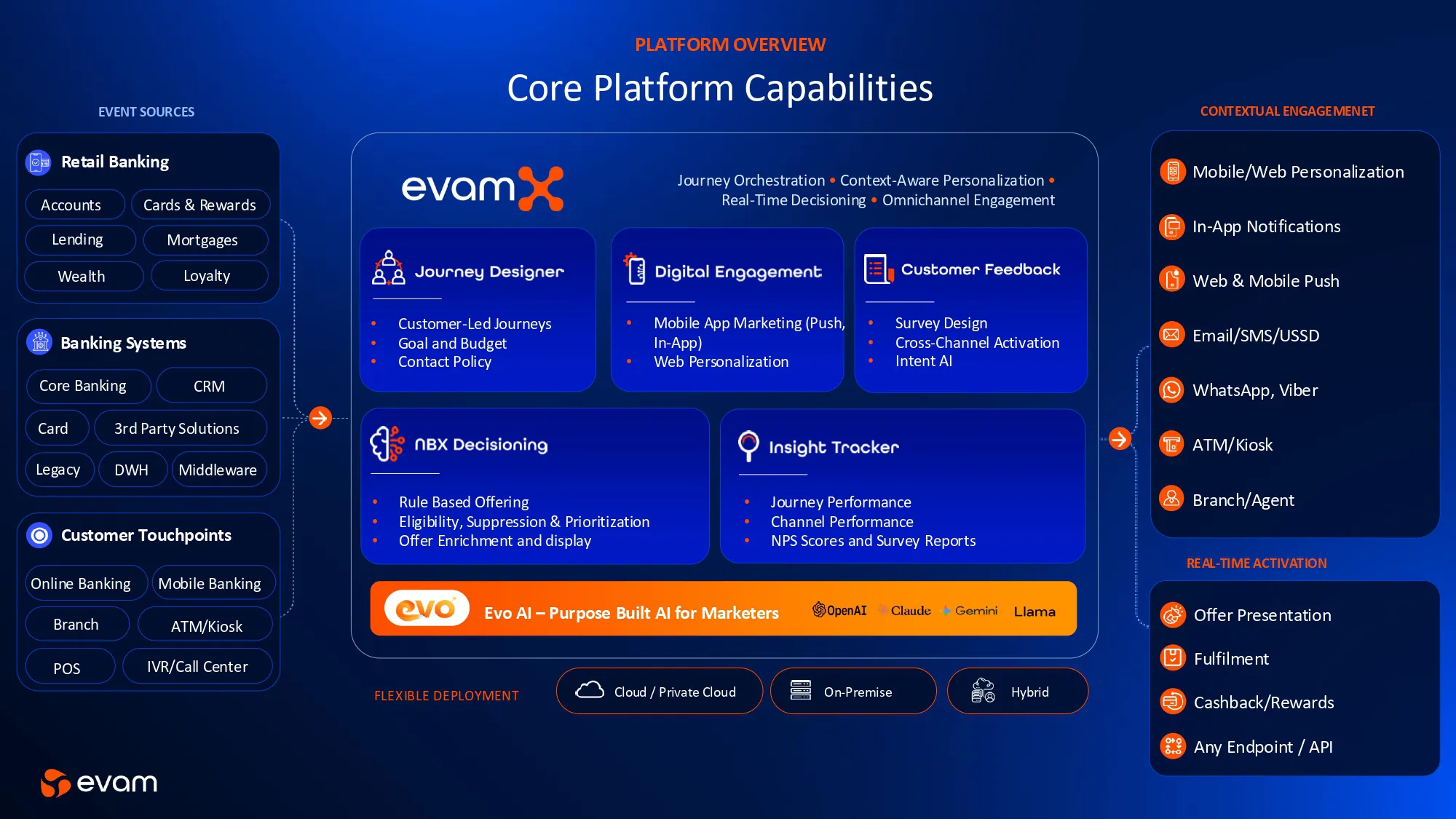
Every customer signal, from mobile and web apps, core banking and billing systems, card platforms, ATM networks, IVR, and call center infrastructure, is ingested as a live event with no batch lag. Journeys trigger the moment the qualifying event occurs, not at the next scheduled data refresh.
Maker Agent, evamX's AI journey builder, translates natural-language campaign briefs into fully configured journey logic: segment definitions, channel sequences, timing rules, eligibility conditions, and escalation paths. A journey that previously required days of configuration can be built, reviewed, and activated in minutes. Business users can create, modify, and launch journeys without IT dependency, through a visual Journey Designer that connects directly to live customer data.
The NBX decisioning engine evaluates each step of each journey for each customer individually, drawing on predictive models, live behavioral signals, and the full context of every active journey the customer is currently in. This ensures that no two journeys conflict, that promotional actions are suppressed when service recovery is active, and that every customer receives the next interaction most likely to produce the right outcome for them right now.
Evo AI continuously monitors journey performance and surfaces where adjustments will improve outcomes, closing the loop between execution and optimization without requiring a manual review cycle.