
Share Post
Table of Contents
- Business Intelligence Explains the Past. Decision Intelligence Acts in the Present.
- What Decision Intelligence Actually Requires
- Where Decision Intelligence Shows Up in Practice
- How evamX Powers Decision Intelligence in Marketing


Summarize with AI


Most marketing teams already have dashboards. Conversion rates by channel, engagement trends over time, campaign performance broken down by segment. What they usually don't have is a system that turns any of that into a decision on its own. That gap is what decision intelligence is actually about, and it's worth being precise about, because the term gets used loosely enough to mean almost any dashboard with a machine learning label attached.
Business Intelligence Explains the Past. Decision Intelligence Acts in the Present.
Business intelligence tools answer a specific kind of question well: what happened, and why. A BI dashboard can show that conversion dropped 12 percent last week, or that one channel is outperforming another this quarter. That's genuinely useful for understanding trends, but it stops at the explanation. A person still has to look at the report, interpret it, and decide what to do differently.
Decision intelligence is built to close that last step. Rather than just surfacing what happened, it combines live data, predictive models, and defined business logic to recommend, or directly trigger, the next action, and it does this continuously rather than waiting for someone to open a dashboard and notice a trend. The distinction isn't about which tool has more advanced analytics. It's about whether the system stops at insight or continues through to a decision.
This matters most for the customers a marketing team never actually gets to review manually. A human analyst can look closely at a handful of accounts or a top-line trend. A decision intelligence system can evaluate the same logic against every individual customer, continuously, at a scale no team could review by hand.
What Decision Intelligence Actually Requires
Three things separate a genuine decision intelligence capability from a dashboard with a smarter label.
It has to combine data with defined judgment, not just data with more data. Historical patterns and predictive scores are necessary inputs, but they aren't the whole decision. Business rules, eligibility constraints, and priority logic set by the people accountable for the outcome have to be part of the system, not something a marketer manually checks after the model produces a recommendation.
It has to work in real time, not on a reporting cadence. A recommendation generated from last week's data describes a customer who may no longer be in that state. Decision intelligence that actually changes outcomes has to evaluate current context, what a customer is doing right now, not a snapshot from the last scheduled analysis.
It has to close the loop into an action, not stop at a recommendation. A system that tells a marketer "this customer is likely to churn" has produced an insight. A system that evaluates that same signal and automatically triggers the right retention response, suppressing conflicting offers and selecting the channel most likely to reach that specific customer, has produced a decision. The gap between the two is usually where marketing teams lose the most value, because a recommendation still depends on someone acting on it before the moment passes.
Where Decision Intelligence Shows Up in Practice
The pattern is easiest to see where the cost of a slow or wrong decision is highest.
In banking, a customer's spending pattern shifting toward a credit limit they've been approaching for months is a decision-intelligence case, not just a data point. The system has to weigh the customer's full context, repayment history, current behavior, eligibility, against the business logic for what response actually fits, and act before the moment where a limit increase or a different product would have mattered has passed.
In telecom, usage signals, a customer running low on data mid-cycle, a pattern that resembles early churn, carry a similar shape: the raw signal is easy to detect, but deciding what to do about it, and doing it before the customer either finds a workaround or switches providers, is the harder problem decision intelligence is meant to solve.
In both cases, the value isn't in noticing the pattern. Most organizations can already do that. The value is in the system reliably converting the pattern into the right action, for every customer showing it, without a person manually reviewing each case.
How evamX Powers Decision Intelligence in Marketing
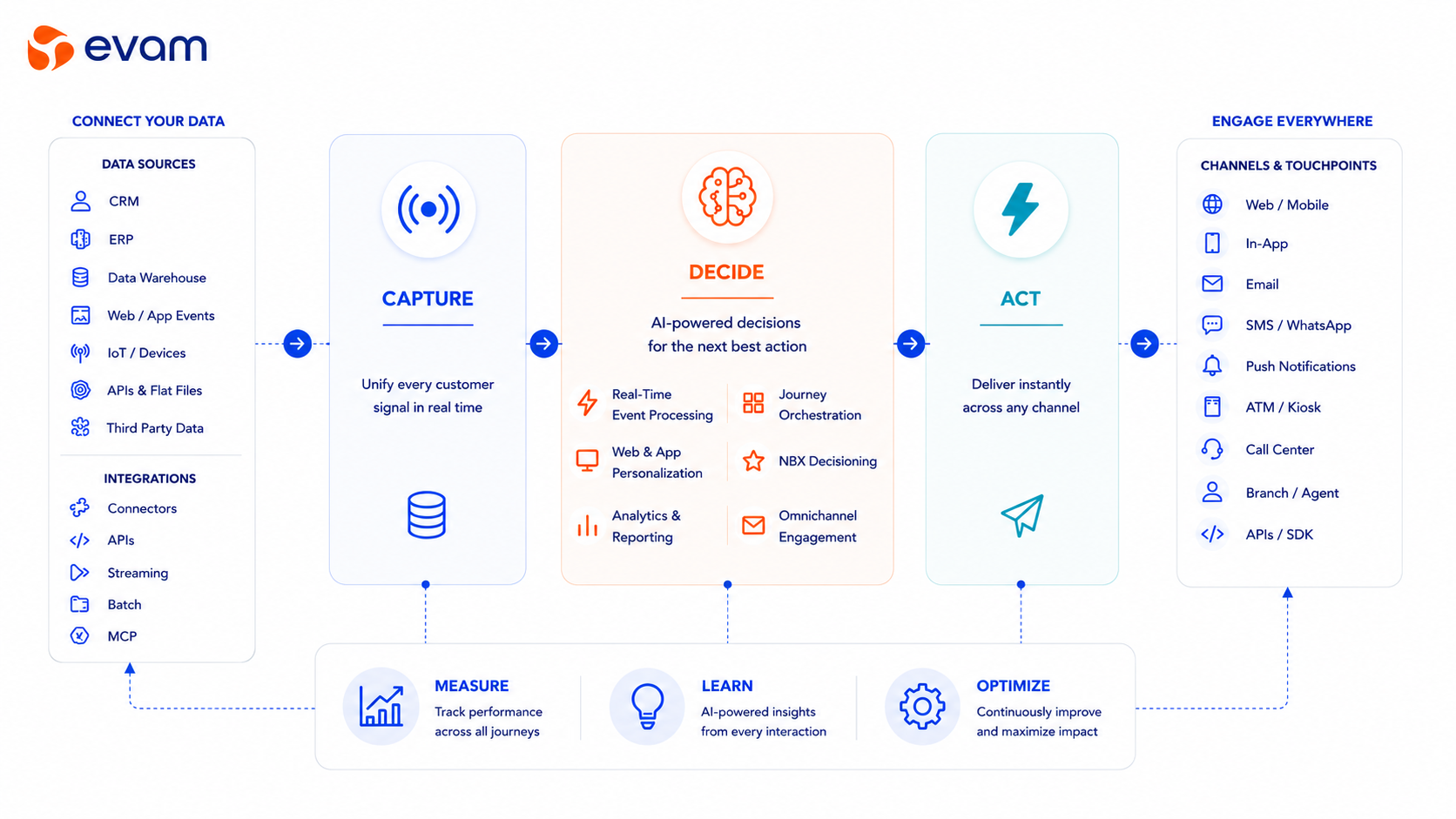
evamX is built around exactly this loop rather than stopping at analysis. The NBX decisioning engine evaluates live customer signals against eligibility rules, suppression logic, and business priority in milliseconds, so a detected pattern doesn't sit in a report waiting for a person to act on it, it becomes a decision and an action in the same moment.
Business teams retain control over the judgment layer that makes this trustworthy: eligibility rules, suppression conditions, and priority logic are configured directly through Journey Designer, not buried inside an opaque model, so the people accountable for the outcome can see and adjust the logic behind every decision. Evo AI adds a layer on top of this, surfacing which decisions are converting and where the underlying logic needs adjusting, continuously, rather than in a quarterly review.
If you want to see what closing the gap between insight and action looks like against your own customer data, our team is glad to walk through it with you. Reach out through our contact page or explore the Product Demo Hub directly.