
Share Post
Table of Contents
- What Is an Always-On AI Agent?
- Why Marketing Is Moving Beyond Task-Based AI
- Always-On Does Not Mean Uncontrolled
- Real-Time Context Is the Foundation of Relevant Agentic Marketing
- From Marketing Automation to Agentic Journey Orchestration
- Governance Must Be Built Into Every Agent Action
- How Evo AI and evamX Support This Shift
- The Next Chapter of AI Customer Engagement


Summarize with AI


AI in marketing is entering a new phase.
Until recently, most AI tools supported marketers with individual tasks. They generated campaign copy, summarized performance reports, suggested audience segments or helped build customer journeys. These capabilities made marketing teams faster, but they still relied on people to initiate and manage each task.
That model is beginning to change.
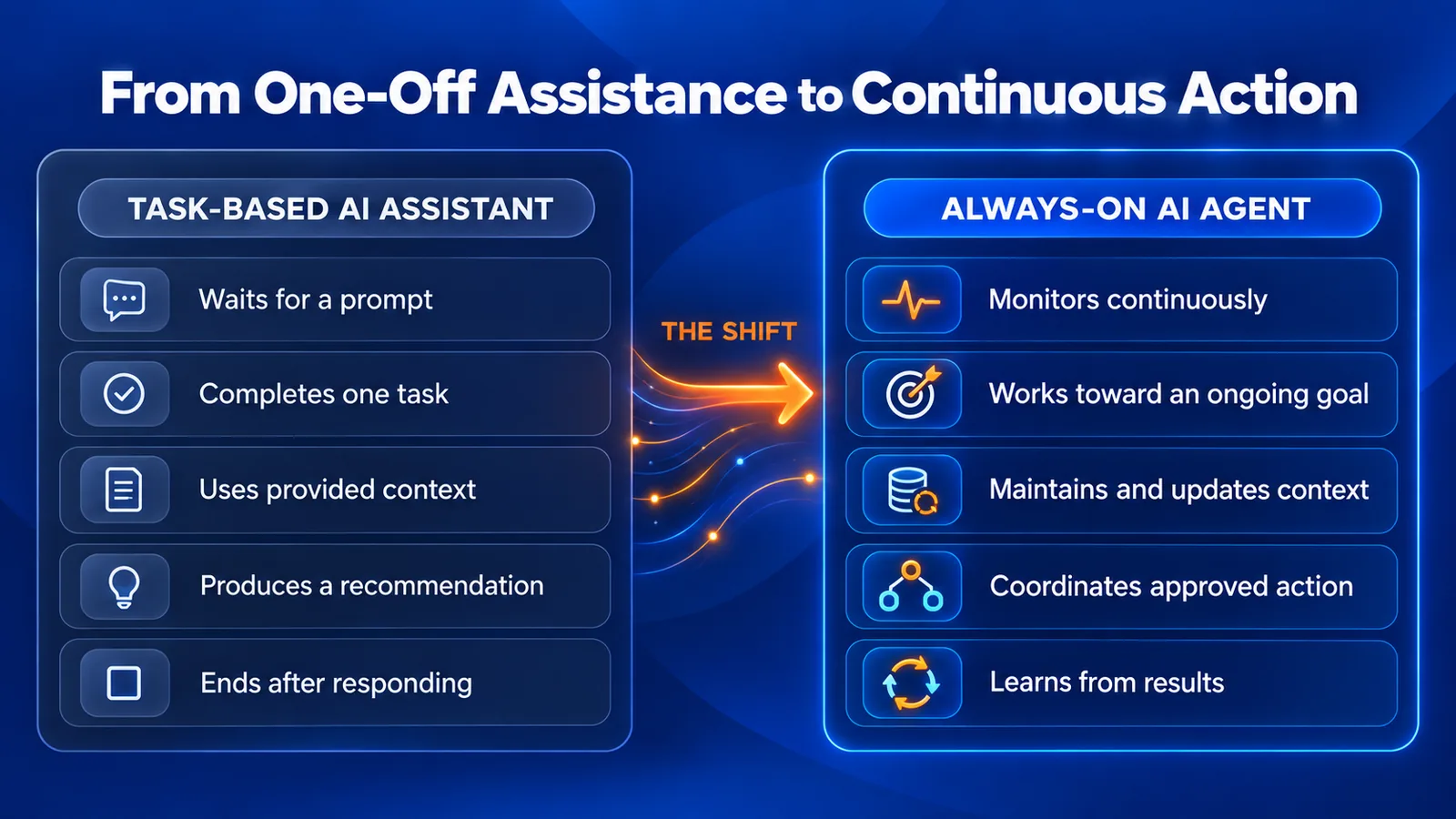
A new generation of always-on AI agents can continuously monitor information, preserve context, respond to changing conditions and work toward an ongoing objective. Instead of waiting for the next prompt, these agents can identify when something requires attention, recommend what should happen next and execute approved actions across connected systems.
For customer engagement, this represents a significant shift: from AI that assists with marketing work to AI that actively helps operate it.
What Is an Always-On AI Agent?
An always-on AI agent is more than a conversational assistant. It can remain connected to a goal, monitor relevant signals and continue working as conditions change.
In a marketing environment, an agent could:
Monitor the performance of active customer journeys
Identify unusual drops in engagement or conversion
Detect emerging customer behaviours
Recommend changes to audiences, messages or journey paths
Prepare updated content when a product or campaign changes
Coordinate work across marketing, customer data and analytics systems
Escalate decisions that require human approval
Measure the results of actions and use feedback to improve future recommendations
The key difference is continuity.
A traditional AI assistant responds to a request. An always-on marketing agent follows an objective over time.
Rather than asking an assistant to analyse a campaign after it ends, a marketing team could give an agent an ongoing objective such as improving onboarding conversion. The agent could then monitor relevant performance indicators, detect where customers are dropping out, investigate possible causes and recommend an intervention.
This moves AI closer to becoming an active member of the marketing operation.
Why Marketing Is Moving Beyond Task-Based AI
Marketing teams do not operate through isolated tasks. They manage continuous processes shaped by changing customer behaviour, business priorities, journey performance and channel conditions.
A journey that performs well today may become less effective when customer behaviour changes. A previously relevant offer may need to be suppressed after a service issue. An onboarding journey may require adjustment when a new point of friction appears. A high-value customer may need a different experience based on an interaction that happened seconds ago.
Task-based AI can help analyse each situation, but it still depends on someone recognising the change and requesting assistance.
Always-on agents address this gap by continuously observing what is happening. They can bring emerging opportunities and problems to the marketer rather than waiting for the marketer to find them.
This changes the relationship between marketing teams and AI. Marketers can spend less time directing repetitive work and more time defining:
The outcomes the business wants to achieve
The customer experiences it wants to create
The rules the organisation must follow
The actions an agent may take independently
The decisions that still require human judgement
The marketer’s role does not disappear. It moves from operating every task to setting direction, applying expertise and governing execution.
Always-On Does Not Mean Uncontrolled
The idea of an agent continuously managing customer engagement is powerful. But autonomy alone does not create a better customer experience.
An AI agent may be able to generate a convincing message or recommend an action. That does not mean the action is appropriate for a particular customer.
Before anything reaches the customer, the organisation may need to determine:
Is the customer eligible for this action or offer?
Has the customer recently rejected or dismissed it?
Is there an active complaint or service problem?
Has the customer already received too many communications?
Is this the right channel and time?
Does the action comply with customer consent and business policy?
Is another action more important at this moment?
Should a person approve the action before execution?
These decisions require more than language generation or general-purpose reasoning. They require live customer context, business rules, journey history, prioritisation and execution controls.
This is why real-time decisioning becomes more important as marketing agents become more autonomous.
Real-Time Context Is the Foundation of Relevant Agentic Marketing
Customer context changes constantly.
A customer who appeared eligible for a commercial offer in the morning may contact customer service about a failed transaction later that day. Someone who ignored an offer twice may demonstrate fresh intent by exploring the same product in the mobile application. A customer progressing through an onboarding journey may suddenly stop at one specific step.
An agent working with an outdated profile could easily recommend the wrong experience. An agent connected to real-time events can respond to what is happening now.
Effective AI customer engagement therefore depends on the ability to combine:
Real-time behavioural and transactional events
Customer profile and segment information
Current journey state
Previous customer responses
Channel availability and delivery status
Eligibility and suppression rules
Business priority and value
AI- or machine-learning-based relevance
Contextual changes occurring at the moment of interaction
The quality of the agent’s recommendation depends on the quality and freshness of this context.
An intelligent interface may understand the marketer’s objective, but a real-time customer engagement platform must determine how that objective should translate into an individual customer experience.
From Marketing Automation to Agentic Journey Orchestration
Traditional marketing automation follows predefined workflows. Marketers determine the triggers, conditions, actions and paths in advance.
Agentic journey orchestration introduces a more adaptive model.
AI agents can help teams build journeys from business objectives, interpret journey performance, identify friction and recommend improvements. Over time, they may also manage specific optimization activities within clearly defined boundaries.
For example, an agent monitoring an onboarding journey might detect that customers are repeatedly dropping out after a particular step. It could:
Analyse the affected audience and journey path.
Identify when and where the drop-off occurs.
Recommend an additional in-app message or follow-up action.
Check the proposed action against communication and eligibility rules.
Present the recommendation for approval.
Apply the approved change to a versioned journey.
Measure whether the change improves conversion.
This creates a continuous cycle:
Sense → Decide → Act → Learn
The agent helps interpret and coordinate the work. The customer engagement platform provides the context, decisioning, governance and execution required to carry it out safely.
Governance Must Be Built Into Every Agent Action
As AI agents gain greater responsibility, “human in the loop” is no longer a sufficient governance explanation.
Businesses need to know exactly:
Which actions an agent can take independently
Which actions require approval
Which actions are prohibited
What customer and business data the agent can access
Which systems and tools it is permitted to use
How each recommendation was produced
Who approved a consequential change
How an action can be paused, overridden or reversed
How outcomes are recorded and audited
These controls are particularly important in regulated and data-sensitive industries such as banking, telecommunications, insurance and healthcare.
The future of agentic marketing will not be defined by maximum autonomy. It will be defined by appropriate autonomy: the ability to act quickly within clear business, customer and regulatory boundaries.
How Evo AI and evamX Support This Shift
At Evam, we see AI agents as the intelligent interface to customer engagement—not as a replacement for real-time decisioning and journey orchestration.
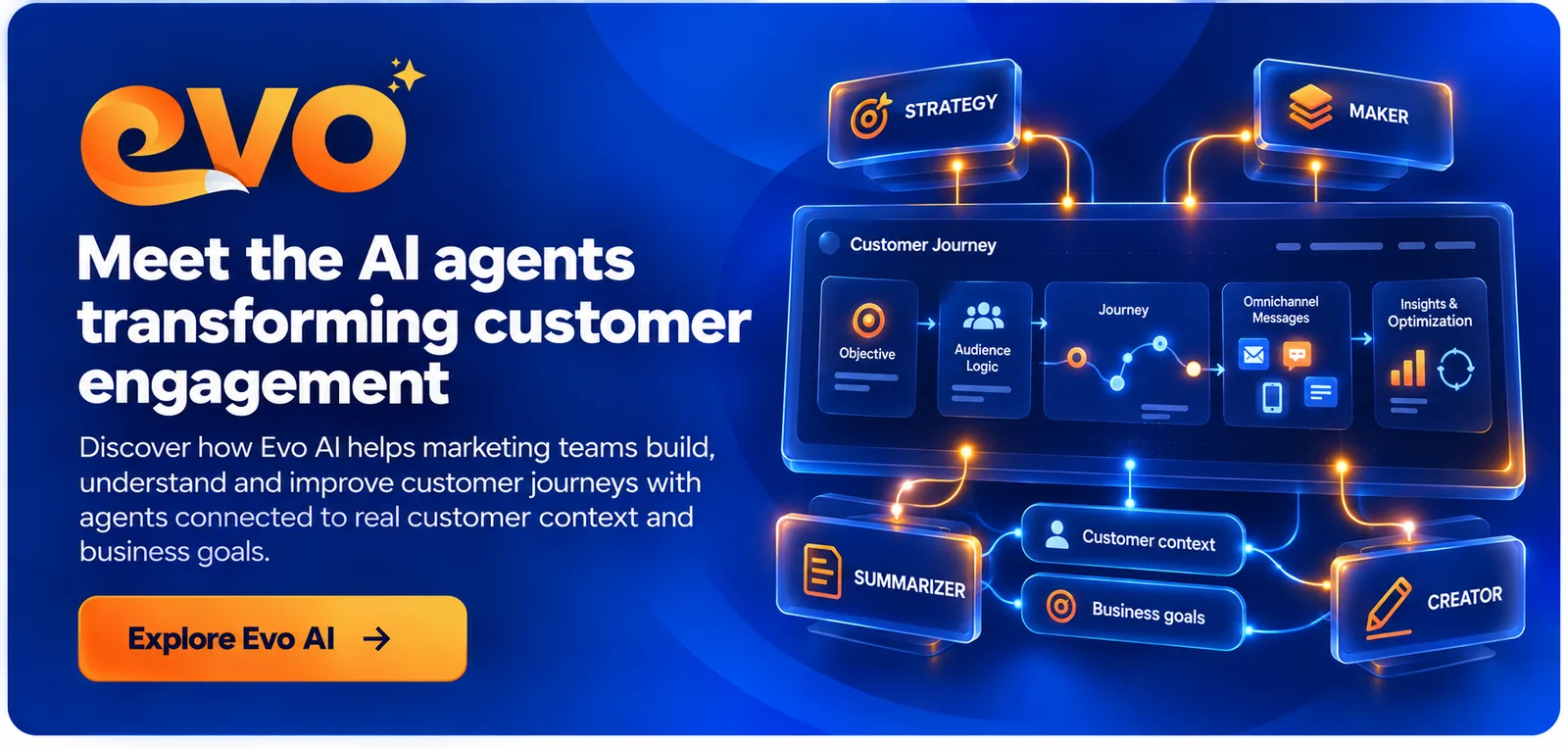
Evo AI brings together specialised agents that help marketing teams build, understand, decide and improve customer engagement. These agents can support marketers across the engagement lifecycle, from translating an objective into a journey to interpreting performance and identifying opportunities for optimization.
Underneath this agent experience, evamX provides the operational foundation required to turn intelligence into relevant action.
It processes customer activity at scale, enriches events with live context and enables actions to be triggered in milliseconds. Journey orchestration, next-best-experience decisioning and omnichannel engagement connect each recommendation to the customer’s current situation.
Together, Evo AI and evamX support a model in which:
Agents understand the marketer’s objective.
Real-time events reveal what is happening with the customer.
Decisioning evaluates eligibility, relevance and priority.
Business rules and guardrails control execution.
Journeys coordinate actions across channels.
Customer responses and business outcomes feed the next decision.
Evo AI helps marketers work with agentic intelligence. evamX ensures that intelligence becomes a relevant, governed and measurable customer experience.
The Next Chapter of AI Customer Engagement
The next stage of marketing AI will not be defined by how much content it can generate.
It will be defined by whether AI can continuously understand what is changing, determine what requires attention and help the organisation respond effectively.
Always-on marketing agents will make customer engagement more adaptive. But their value will depend on the infrastructure around them: real-time context, trusted decisioning, journey orchestration, clear permissions and measurable outcomes.
The organisations that succeed will not simply deploy more agents. They will connect agentic intelligence to a governed customer engagement platform capable of making every action relevant to the customer’s current context.
Because moving from assistance to action is only valuable when the action is the right one.