
Share Post
Table of Contents
- What Is AI Decisioning?
- AI Decisioning vs a Rules-Based Decision Engine
- How an AI Decision Gets Made
- Where Agentic Decisioning Fits
- What an AI Decisioning Platform Must Prove
- Where AI Decisioning Pays Off
- How evamX Supports AI Decisioning


Summarize with AI



Most teams use AI to score customers. Fewer use it to decide what to do next. The gap between the two is where results are won or lost.
A churn score tells you who might leave. It does not tell you what to say, when to say it or whether to say anything at all. That choice is a decision, and making it well for millions of customers, in the moment, is what AI decisioning is for.
What Is AI Decisioning?
AI decisioning for customer engagement is the use of AI to choose the best action for each customer at the moment of interaction. The action can be an offer, a service message, a reminder or no contact at all. The AI weighs what the customer is doing now, what they have done before and what the business needs, then picks one option.
The word "decision" matters. A model that predicts is only one input. A decision also needs rules, limits and a way to act on the result across channels.
This article is about decisions in customer engagement, such as which offer to show in a banking app or which message to send a mobile subscriber. It is not about credit decisioning, where AI approves or declines a loan. That field has its own risk models and regulations.
AI Decisioning vs a Rules-Based Decision Engine
A rules-based engine runs logic that people wrote in advance. If a customer meets condition A, send offer B. It is fast and easy to explain, and it works well for clear policies such as eligibility.
It struggles when choices multiply. With hundreds of offers, dozens of segments and several channels, nobody can write every rule. Rules also do not learn. They keep doing what they were told even when customers change.
AI decisioning adds a layer that ranks the options that remain and improves its choices from results. The two work together. Rules protect the business and the customer. AI finds the best option inside those limits. For a closer look at the engine side, see our article on what a real-time decisioning engine is and how it works. If you are choosing software for the offer-selection part of this loop, our piece on next best action software covers what to evaluate.
How an AI Decision Gets Made
A good AI decision follows the same order each time.
Eligibility comes first. Is this customer allowed to receive this offer? Product rules, consent and regulation apply here. No model should override them.
Suppression comes next. Did the customer already reject this offer? Did they just contact support with a complaint? Is another journey already active? Anything that fails is removed.
Then the AI ranks what is left. It estimates which option is most likely to matter to this customer now, using behavior, context and past response. Business value and priority also count.
Delivery is the last step. The winning action goes out on the channel the customer is using. If every option is weak, the best decision is to send nothing.
Every result feeds back into the next decision. That loop is what makes it AI decisioning and not a static list.
The same loop depends on fresh data. A decision made on yesterday's behavior describes a customer who has already moved on. Contextual, event-driven data is what lets the AI act while the moment is still open.
Where Agentic Decisioning Fits
Agentic decisioning is a newer idea. It describes AI agents that help run the decision process itself, not only make a single choice.
In practice, an agent can draft a journey from a goal, explain why a journey behaves as it does, watch performance for stalled steps and suggest changes to test. It works toward an objective over time, using the tools it is given.
The key point is where the agent stops. The decision layer still checks eligibility, suppression and priority. People still approve what customers will see. The agent shortens the path from a signal to a team decision. It does not replace the controls that make the decision safe.
For more on how much freedom agents should have, read our article on always-on AI marketing agents.
What an AI Decisioning Platform Must Prove
Four questions separate a real AI decisioning platform from a demo.
How fresh is the data when the decision is made? Ask for the time between a customer action and a response, in seconds. "Near real time" is not an answer.
Can the business change the logic without engineering? If every change needs a ticket, the platform will fall behind the market within a quarter.
Can it explain a decision? Banks and telecom operators must show why a customer received an offer. Look for approval steps, a full audit trail and a way to test journeys on real customer profiles before launch.
Does it respect limits by design? Suppression, frequency caps and consent checks should be part of the product. In regulated industries, GDPR and local rules such as KVKK and BDDK apply to every message.
If the answer to any of these is vague, the platform is a scoring tool with a nicer interface.
Where AI Decisioning Pays Off
The strongest results come from picking a few moments and making the decision sharper there. Turkcell, a leading telecom operator, runs more than 200 complex scenarios and more than 100 automated personalization strategies on Evam, processing 1.8 billion events a day. Doubled next-best-offer acceptance among its mobile customers is the published result.
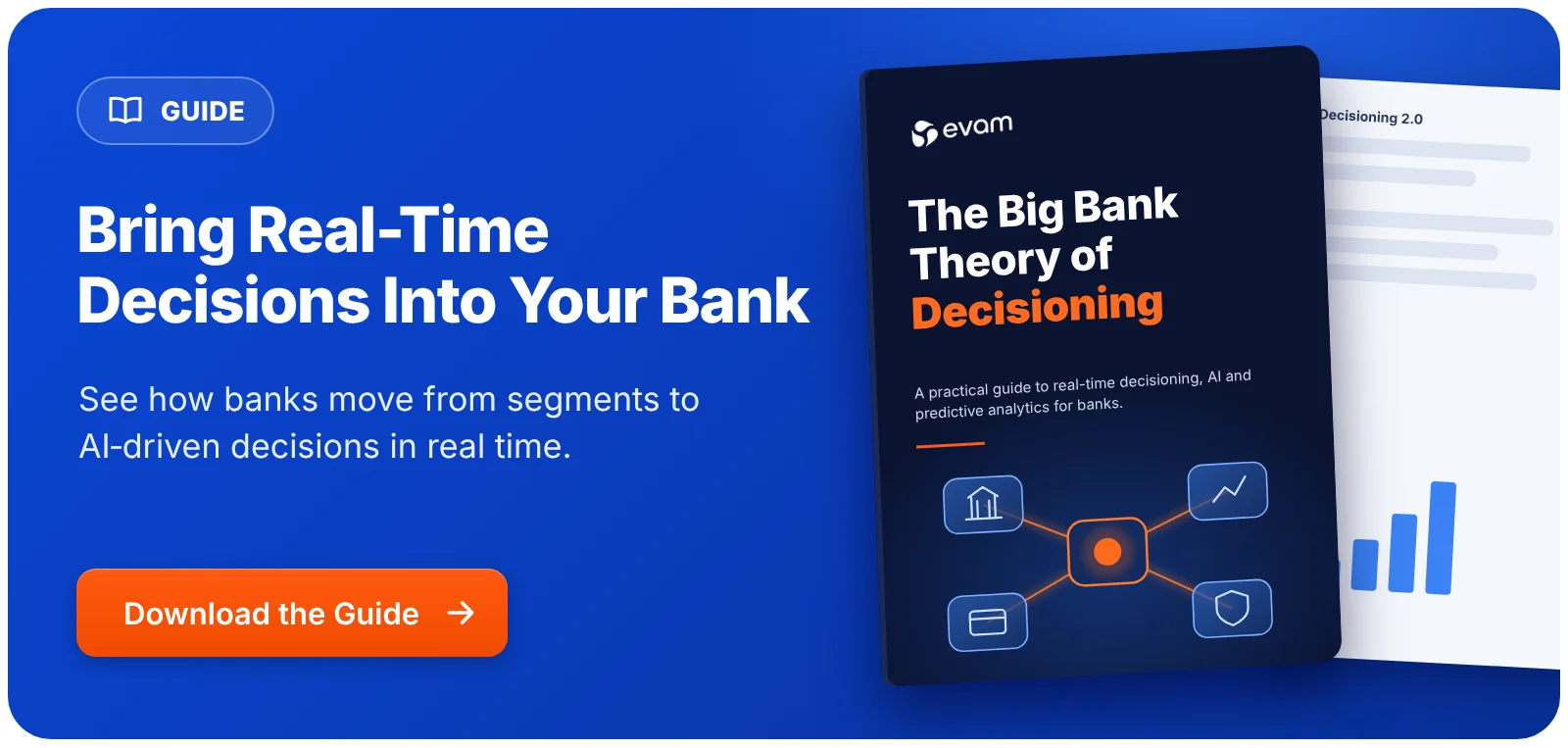
Banks follow the same pattern with onboarding, card activation and cross-sell. The cause is the same in each case. The decision moved closer to the moment of the customer's action and became specific to that customer. Our guide, The Big Bank Theory of Decisioning, looks at how banks move from segment-based decisions to proactive, AI-driven ones.
How evamX Supports AI Decisioning
evamX is built around the decision loop described above. It streams live events from the systems an enterprise already runs, so there is no need to replace the core stack. The NBX decisioning engine checks eligibility, removes what the customer rejected, ranks what is left and sends the winner on the right channel. It can also send nothing.
Business teams build and change journeys themselves with no-code tools. EVO AI Hub adds one conversational workspace where teams build journeys and segments in plain language, summarize journey performance and draft message content. Four-eyes approval, a simulator that tests journeys against real customer profiles before launch and a full audit trail keep every decision explainable.
evamX runs customer engagement for operators and financial institutions in 18 countries, delivering more than 200 million personalized experiences a day. The real-time customer engagement platform page covers the architecture, and Turkcell's story shows the approach in a live telecom program.
If you want to see where AI decisioning would pay off first in your own data, our team is glad to walk through it with you. Reach out through our contact page.