
Share Post
Table of Contents
- A Customer, a Credit Limit, and a Decision Most Banks Get Wrong
- What Customer Value Management Actually Is
- The Real Cost of Managing Products Instead of Relationships
- From Cross-Sell to Full Relationship: What Actually Changes
- What This Looks Like When Banks Get It Right
- The Numbers Worth Watching
- Where Judgment Matters as Much as Speed
- Building It Without Rebuilding Everything
- How evamX Supports Customer Value Management in Banking


Summarize with AI


Picture a customer with two years of on-time repayments. For the past three months, their card spending has been landing close to the credit limit almost every cycle. Nothing about the account looks risky. If anything, it looks like a customer who's outgrown their current limit.
At most banks, nothing happens. The signal sits in a transaction table until someone runs a quarterly report, by which point the moment has usually passed and the customer has either found the room they needed elsewhere or simply adjusted their spending down. A smaller number of banks catch it differently: the next time that customer opens the mobile app, a limit increase offer is already there, sized to match exactly what their spending has been telling the bank for three months.
Same customer. Same signal. Very different outcome. That difference is what customer value management is actually about, and it has very little to do with how many products a bank sells.
What Customer Value Management Actually Is
Customer value management, CVM, is the discipline of getting more value out of an existing customer relationship by understanding what a customer is doing, anticipating what they'll need, and responding with the right product or service at a moment that actually matters to them.
It's easy to confuse this with cross-selling, and many banking CVM programs never grow past that confusion. Cross-selling asks "what else can we sell this customer." CVM, done properly, asks a different question: "given everything this relationship currently looks like, what's the single best thing to do next, and is that even a sale at all?" The second question is harder, and it's the one that actually determines whether a customer relationship deepens over years or stalls at whatever product mix they started with.
The Real Cost of Managing Products Instead of Relationships
Most retail banks still run customer management the way they always have: a checking account gets opened, a card gets attached, and from there the relationship is measured almost entirely in balance and attrition. Everything else, whether that customer might want a savings product, whether their spending pattern signals a loan need, whether they're one bad support call away from leaving, tends to live in a report someone reviews weeks after the fact.
The problem isn't a lack of data. Most banks have more transaction and behavioral data than they know what to do with. The problem is that a customer's real financial life doesn't wait for the next scheduled review. A large transfer moving toward a competitor, a loan calculator opened three times in a week, a support call about the same unresolved issue for the second time, none of these show up as a "churn risk" in a monthly model. They show up as ordinary activity, right up until the customer is gone.
This gap gets more expensive every year, for a simple reason: the products customers hold have multiplied. A customer who used to have just a checking account now has a savings goal, a card they're actively using, and possibly a loan decision sitting somewhere in their near future. Each of those is a live signal a bank could be acting on. Most banks are still built to notice them a quarter too late.
From Cross-Sell to Full Relationship: What Actually Changes
Banks that get this right aren't running better cross-sell campaigns. They've changed what they're actually managing, and that change touches three things at once.
What gets measured changes first. Instead of tracking a single account's balance and hoping it grows, the relevant number becomes how many products a customer holds, how much of their total financial activity the bank actually captures, and how deep that relationship runs relative to a competitor's reach into the same customer.
How decisions get made changes next. Static segments built from last quarter's data give way to live evaluation: not "which segment does this customer belong to," but "what does this specific customer's activity, right now, actually suggest." A batch process can tell you who was worth targeting last month. Only a real-time layer can tell you who's worth acting on today.
Who gets to act changes last, and it matters more than it sounds. If every new trigger or eligibility rule requires an engineering ticket, the gap between noticing an opportunity and doing something about it stays wide no matter how good the underlying data is. The banks moving fastest have put that control directly in the hands of the CVM and marketing teams who actually own the relationship, without losing the audit trail and approval controls a regulated business requires.
What This Looks Like When Banks Get It Right
Kapital Bank, Azerbaijan's largest financial institution, runs 96 active real-time scenarios against more than 2 million customer events a day. The results show up directly in the relationship metrics that matter: a 16 percent lift in incremental deposit sales, a 2.5 percent increase in cash loan sales, and app downloads from first-time users up 15 percent, growth that came from matching signals to responses in the moment, not from a bigger campaign budget.
ABB Bank scaled a similar approach without growing its team to manage it. More than 40 active real-time scenarios now reach 1.5 million customers a month, and in a single three-month window the bank generated 25 million AZN in cash loan sales, largely by making sure the right offer reached the right customer while their situation still matched it.
Home Credit Kazakhstan used the same underlying idea to solve a different problem: reactivating customers who had gone quiet. Real-time, event-based engagement drove a 6x lift in conversion among dormant customers, not through a bigger discount, but by reaching them the moment their behavior signaled renewed interest. As the bank's own Director of Customer Value Management put it, the value wasn't in having the data. It was in how fast an idea could reach the customer once the data said something worth acting on.
The Numbers Worth Watching
A bank that's actually managing customer value, rather than just running campaigns against it, tends to watch a specific set of numbers.
Product penetration, how many products the average customer holds, is the clearest early signal of how anchored a relationship actually is. Share of wallet, how much of a customer's total financial activity the bank captures versus a competitor, reframes the conversation away from a single account balance toward the full relationship. Journey velocity, the time between a signal appearing and a response reaching the customer, is often the single biggest lever a bank has: a limit-increase offer that takes three months to reach a customer has usually missed the reason it was relevant in the first place. And cross-sell conversion rate, tracked properly, is the metric that tells a bank whether its CVM program is actually deepening relationships or just generating activity.
Where Judgment Matters as Much as Speed
Not every signal should trigger an offer, and this is where a lot of otherwise well-built CVM programs go wrong.
A customer who has called support twice in two weeks about the same unresolved problem is, technically, still eligible for whatever cross-sell offer a propensity model ranks highest for them. Showing it anyway is a mistake most automated systems will happily make, because nothing in the model knows the difference between a customer who's ready to buy and a customer who's frustrated. A well-built CVM system recognizes that the right response, in that specific moment, isn't a product at all. It's acknowledgment that the issue matters more right now than anything the bank is trying to sell.
This is really the same discipline as the credit-limit example from the start, just from the other direction. Sometimes the signal says yes, and the job is to show up with the right offer before the customer moves on. Sometimes the signal says not yet, and the job is knowing when to stay quiet. Both require the same thing: a system that's actually looking at what's true about this customer right now, not a segment they were assigned to weeks ago.
Building It Without Rebuilding Everything
None of this requires a bank to replace its core systems or its existing analytics investment. The banks that get real-time CVM off the ground fastest tend to follow roughly the same path: pick one or two moments where the signal is already available and the business case is easy to measure, a credit-limit pattern, a large transfer in progress, a repeat support contact, prove the response works with a proper control group, and only then expand.
That sequencing matters more than the technology choice. A single well-executed moment, measured honestly against a group that didn't get the real-time treatment, tends to build the internal case for expanding the approach far more effectively than a broad rollout ever does.
How evamX Supports Customer Value Management in Banking
evamX is built around the same architecture the examples above depend on: continuous event capture from core banking, card transactions, mobile and web apps, ATM networks, and the call center, evaluated the moment it happens rather than on a batch schedule.
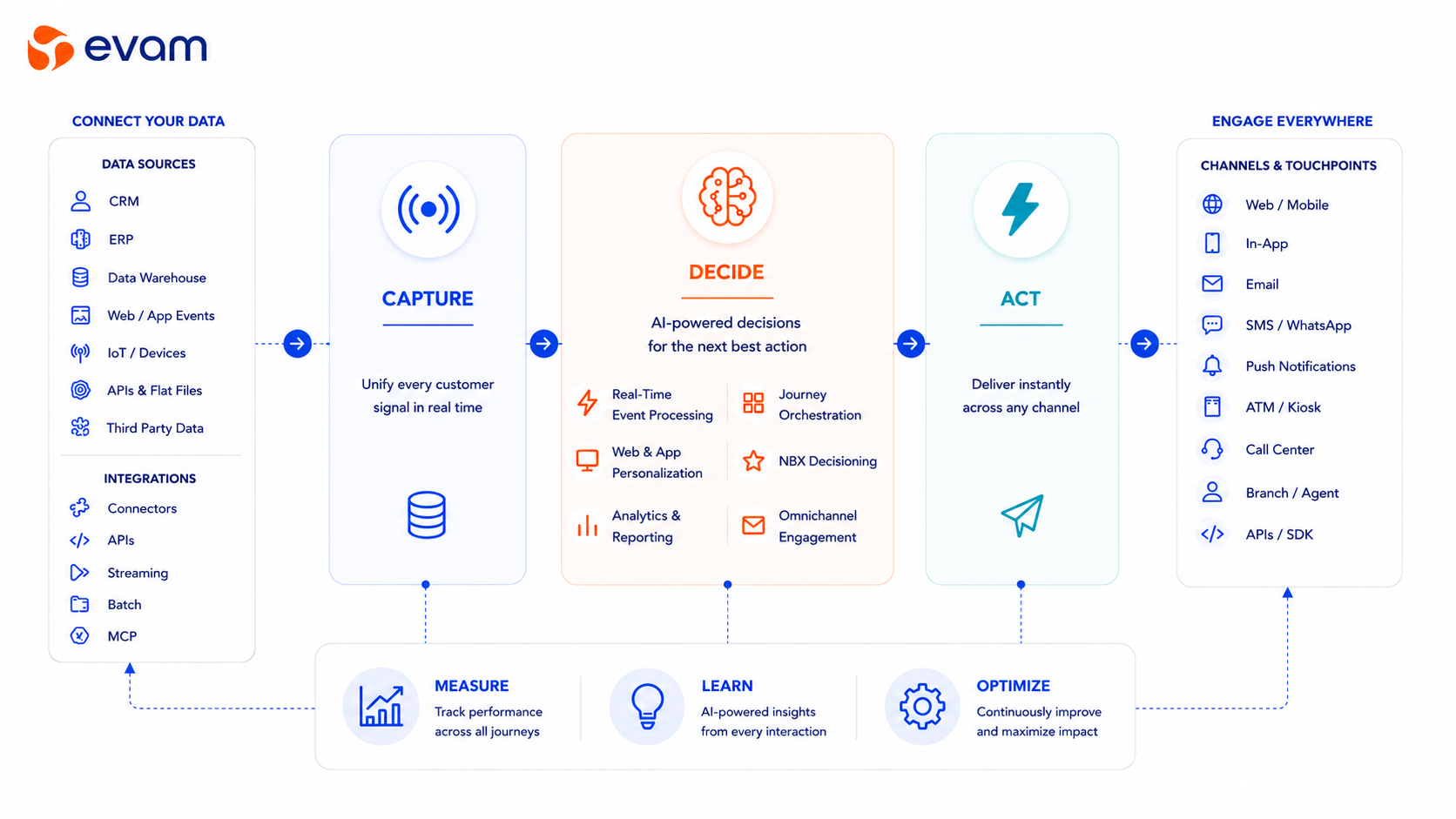
The NBX decisioning engine checks eligibility, applies suppression where it should, and ranks what's left by priority, all in milliseconds, so a decision reflects what's actually true about a customer right now. That decision then reaches the customer through whatever channel they're using, push, SMS, in-app, ATM, or an agent's screen, from one coordinated layer, so a decline on one channel doesn't get repeated on another minutes later. Journey Designer puts the configuration of these rules directly in the hands of CVM and marketing teams, with the four-eyes approval, simulation, and audit trail a regulated environment requires built into the same workflow, not bolted on afterward.
Kapital Bank, ABB Bank, and Home Credit Kazakhstan are all running some version of this today. The results look different in each case, deposit growth, loan sales, dormant reactivation, but the underlying discipline is the same: notice what's actually happening, and be fast enough, and disciplined enough, to do something about it while it still matters.
If you want to see what this looks like against your own customer relationships, our team is glad to walk through it with you. Reach out through our contact page or explore the Product Demo Hub directly.