
Share Post
Table of Contents
- What Is Agentic AI in Telecom?
- Two Layers: Network and Customer
- Four Jobs for AI Agents in Telecom Marketing
- Why AI Agents in Telecom Need a Decision Layer
- How Much Autonomy Is Right?
- How to Start With Agentic AI in Telecom
- How evamX Supports Agentic AI in Telecom


Summarize with AI



Most talk about agentic AI in telecom is about networks. Self-healing, self-optimizing, autonomous. That story is real, but it is only half of the industry. The other half is the customer: the top-up that did not go through, the bundle that no longer fits, the app session that ends before the offer appears.
This article covers that second half. It explains what AI agents can do for telecom customer engagement today, where they fall short, and how much freedom they should have.
What Is Agentic AI in Telecom?
Agentic AI is AI that works toward a goal using context and tools, not just a single prompt. A chatbot answers a question. An agent takes a defined task, looks at the data it is allowed to see, and produces a result, such as a draft journey, a summary or a recommendation.
In telecom, this matters because the work never stops. Customers top up, run out of data, call care, switch plans and go quiet. Each signal changes what the best next step is. Teams cannot read every signal by hand, and that gap is where AI agents in telecom help.
An agent is not a replacement for the people who run marketing. The marketer sets the goal, checks the logic and approves anything the customer will see. The agent shortens the path between a signal and a decision.
Two Layers: Network and Customer
Agentic AI in telecom works in two different layers, and they solve different problems.
The network layer covers fault detection, capacity planning and service assurance. The data is technical, the actions stay inside the operator, and the customer rarely sees the result directly.
The customer layer covers offers, retention, onboarding, care and feedback. The data is behavioral, the actions reach customers on their phones, and a wrong move costs trust. This layer needs more than a smart model. It needs rules on eligibility, consent, timing and frequency.
Because the risks differ, the controls should differ too. An agent that tunes a cell tower and an agent that messages a customer should not share the same level of freedom.
Four Jobs for AI Agents in Telecom Marketing
In customer engagement, agents are most useful when each one has a narrow job. Four jobs cover most of the value.
Build. An agent turns a goal into an editable journey. A marketer types "reward customers who top up often and are active in the app," and the agent drafts the audience, the steps and the channel messages. The team edits the draft before anything goes live.
Understand. An agent explains a journey in plain language. It lists the audience, the timing, the branches, the suppressions and the exits. This helps in large operators, where a journey built by one team is often inherited by another. A person can read the summary in a minute instead of tracing the canvas.
Monitor. An agent watches journey performance and flags what changed. A retention journey may show an unusual drop between two steps. The agent points to the step, summarizes what moved and suggests where to look. It does not decide the cause. The team checks the data.
Improve. An agent turns what it observed into a suggestion the team can test. It might propose a shorter follow-up or a different channel order. The team picks the test and measures the result against a baseline.
Notice what these jobs have in common. Each one ends with a person. That is by design.
Our guide on AI agents in marketing automation walks through these four jobs with example journeys across acquisition, engagement, care and retention, including a telecom case.
Why AI Agents in Telecom Need a Decision Layer
An agent can write a good message. That does not mean the message should be sent.
Before any action reaches a customer, a set of checks has to pass. Is the customer eligible? Did they already reject this offer? Have they given consent for this channel? Is it the right time? Are they already in another journey with higher priority? Does a frequency cap apply?
These checks are not a job for the agent. They belong to a decision layer that sits between the agent and the customer. The agent suggests. The decision layer tests the suggestion against eligibility, suppression, consent, channel, timing and priority, then ranks what is left.
Without that layer, more agents mean more noise. Three teams with three agents can message the same customer on the same day, and the customer sees a company that does not know itself.
The decision layer also needs fresh data. A signal that arrives a day late describes a customer who has already moved on. A top-up that failed ten minutes ago is a service moment. A top-up that failed yesterday is a churn risk. This is why contextual, event-driven data sits underneath every useful agent. We cover the same idea in our piece on always-on AI marketing agents.
Telecom operators have already seen what this foundation does. Onic, a digital-first operator, moved from calendar-based campaigns to behavior-triggered journeys and reported 44 percent higher engagement, campaigns built twice as fast and a 1.2 percent drop in churn among customers inactive for 90 days. That was a decision-layer result, not an agent result. It shows the base that agents should be added to, not a replacement for it.
How Much Autonomy Is Right?
The goal is appropriate autonomy, not maximum autonomy.
For each agent action, an operator should be able to answer six questions. Which actions can the agent take alone? Which need approval? Which are never allowed? What data and systems can it reach? Who approved each change? Can an action be paused, overridden, reversed and audited?
A simple rule works well. Let agents act alone on internal, reversible work, such as drafting and summarizing. Require approval for anything customer-facing. Block anything that touches pricing, consent or regulated content unless a person signs off.
Telecom is a regulated, data-sensitive industry. Consent rules and local frameworks such as GDPR and KVKK apply, and regulators ask operators to explain why a customer received an offer. An approval step, a simulation of the journey before launch and a full audit trail are not extras. They are what makes agentic AI usable at scale.
How to Start With Agentic AI in Telecom
Start narrow. Pick one journey where the team already feels pain, such as top-up recovery, plan upgrade or 90-day inactivity.
Record the baseline first. Measure how long a journey takes to build, how much review it needs and how it performs today. Then let an agent assist with one job, such as building the first draft or monitoring progression.
Measure two things. The first is the work: preparation time, review effort and the time before the team notices a meaningful change. The second is the outcome: customer movement through key steps, response, opt-outs and the effect of each test against a control.
Faster production is useful only when journeys also become easier to review and perform better. If an agent saves hours but the team spends the same hours correcting its output, the gain is not real.
Then widen the scope one job at a time, with the same checks in place.
How evamX Supports Agentic AI in Telecom
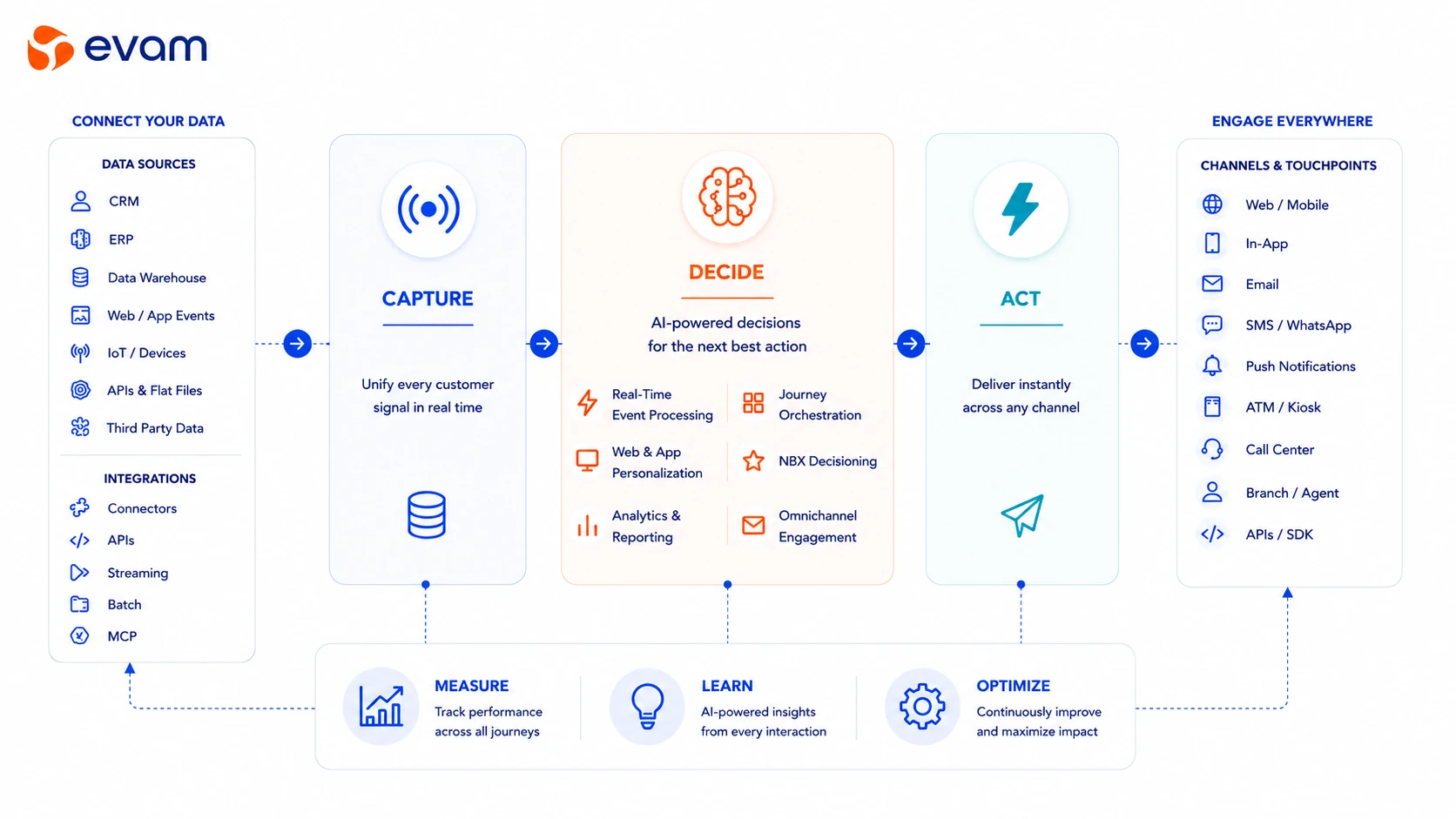
evamX gives agents the foundation they need. It captures events as they happen from billing, the app, the network and care. The NBX decisioning engine checks eligibility, removes what the customer rejected, ranks what is left and sends the winner on the right channel, or sends nothing at all.
EVO AI Hub adds the agent layer. Teams use one conversational workspace to build journeys and segments in plain language, summarize journey performance and draft message content. Marketers review and approve what the agent prepares. Four-eyes approval, a simulator that tests journeys against real customer profiles before launch and a full audit trail keep every action explainable.
Operators and financial institutions in 18 countries run customer engagement on evamX, with more than 200 million personalized experiences a day. Our telecom solutions page shows how operators use it for onboarding, upsell and retention, and Onic's story shows the approach in a live program.
If you want to see where AI agents would help your telecom team first, we are glad to walk through it with you. Reach out through our contact page.