
 Evo AI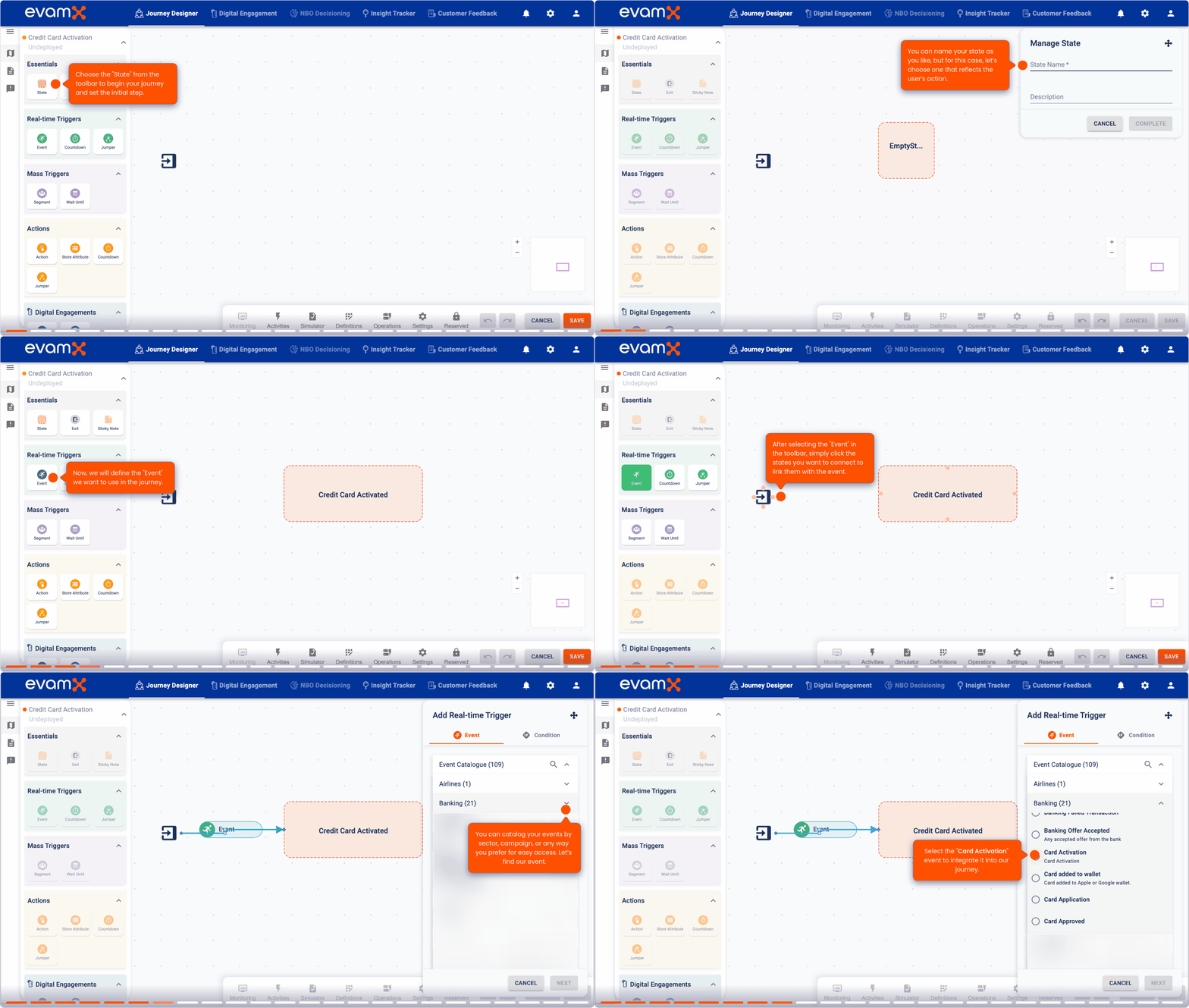
Share Post
Table of Contents
- What a Customer Engagement Platform Actually Needs to Do
- What Separates One Platform From Another
- How the Major Platforms Compare
- Where Evam Fits, and Where It Doesn't
- Where to Go Next


Summarize with AI


Search "customer engagement platform" and the category looks enormous, dozens of vendors, all describing themselves in nearly identical language: omnichannel, personalized, AI-powered, real-time. The category is genuinely crowded, but the products underneath that shared vocabulary solve meaningfully different problems, and the differences matter more once you're evaluating one for a specific industry rather than reading a features page.
What a Customer Engagement Platform Actually Needs to Do
Stripped down, a customer engagement platform exists to do one thing: connect what a business knows about a customer to what it actually says or does next, across whatever channel that customer happens to be using. Email, SMS, push, in-app, WhatsApp, web, call center. The channel list on most vendor pages looks similar. What varies enormously is what happens between the customer signal arriving and the platform acting on it.
Some platforms are built primarily as sending infrastructure: strong channel coverage, solid campaign tooling, decent personalization at the segment level. Others are built around a real decisioning layer: evaluating a live signal, checking eligibility and prior responses, and deciding the next action in the moment rather than from a pre-built campaign. Both get marketed as "customer engagement platforms." Only one of them can actually respond to a customer signal while it's still relevant.
What Separates One Platform From Another
A handful of questions cut through the shared marketing language faster than a features comparison does.
How fast is the decision actually made, not just the send. A platform can have excellent delivery speed and still be deciding on stale data if the underlying logic only refreshes on a schedule. The real question is whether the platform evaluates a signal the moment it happens or works from a periodic segment refresh.
How deep does the platform go in your specific industry. A platform built primarily for retail or SaaS engagement often lacks native support for banking-grade eligibility and suppression logic, or telecom-scale event volume, as a baseline capability rather than a custom build.
What deployment options actually exist. Most of this category is multitenant SaaS by default, which fits most industries fine. Regulated industries, banks especially, often need private cloud or on-premise deployment for data residency reasons a pure SaaS architecture can't accommodate without real compromise.
Who can actually change the logic once it's live. Some platforms require engineering involvement for meaningful changes to targeting or triggers. Others are built so a marketing or CVM team can adjust journeys directly, which affects total cost of ownership far more than the license price does.

How the Major Platforms Compare
| Platform | Real-Time Decisioning | Industry Depth | Deployment Options | Who Can Edit Live Journeys |
| Evam (evamX) | Sub-second, event-driven via the NBX engine | Purpose-built for banking, telecom, and retail with native eligibility and suppression logic | Cloud, private cloud, on-premise, hybrid | Business teams, via Journey Designer and Evo AI |
| Braze | Fast, cross-channel messaging with growing AI-driven triggers | Strong in retail, media, and app-first brands, less built around regulated-industry compliance | Multitenant SaaS | Marketer-friendly, geared toward campaign and lifecycle messaging |
| Salesforce | Decisioning layered on top of a CRM-first architecture | Broad reach across industries rather than deep banking or telecom specialization | Multitenant SaaS | Strong no-code tooling, though real-time depth varies by module |
| HubSpot | Primarily campaign and workflow automation rather than live-signal decisioning | Broad horizontal reach, built around combined marketing and sales use cases | Multitenant SaaS | Marketer-friendly, oriented around inbound and CRM-driven workflows |
| MoEngage | Strong mobile-first, real-time triggering, notably in WhatsApp-heavy and international markets | Deep in mobile-first consumer brands, less specialized in banking-grade compliance needs | Multitenant SaaS | Marketing-led, positioned around ease of use for growth teams |
None of these are weak platforms. Each is a legitimate, widely deployed choice for the use case it was built around. The mismatch shows up when a bank or telecom operator picks a platform built primarily for retail or SaaS engagement and then spends the next year building the compliance and latency requirements that should have been there from the start.
Where Evam Fits, and Where It Doesn't
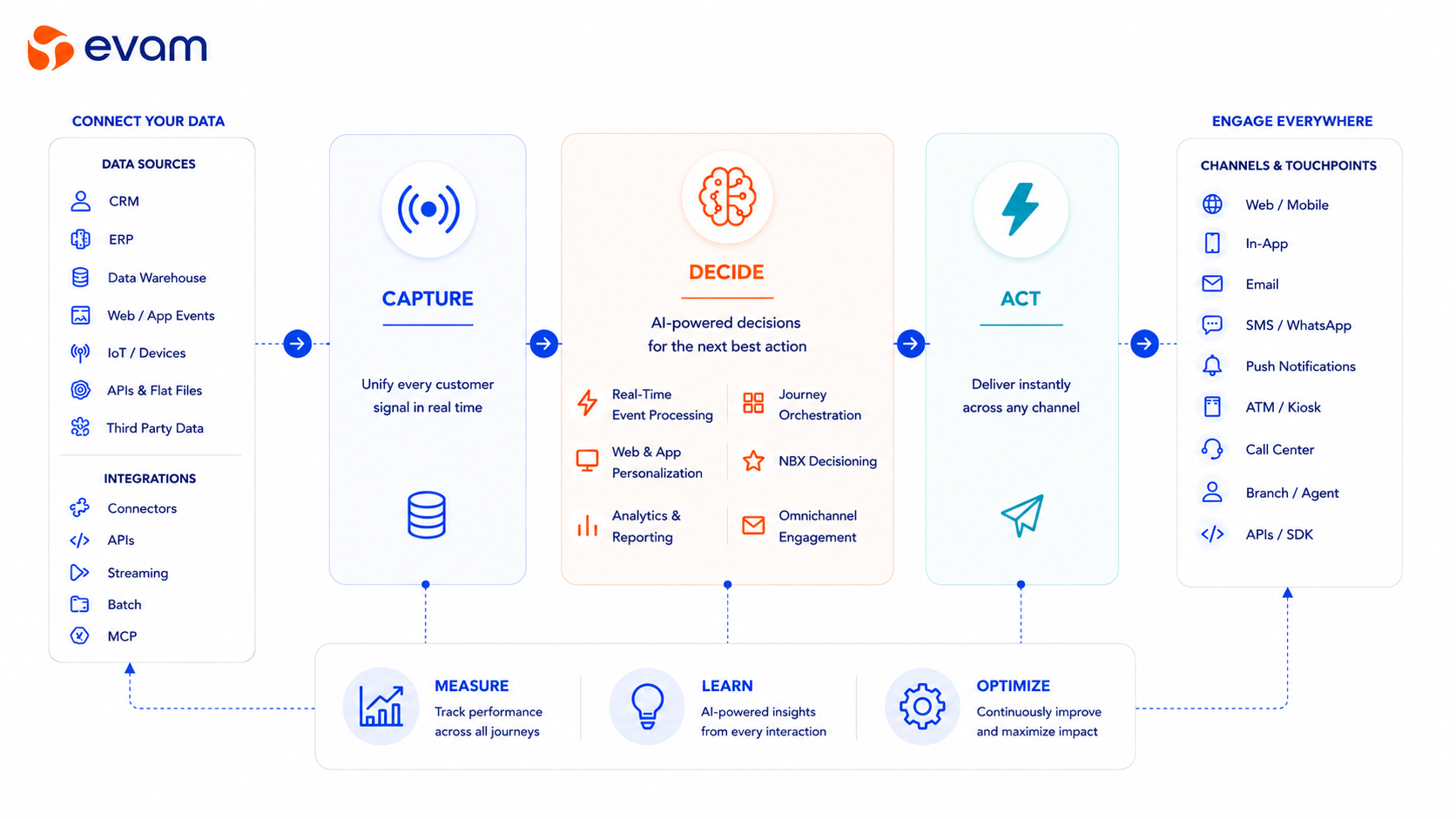
Evam is built specifically for industries where an engagement decision has to be fast, compliant, and coordinated across channels a typical retail-first platform doesn't prioritize, ATM, IVR, call center, and core banking or telecom systems alongside the usual app, web, and messaging channels. Our real-time customer engagement platform is built around exactly this focus, a genuine strength for banking, telecom, and retail operators managing high-volume, real-time decisions, and a genuine mismatch for a brand whose engagement needs stop at email and app push.
For a closer look at what this looks like inside a specific industry, our piece on customer engagement in banking covers what actually drives engagement quality once channel count stops being the differentiator, and our customer journey orchestration platform comparison covers the closely related orchestration layer this same architecture powers.
Where to Go Next
The honest way to choose between these platforms isn't reading feature lists that all use the same words. It's asking how each one handles the specific decision that matters most in your business, and how fast it can actually make that decision when it counts.
If you want to see what real-time customer engagement looks like against your own systems, our team is glad to walk through it with you. Reach out through our contact page or explore the Product Demo Hub directly.