
Share Post
Table of Contents
- Why Banking Is Rethinking Its Technology Stack
- What AI Actually Changes for Banks
- Retail Banking's Shift Toward Intelligent Service
- Where AI in Banking Is Heading Next
- How evamX Supports Real-Time Decisioning in Banking


Summarize with AI


Most conversations about AI in banking are organized around use cases: a chatbot on the mobile app, fraud detection running in the background, an engine deciding which offer a customer sees at login. Each is real, and none explain why two banks running the same use case see completely different results.
The variable that actually separates them is not which use case they deployed. It is whether that use case runs on a decisioning layer reading live customer context, or a batch process that catches up hours or days later. A fraud model that flags a transaction after the money has already moved is a different product from one that flags it before the transaction clears, even with an identical underlying model. AI in banking is not one initiative. It is a shift in how decisions get made, and that shift matters more than any single feature built on top of it.
Why Banking Is Rethinking Its Technology Stack
The pressure banks feel right now is less about AI itself and more about the gap between what customers expect and what legacy infrastructure can deliver. A customer who gets a relevant, timely suggestion from a retail app does not lower that expectation when they open their banking app next. That comparison used to feel unfair to banks. It no longer does, because the technology to close the gap now exists and competitors are already using it.
Three trends are driving this in parallel. Core systems built for transaction processing are being layered with decisioning capabilities that operate independently of the core, so banks can move faster without a multi-year core replacement. Data that used to sit in silos, one system for transactions, another for CRM, another for the call center, is increasingly treated as a single real-time asset any channel can draw from. And regulatory comfort with AI-driven decisioning has grown, provided the reasoning behind each decision can be explained and audited.
None of this is about novelty. It is about making thousands of small decisions a day at a speed manual processes cannot match anymore.
What AI Actually Changes for Banks
Strip away the buzzwords and the benefits cluster around three things: speed, relevance, and cost.
Speed shows up in how fast a bank responds to a customer action: a payment cleared or flagged in real time instead of hours later, a churn signal triggering outreach the same day instead of next month's report. Relevance shows up in what the customer actually sees, an offer reflecting their situation now rather than a segment from a year ago, where irrelevant offers quietly erode trust. Cost shows up less visibly: contact center volume drops when routine questions resolve before an agent is needed, fraud losses drop when detection happens at the transaction itself, compliance costs drop when decisioning logic is explainable by design.
The banks getting the most value picked a handful of moments, a login, a payment, a support call, and made the decisioning sharper there, rather than chasing every use case available. Our piece on next-best-offer engines in banking goes deeper into how that plays out around real-time offers.
Retail Banking's Shift Toward Intelligent Service
Retail banking earns its own section because it is where customers actually experience whether a bank has modernized. A corporate client has a relationship manager who can compensate for gaps in the technology. A retail customer interacting through an app or a call center has no such buffer. The system is the experience.
What has changed specifically is the move from static rules to dynamic decisioning. A rules-based system says: if balance drops below a threshold, send an alert. A decisioning system asks whether the drop is meaningful given this customer's full pattern, and what is actually useful to tell them right now. Customers stop getting blasted with alerts that don't apply and start getting fewer, sharper ones. The same logic applies to service routing: a disputed-transaction call increasingly routes based on customer history and issue complexity, without replacing the contact center software itself. Our piece on orchestrating banking journeys in real time covers this in more depth.

A concrete version shows up constantly. A customer declines a loan offer at the ATM. Minutes later, on the mobile app, a system without shared memory shows the identical offer again. A decisioning layer that treats every channel as one continuous conversation suppresses that offer everywhere instead, and if the same session shows a large cash withdrawal signaling a temporary low balance, surfaces a short-term cash option the customer already qualifies for. The difference is not a smarter offer. It is a system that remembers what just happened.
Retail banks that fix this channel-by-channel end up with three inconsistent versions of "smart." The ones that treat it as one decisioning layer feeding every channel end up coherent regardless of where the customer shows up.
Where AI in Banking Is Heading Next
Three directions look most likely to define the next few years. AI moves from bolt-on feature to infrastructure, the same way banks stopped talking about "our internet banking initiative" once online banking became table stakes. Personalization and compliance tighten together, since regulators are watching how lending and advice decisions get made, and banks that build explainability in from the start will beat those retrofitting it later, a balance our piece on real-time personalization platforms in banking covers in more depth. And the decisioning layer itself consolidates, instead of separate systems for fraud, offers, and churn contradicting each other.
None of this requires predicting the future perfectly. It requires picking an architecture now that doesn't have to be torn out later.
How evamX Supports Real-Time Decisioning in Banking
Most banks sit somewhere in the middle of this shift, further along in fraud detection than personalization, further along in one channel than another. What separates the ones closing that gap from the ones stalling is usually the decisioning layer underneath: capturing events as they happen, deciding what to do in real time, and acting across every channel at once.
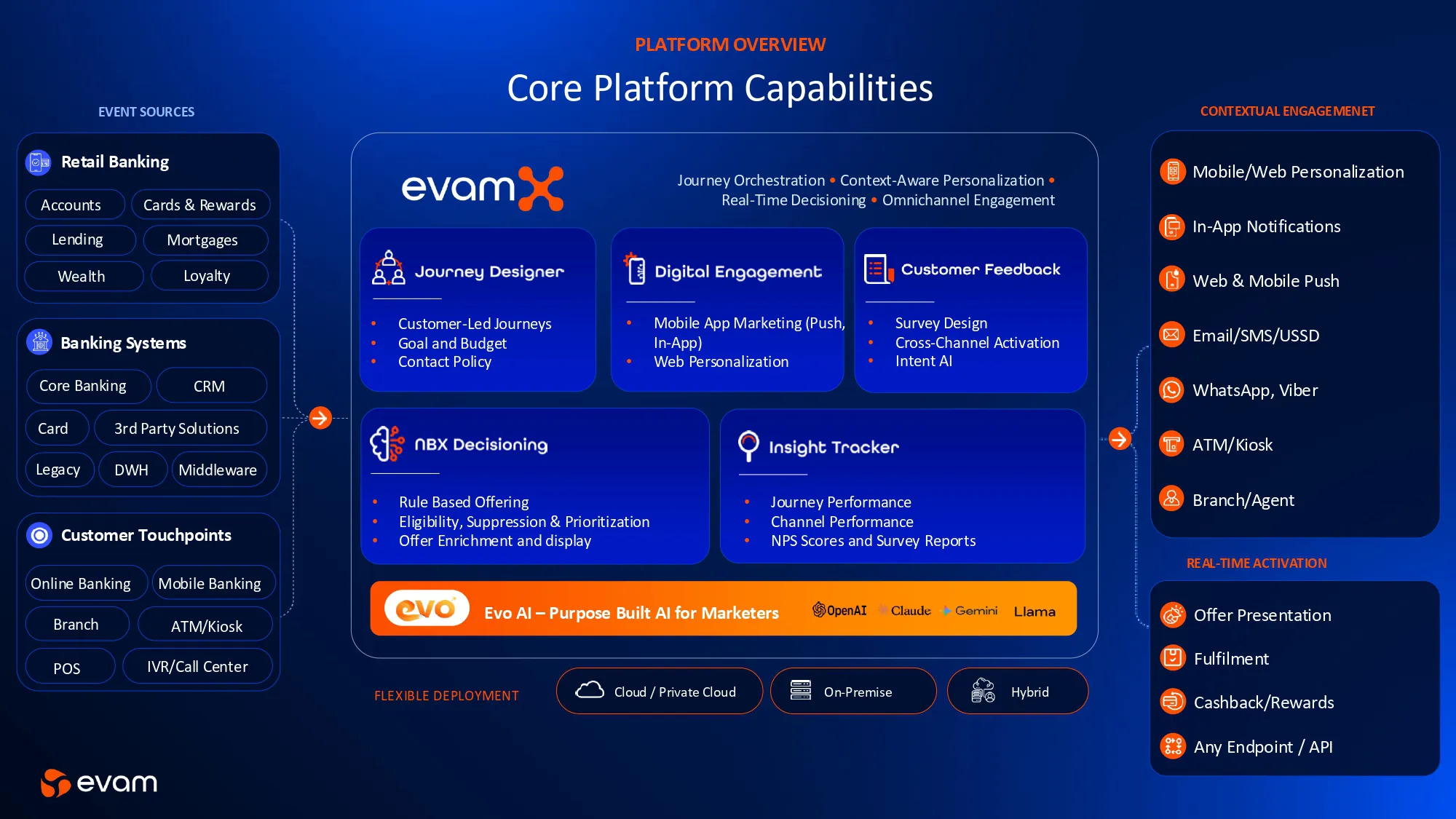
evamX sits alongside a bank's core banking, card, or CRM systems rather than replacing them, streaming in events the moment they occur, a login, a payment, a declined offer, and evaluating each against live customer context instead of last night's batch file. The NBX decisioning engine checks eligibility, suppresses offers the customer has already seen or rejected, ranks what's left by relevance, then acts through whatever channel the customer is actually in, the exact mechanism behind the ATM-to-mobile example above. Business teams configure eligibility rules and channel logic themselves, without an engineering ticket for every change, which matters most three weeks after launch, when the fifth adjustment is usually where manual processes break down.
Across bank deployments running this way, onboarding completion has improved by up to 30 percent, card activation and utilization have moved measurably once offers triggered at the transaction itself, and credit card and cash loan cross-sell has converted at 1.4 to 1.7 times the batch equivalent, while call center costs have dropped by roughly half.
If you want to see where your own bank sits on this path, our team is glad to walk through it with you.