
 Evo AI
Share Post
Table of Contents
- Why "AI-Powered Engagement" Usually Just Means a Chatbot
- What an AI Customer Engagement Engine Actually Does
- The Real Challenge Isn't Capability. It's Context.
- What This Looks Like in Practice
- How evamX Powers AI Customer Engagement
- Where to Go Next


Summarize with AI


Ask most companies what their "AI-powered customer engagement" looks like and the answer is usually a chatbot, sometimes a generative AI tool that drafts marketing copy faster than a human could. Both are genuinely useful. Neither one is what actually builds a stronger customer relationship, because both still wait for the customer to show up before doing anything.
An AI customer engagement engine works differently. It doesn't wait for a support ticket or a campaign brief. It watches customer behavior continuously and initiates the right interaction the moment it becomes relevant, which is a fundamentally different job than answering questions faster or writing content at scale.
Why "AI-Powered Engagement" Usually Just Means a Chatbot
Three tools tend to get bundled under the "AI-powered engagement" label, and each does something real, but none of them alone constitutes an engagement strategy.
Generative AI creates content at scale, blog posts, product descriptions, marketing copy, tailored to a segment faster than a human team could produce it manually. That's valuable for production speed. It says nothing about whether the content reaches the right customer at the right moment.
AI agents, chatbots and virtual assistants, extend availability to 24/7 and reduce the cost of routine support interactions. That's valuable for accessibility. It's still reactive, waiting for the customer to initiate contact rather than noticing when a customer needs something before they ask.
Decisioning engines are the piece most companies skip, and the piece that actually determines whether engagement feels personal or generic. A decisioning engine analyzes behavior continuously, purchase history, usage patterns, support interactions, and initiates the next best interaction proactively, without waiting for the customer to start the conversation.
Content generation and support automation are necessary infrastructure. Neither one is the engine. The engine is the layer that decides when to act, and most "AI-powered engagement" stacks are missing it entirely.
What an AI Customer Engagement Engine Actually Does
A real engagement engine treats every customer signal, a login, a purchase, a support interaction, a moment of hesitation, as an input that continuously refines what happens next, not a data point that gets reviewed in next month's report. Our real-time customer engagement platform is built around exactly this loop, sensing, deciding, and engaging continuously rather than on a campaign schedule.
That means engagement stops being a campaign a team plans in advance and starts being a live response to what's actually happening. A customer whose usage pattern shifts gets a different interaction than one following a normal routine, decided in the moment rather than weeks later when a segment gets reclassified. The distinction between engagement that feels personal and engagement that feels automated almost always comes down to this: whether the system is responding to something the customer is doing right now, or something they did that already got filed away.
The Real Challenge Isn't Capability. It's Context.
Most AI engagement tools available today are technically capable. The harder problem is real-time context, and it shows up as two separate risks.
The first is privacy. Customers want personalized experiences and are simultaneously uneasy about how much data that requires, a genuine tension rather than a communication problem to spin away. The only durable answer is transparency about what data gets used and real opt-out control, treated as a design requirement rather than a legal afterthought.
The second is relevance without context. An AI system acting on stale or incomplete data doesn't fail quietly, it fails loudly, producing messages that feel generic, poorly timed, or invasive precisely because they were built without knowing what the customer's situation actually looks like right now. The fix isn't reaching customers on every available channel more aggressively. It's what we've described elsewhere as an optichannel approach: choosing the one channel most relevant to that customer in that moment, rather than treating channel reach as a volume game.
What This Looks Like in Practice
Jazz, Pakistan's leading digital communications operator, used AI-driven, real-time engagement to do more than run better campaigns, it used the approach to transform its relationship with customers entirely. Through evamX, Jazz configured real-time triggers and launched more than 20 real-time campaigns as part of a broader shift into PartnerUp, a data monetization ecosystem that let Jazz evolve from a connectivity provider into a platform connecting customers with a wider partner network. The full story is covered in Jazz's success story.
That shift is the clearest evidence that an engagement engine changes more than campaign performance. It changes what the relationship with the customer can become, because the company is no longer just responding to requests, it's continuously present in ways a scheduled campaign calendar never could be.
How evamX Powers AI Customer Engagement
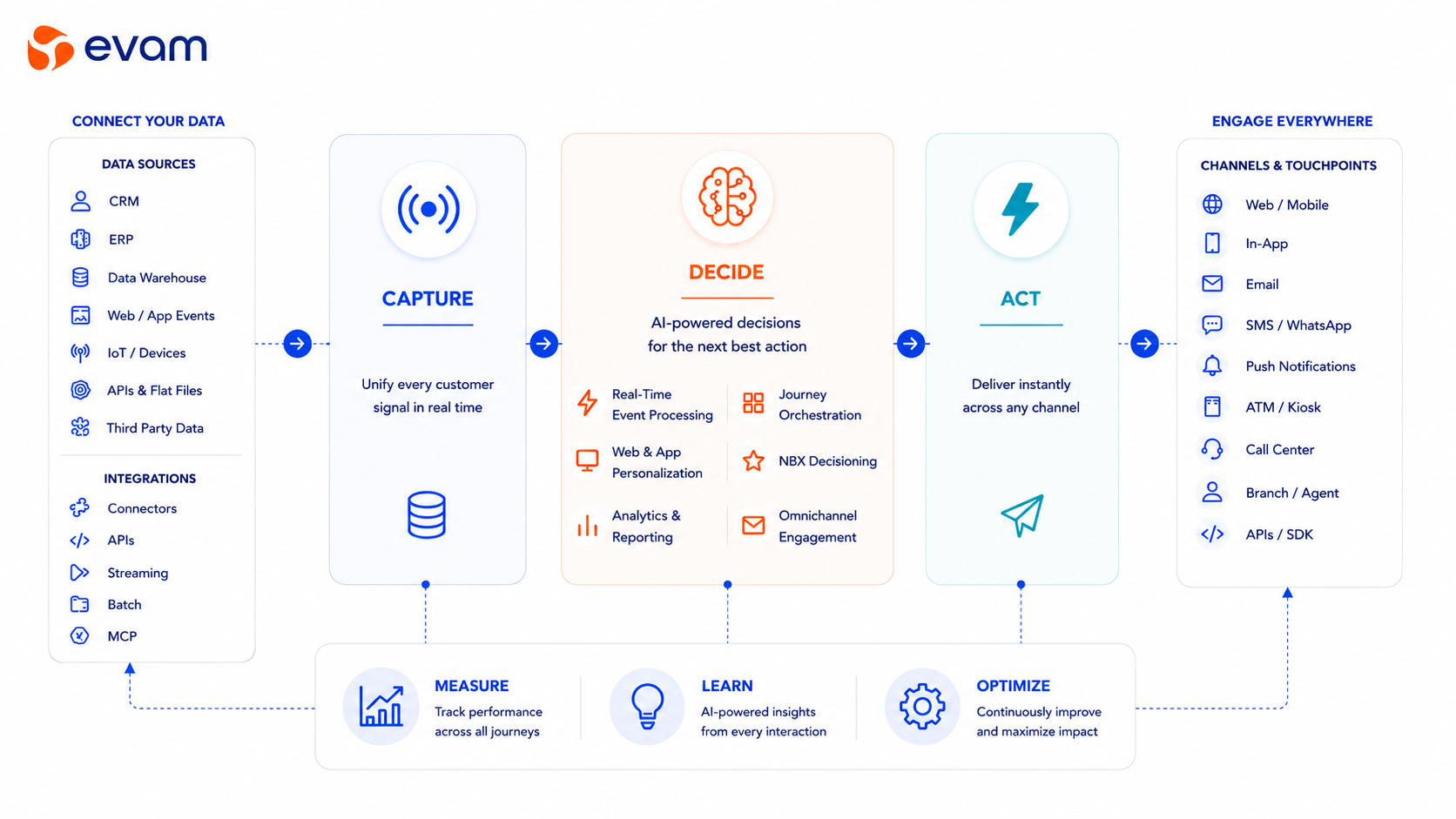
evamX is built around exactly the decisioning layer most "AI-powered engagement" stacks are missing. It captures behavioral and transactional signals as they happen and the NBX decisioning engine evaluates each one in real time to determine the next best action, not a scheduled campaign, but a decision made in the moment a signal appears. Evo AI adds generative capability on top of that decisioning layer, so content and journeys can be created and adjusted quickly once the engine has already decided what needs to happen.
Every action runs through an optichannel model rather than a blanket, every-channel-at-once approach, reaching the customer through whichever single channel actually fits the moment, with contextual segmentation and privacy controls built into the platform rather than added on afterward.
Where to Go Next
The test for whether a company has an AI customer engagement engine, or just AI-labeled tools bolted onto an existing process, is simple: does the system ever act before the customer asks it to. Jazz's shift from telecom operator to platform is what that looks like at full scale.
If you want to see what this looks like against your own customer engagement strategy, our team is glad to walk through it with you. Reach out through our contact page or explore the Product Demo Hub directly.