
Table of Contents
Table of Content
- How Does Website Personalization Work?
- Website Personalization Examples
- Web Personalization vs. Static Web Experiences
- Key Data Points That Enable Website Personalization
- Website Personalization with evamX
Website personalization is the practice of dynamically tailoring a website's content, layout, and messaging to individual visitors based on who they are, how they behave, and what they need at a given moment. Rather than presenting every visitor with the same static experience, personalized websites adapt in real time, surfacing relevant product recommendations, adjusting banners, modifying calls to action, or even restructuring page content based on signals like browsing history, location, device type, or customer lifecycle stage.
The concept sits at the intersection of data, technology, and user experience. A new visitor arriving at a financial services website for the first time sees a different experience than a returning customer who has already opened a savings account, and that difference is deliberate. Website personalization makes that distinction possible at scale, without manual intervention.
How Does Website Personalization Work?
Website personalization relies on collecting and processing visitor data in real time. When a user lands on a page, behavioral signals such as pages visited, time spent, products viewed, past purchases, and referral source are captured and matched against predefined segments or machine learning models. The system then determines which version of the content is most relevant for that visitor and delivers it instantly, often before the page fully loads.
The data driving personalization can come from multiple sources: first-party behavioral data collected directly on the site, CRM data that identifies known customers, contextual data such as device or geography, and in more advanced implementations, real-time event streams that reflect what a customer is doing right now rather than what they did last week.
Website Personalization Examples
The most recognizable form of website personalization is product recommendation engines, the "you might also like" or "frequently bought together" modules that appear on e-commerce pages. But the scope extends well beyond retail.
In financial services, a bank might display a mortgage calculator prominently to a visitor who has been browsing home loan content, while showing a savings account offer to someone who has recently received a salary deposit. In telecommunications, a returning customer nearing the end of their contract might see a renewal offer the moment they visit the homepage, rather than a generic acquisition campaign meant for new prospects. In retail, a loyalty member who has not made a purchase in 60 days might be greeted with a personalized discount the moment they return to the site.
Other common website personalization examples include personalized welcome messages for logged-in users, dynamic hero banners that change based on traffic source, geo-targeted content that surfaces locally relevant offers, and adaptive navigation that prioritizes sections most relevant to a given user's profile.
Web Personalization vs. Static Web Experiences
Static websites deliver identical content to every visitor regardless of context. This approach is straightforward to build and maintain, but it treats a first-time visitor from a paid ad the same as a high-value returning customer, and that misalignment has a direct cost in engagement, conversion, and retention.
Web personalization addresses this by making the experience responsive to individual context. The difference is not cosmetic. Personalized web experiences consistently drive higher engagement rates, longer session durations, and meaningfully better conversion performance compared to generic alternatives. For industries like banking, telecom, and retail where customer relationships are long-term and competitive differentiation is difficult, the ability to make every website visit feel relevant is a significant advantage.
Key Data Points That Enable Website Personalization
Effective website personalization depends on the quality and breadth of the data available. The most commonly used data points include demographic attributes such as age, location, and language; behavioral signals such as pages visited, search queries, and click patterns; transactional history including past purchases and average order value; lifecycle stage indicators that identify where a customer sits in their relationship with the brand; and real-time contextual signals such as device type, referral source, and time of day.
The more granular and current the data, the more precise the personalization. Organizations that can combine historical CRM data with real-time behavioral streams are able to deliver experiences that feel genuinely individual rather than broadly segmented.
Website Personalization with evamX
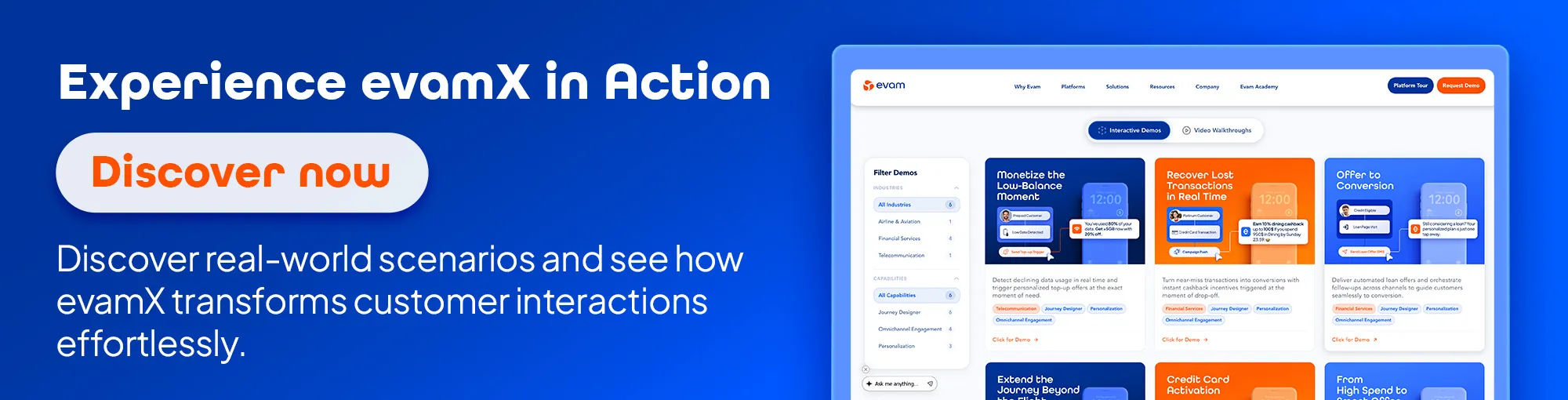
evamX enables website personalization as part of a broader real-time customer engagement strategy. Rather than treating the website as an isolated channel, evamX connects web behavior to the full customer journey, so what a customer does on the site informs what they receive via push notification, email, or in-app message, and vice versa.
Using evamX's Journey Designer and real-time decisioning engine, teams can define personalization logic based on live behavioral signals, customer lifecycle stage, and predictive models, without requiring custom development for each rule or segment. Web experiences update dynamically as customer context changes, ensuring that relevance is maintained across sessions, not just at the moment of first visit.