
 Evo AI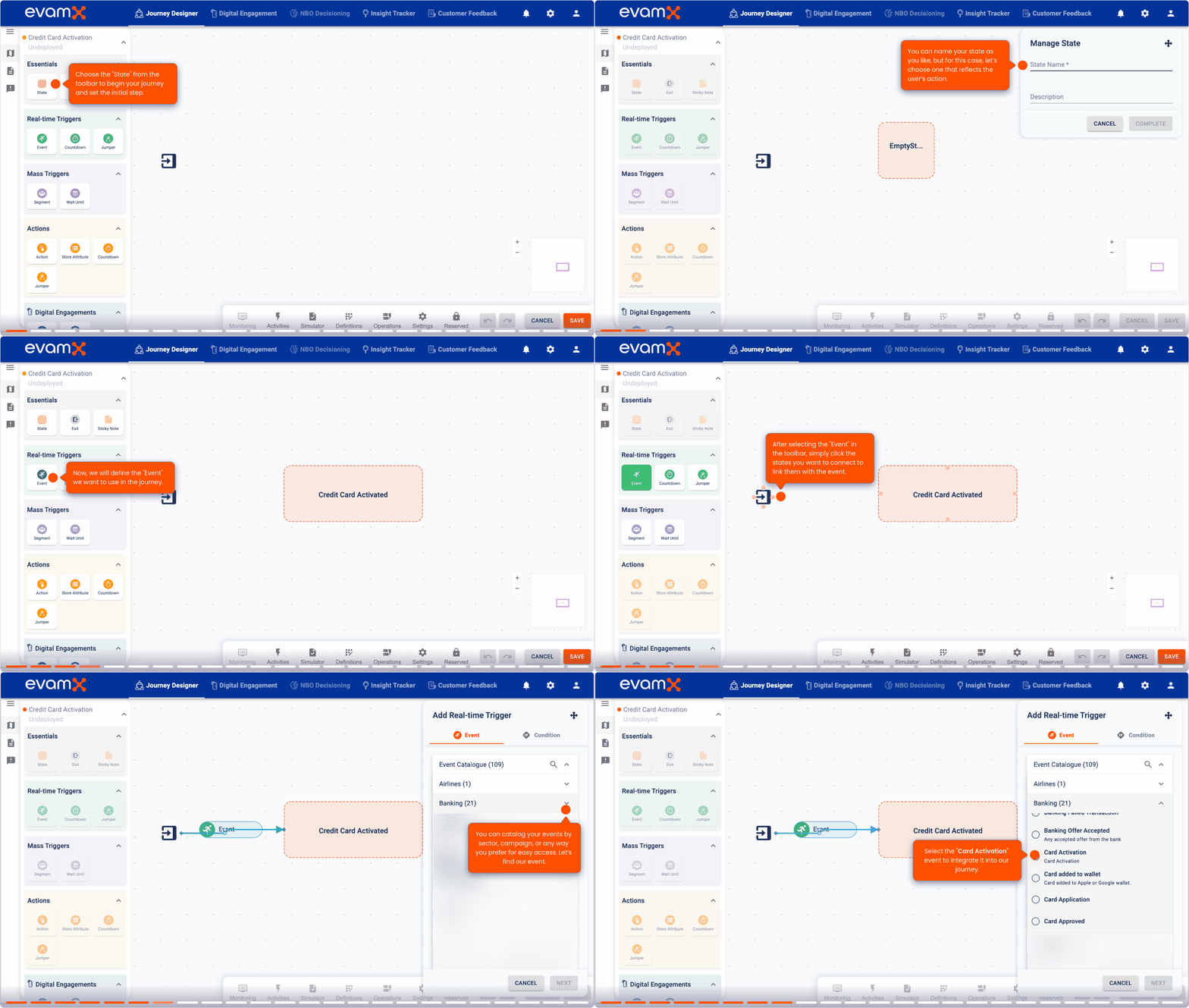
Table of Contents
Table of Contents:
- What is a Mobile SDK?
- How a Mobile SDK Works
- Mobile SDK vs API
- Mobile SDK in Marketing
- SDK Integration
- Mobile SDK with evamX
A mobile SDK, or Software Development Kit, is a collection of pre-written code, libraries, tools, and documentation that developers integrate into a mobile application to add specific capabilities without building those capabilities from scratch. Rather than engineering a feature set independently, a development team integrates an SDK that handles the technical complexity of a particular function, and the app gains that functionality through a relatively straightforward integration process.
In marketing and customer engagement, mobile SDKs are the technical infrastructure that connects a mobile app to external platforms. When a banking app sends a personalized push notification, when a retail app displays a contextual in-app message, or when a telecommunications app tracks a behavioral event in real time and passes it to a decisioning engine, a mobile SDK is the component making that connection possible. Without it, the app and the engagement platform operate as separate systems with no live data flowing between them.
What is a Mobile SDK?
A mobile SDK is a software package designed for a specific platform, typically iOS, Android, or both, that provides developers with the tools to integrate a defined set of capabilities into their application. It typically includes libraries containing reusable code, APIs that define how the SDK communicates with external systems, documentation that guides implementation, and in some cases testing tools and sample code to accelerate development.
SDKs are used across virtually every category of mobile functionality: analytics SDKs that track user behavior, authentication SDKs that handle login and identity verification, payment SDKs that process transactions, and engagement SDKs that power marketing communication capabilities. Each SDK abstracts the underlying technical complexity of its function, allowing development teams to implement sophisticated capabilities in days rather than months.
The defining characteristic of a well-designed mobile SDK is that it reduces integration effort while maintaining reliability and performance. An engagement SDK that requires extensive custom development work, introduces significant app size overhead, or creates instability in the host application will generate internal resistance regardless of the value of the capabilities it unlocks. The best SDKs are lightweight, well-documented, and designed to integrate cleanly into existing app architectures with minimal disruption.
How a Mobile SDK Works
A mobile SDK is integrated into a mobile app during development by adding the SDK package to the app's codebase and implementing the SDK's initialization and configuration logic. Once integrated, the SDK runs within the app's runtime environment and communicates with external systems through APIs.
In the context of customer engagement, a mobile engagement SDK typically performs several functions simultaneously. It captures behavioral events within the app, actions like screen views, button taps, product views, transaction completions, or feature activations, and sends those events to the connected engagement platform in real time. It receives instructions from the engagement platform about what communications to deliver, such as in-app messages triggered by specific behavioral conditions, and renders those communications within the app. It manages the technical delivery of push notifications by handling the device token registration and notification receipt logic that connects the app to the device's operating system notification infrastructure.
This bidirectional communication, sending behavioral data out and receiving engagement instructions in, is what makes a mobile engagement SDK the technical foundation of real-time mobile customer engagement. Without it, there is no live connection between what a customer does in the app and what the engagement platform can do in response.
Mobile SDK vs API
Mobile SDKs and APIs are related but distinct concepts that are sometimes conflated. An API, or Application Programming Interface, is a set of rules and protocols that defines how two software systems communicate with each other. An SDK typically contains one or more APIs as part of its package, but it also includes additional components: libraries, documentation, tools, and pre-built code that make it easier to use those APIs correctly and efficiently.
The practical difference is in the implementation experience. Integrating a well-designed SDK is typically faster and more reliable than building a custom API integration from scratch, because the SDK handles many of the low-level implementation details, error handling, and platform-specific considerations that a raw API integration would require the development team to address independently. For this reason, most enterprise engagement platforms offer both an SDK for standard mobile app integrations and API access for custom or server-side integrations that fall outside the SDK's scope.
Mobile SDK in Marketing
In marketing, a mobile SDK is the technical prerequisite for any mobile engagement capability that depends on real-time app behavior. Push notifications require an SDK to handle device token management and notification delivery. In-app messages require an SDK to receive rendering instructions and display message templates within the app. Real-time behavioral event tracking requires an SDK to capture and transmit user actions as they occur during an active session.
Without a mobile SDK integrated into the app, a marketing team's ability to engage mobile customers is limited to channels that do not depend on app behavior: email, SMS, and paid advertising. These channels can drive customers back to the app, but they cannot respond to what customers do inside it. The mobile SDK is what closes the gap between the app experience and the engagement platform, making it possible for marketing decisions to be driven by what customers are doing right now rather than what they did last week.
For organizations in banking, telecommunications, and retail where the mobile app is the primary customer touchpoint, the mobile SDK is not a peripheral technical component. It is the infrastructure that determines whether real-time customer engagement is possible at all.
SDK Integration
SDK integration refers to the process of embedding an SDK into a mobile application's codebase. The integration process varies in complexity depending on the SDK's design, the app's existing architecture, and the capabilities being activated, but modern engagement SDKs are designed to minimize integration effort and developer dependency.
A typical mobile SDK integration involves adding the SDK package to the app's dependency management system, initializing the SDK with the appropriate configuration credentials, and implementing the event tracking calls that send behavioral data to the connected platform. For engagement SDKs that support in-app messaging, additional setup may be required to define the display zones where in-app messages can appear within the app interface.
The quality of SDK integration directly affects the quality of engagement outcomes. An integration that captures a comprehensive set of behavioral events provides richer signal data for the engagement platform's decisioning engine. An integration that tracks only a minimal set of events limits the platform's ability to recognize meaningful behavioral patterns and respond to them appropriately. Investing in thorough event instrumentation during SDK integration is therefore not purely a technical decision. It is a marketing decision that determines the ceiling of what personalization and real-time engagement can achieve.
Mobile SDK with evamX
Evam's mobile and web SDK is the technical bridge between a customer's app behavior and evamX's real-time decisioning engine. Once integrated, the SDK captures behavioral events from the mobile app and transmits them to evamX in real time, where they are processed immediately as inputs to the engagement decisioning layer.
This means that every meaningful action a customer takes in a connected app, a login, a product view, a transaction, a feature activation, or a navigation pattern, becomes a live signal available to evamX within milliseconds of the event occurring. The decisioning engine evaluates that signal in the context of the customer's full behavioral history and profile, determines whether an engagement action is appropriate, and if so, delivers the appropriate response through the optimal channel immediately.
For push notifications, the evamX SDK manages device token registration and handles the delivery mechanics that connect evamX's campaign logic to the device's operating system. For in-app messages, the SDK renders message templates within the app interface according to the conditions and display logic configured in evamX's Journey Designer. For behavioral event tracking, the SDK provides a comprehensive event catalogue covering the full range of mobile interactions that are commercially relevant for banking, telecommunications, and retail engagement programs.