

 Evo AI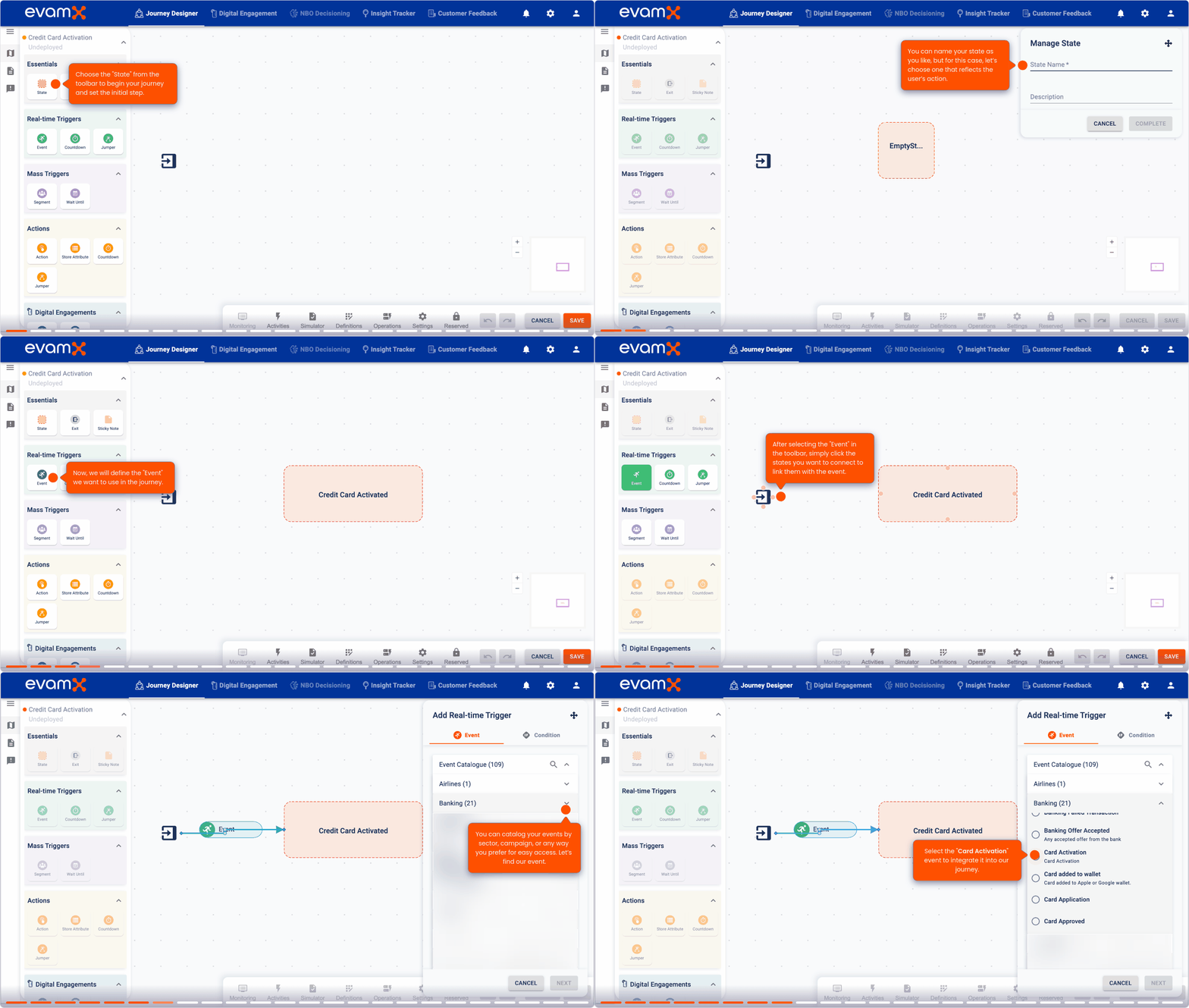
Table of Contents
Table of Content
- What is DAU?
- DAU vs MAU
- DAU MAU Ratio
- How to Measure Daily Active Users
- How to Increase Daily Active Users
- Daily Active Users with evamX
DAU, or Daily Active Users, is a metric that measures the number of unique users who engage with a product, app, or platform on a given day. It is one of the most widely tracked indicators of product health and user engagement, providing a daily read on how many people are actively using a service rather than simply being registered or installed.
Understanding DAU meaning goes beyond the definition. Daily Active Users is a forward-looking metric: it does not tell you what happened in the past, it tells you the current state of engagement. A rising DAU trend signals that a product is growing its engaged user base. A declining DAU trend signals that users are drifting away, even if total registered users continue to grow. For any business that depends on regular customer interaction — a banking app, a telecommunications self-service platform, a retail app — DAU is a real-time indicator of whether customers are finding ongoing value in the product.
What is DAU?
DAU stands for Daily Active Users. It counts the number of unique individuals who perform at least one qualifying action within a product during a 24-hour period. The definition of a qualifying action varies by product: for a banking app it might be a login or a transaction, for a retail app it might be a browse or a purchase, for a telecommunications app it might be a balance check or a plan management action.
The key word in the definition is unique. A single user who opens an app five times in one day counts as one DAU, not five. This makes DAU a measure of audience size rather than total activity volume, which is important for interpreting it correctly. High session frequency from a small number of users can produce engagement metrics that look healthy while DAU remains flat or declining, signaling a concentration risk in the active user base.
DAU is typically tracked as a daily time series and analyzed for trends rather than as a single point-in-time figure. Day-over-day changes, weekly patterns, and longer-term trajectories tell a more complete story than any single day's number in isolation.
DAU vs MAU
DAU vs MAU is one of the most common comparisons in product and engagement analytics. MAU, or Monthly Active Users, measures the number of unique users who engage with a product at least once within a 30-day period. Both metrics measure active engagement, but at different time horizons.
DAU captures daily engagement patterns and is sensitive to short-term changes in user behavior. It reflects whether users are returning to a product habitually, day after day, or only occasionally. MAU captures the broader engaged audience — users who interact at least once a month, regardless of frequency.
The relationship between DAU and MAU reveals the nature of user engagement with a product. A product with high MAU but low DAU has a broad audience that engages infrequently. A product with DAU close to its MAU has an audience that engages almost every day, indicating strong habitual usage. Neither profile is inherently better — the right DAU to MAU relationship depends on what the product is designed to do and how frequently it is expected to be used.
DAU MAU Ratio
The DAU MAU ratio, sometimes called the stickiness ratio, expresses what proportion of monthly active users return on any given day. It is calculated by dividing DAU by MAU and expressing the result as a percentage.
A DAU MAU ratio of 30 percent means that on an average day, 30 percent of the monthly active user base engages with the product. A ratio of 50 percent means half the monthly audience returns daily. The higher the ratio, the more habitual the engagement pattern across the user base.
The DAU MAU ratio is particularly useful for benchmarking engagement quality over time and across user segments. A segment with a consistently high DAU MAU ratio represents a core of highly engaged users whose behavior patterns are worth studying and replicating. A segment with a declining ratio is showing early signs of reduced engagement frequency, even if absolute DAU and MAU numbers have not yet fallen significantly.
For products where daily usage is the goal — a mobile banking app that customers use for daily financial management, or a loyalty app that customers check for rewards and offers — a low or declining DAU MAU ratio is a meaningful warning signal that the product is not achieving the habitual engagement it was designed to create.
How to Measure Daily Active Users
Measuring daily active users requires defining two things clearly before any data is collected: the time window and the qualifying event. The time window is typically a rolling 24-hour period, though some implementations use calendar days. The qualifying event is the minimum interaction that counts a user as active — a login, a specific feature use, a transaction, or any meaningful product interaction depending on the context.
Accurate DAU measurement also requires deduplication: if the same user logs in from two devices on the same day, they should count as one DAU, not two. This requires user-level identity resolution that connects activity across devices and sessions to a single customer record.
Once defined and implemented consistently, DAU should be tracked as a daily time series and segmented by relevant dimensions: acquisition cohort, product version, customer segment, geography, and device type. Segmented DAU analysis reveals which parts of the user base are most engaged, which are declining, and where intervention is most needed.
How to Increase Daily Active Users
Increasing daily active users requires identifying the specific barriers that prevent users from returning each day and removing them systematically. The most effective interventions are those that increase the perceived daily value of the product — giving users a compelling reason to open the app every day — rather than simply sending more notifications to drive opens that do not translate into genuine engagement.
Personalized daily engagement triggers are among the most effective tools for increasing DAU. A banking app that surfaces a relevant insight or action every time a customer opens it — a spending summary, a savings milestone, a timely offer — gives users a reason to return that is grounded in value rather than habit alone. A telecommunications app that proactively notifies customers of usage milestones or relevant offers before they need to seek that information out creates daily touchpoints that feel useful rather than intrusive.
Re-engagement programs targeting users whose DAU contribution has declined — those who were previously active daily but have reduced their frequency — can recover engagement before it deteriorates into full inactivity. These programs are most effective when they are triggered by the behavioral signal of declining frequency rather than by a fixed time threshold, and when the re-engagement message reflects the specific context of each user's last interaction.
Daily Active Users with evamX
evamX tracks behavioral engagement signals across every channel and touchpoint in real time, enabling organizations to monitor DAU trends at the individual customer level and respond to declining engagement patterns before they aggregate into a measurable drop in daily active users.
When a customer's daily engagement frequency begins to decline — fewer app opens, fewer interactions, reduced response to communications — evamX identifies the pattern and triggers a personalized re-engagement journey designed to restore the habit before it breaks entirely. This real-time, individual-level approach to DAU management complements the aggregate metric tracking that reveals trends across the full user base, ensuring that the response to declining engagement is targeted and timely rather than broad and retrospective.