
 Evo AI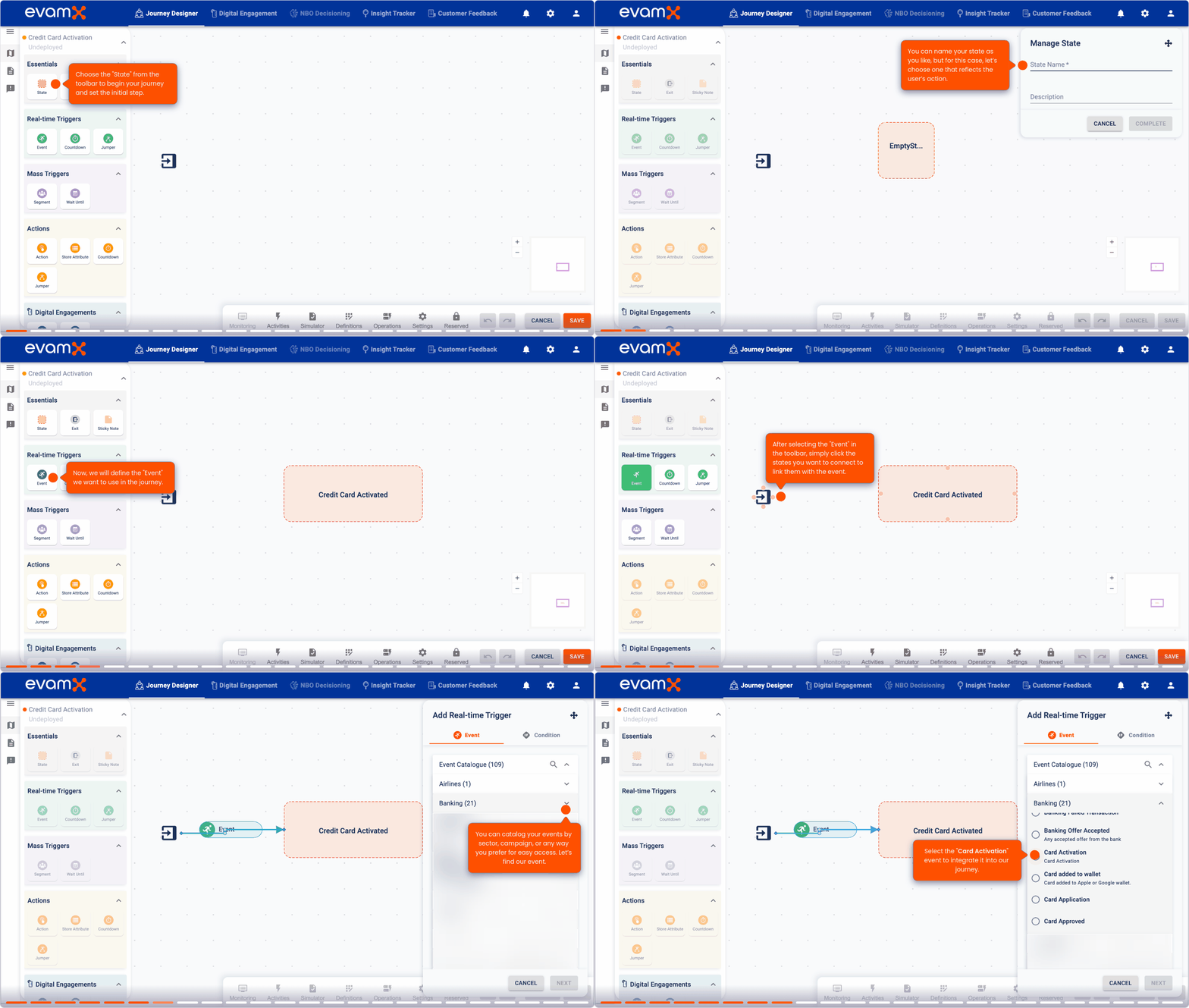
Share Post
Table of Contents
- Why Most "Real-Time Marketing" Isn't Actually Real-Time
- What a Real-Time Marketing Platform Actually Needs to Do
- What This Looks Like Across Industries
- How evamX Powers Real-Time Marketing
- Where to Go Next


Summarize with AI


Marketers have been told for years to jump on trends, respond to conversations, and catch the cultural moment while it's still relevant. That advice is fine, but it isn't a platform, and confusing the two is why so many "real-time marketing" programs are really just campaigns scheduled a few hours faster than usual.
A real-time marketing platform isn't about reacting to what's trending on social media. It's about a technical capability: evaluating a customer signal the moment it happens and acting on it before the moment closes, whether that signal is a page visit, a failed transaction, a support call, or a usage spike. That's a fundamentally different problem than content calendars and social listening tools solve, and it's worth being precise about the difference before evaluating any platform against it.
Why Most "Real-Time Marketing" Isn't Actually Real-Time
The tell is in the response time. A platform that captures a customer event and gets a campaign live within a few hours is faster than traditional marketing, but it isn't real-time. The customer who triggered that event has usually already moved on by the time anything reaches them.
Genuine real-time marketing requires an architecture most marketing stacks were never built for: continuous event capture instead of periodic exports, a decisioning layer that evaluates each event the instant it arrives, and execution that reaches the customer in the same session, not the next campaign cycle. Most platforms marketed as real-time are missing at least one of these three pieces, usually the decisioning layer, which is why they can send a message quickly but can't decide what that message should be based on what's happening right now.
What a Real-Time Marketing Platform Actually Needs to Do
Three capabilities separate a genuine real-time customer engagement platform from a faster version of the same batch process.
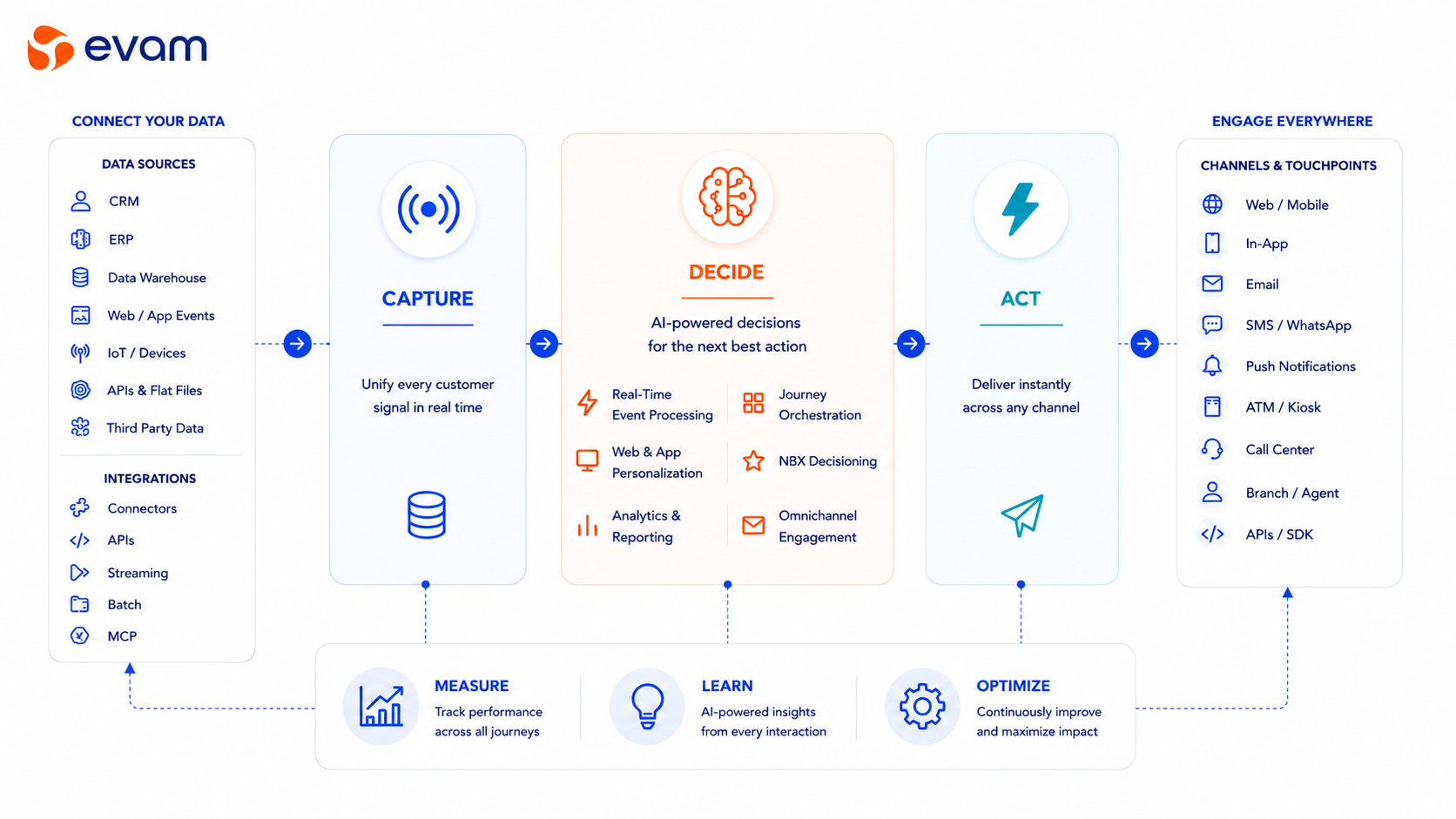
Event streaming, not batch import. Customer behavior has to flow into the platform continuously, transactions, clicks, app usage, support interactions, as a live stream rather than a scheduled data pull. A platform built on an event-streaming architecture can evaluate a signal within milliseconds of it happening. A platform built on periodic imports is always working with data that's already a few hours or a day old, no matter how fast its sending mechanism is.
Decisioning at the moment of contact, not campaign planning in advance. The platform has to decide what to do with a signal when it arrives, checking eligibility, applying suppression so a customer doesn't get the same message twice through two different triggers, and ranking what's left by relevance, all before the moment passes. A platform that only executes pre-built campaigns faster is still deciding in advance. It's just executing that decision more quickly.
Omnichannel execution from one decisioning layer. The response has to reach the customer through whatever channel they're actually using right now, SMS, push, WhatsApp, in-app, email, or a call center agent's screen, coordinated from a single system so a customer doesn't get contradicted or repeated across channels. Sub-second trigger latency only matters if the channel the message goes out on is the channel the customer is actually paying attention to.
What This Looks Like Across Industries
The mechanics stay the same. What changes is which signal carries the most urgency.
In telecom, a customer whose data bundle runs out mid-session is a moment with a short window: an immediate top-up offer, sized to their actual usage pattern, converts at a different rate than the same offer arriving the next day after the customer has already found a workaround or grown frustrated.
In banking, an unusual transaction pattern is a moment that has to be acted on in seconds, not reviewed in a batch fraud report hours later. The same real-time architecture that flags a suspicious transaction instantly is what also makes a well-timed, relevant offer possible at the moment a customer is actually engaged with their account.
In retail, a customer physically near a store, or browsing a product with clear purchase intent, is in a narrow window where a real-time nudge, a flash offer, a location-triggered notification, a cart-abandonment message sent within minutes rather than the next morning, has a meaningfully higher chance of converting than the same message delivered on a generic campaign schedule.
In every case, the platform's value isn't the creativity of the message. It's whether the architecture underneath can actually recognize the moment and act inside it.
How evamX Powers Real-Time Marketing
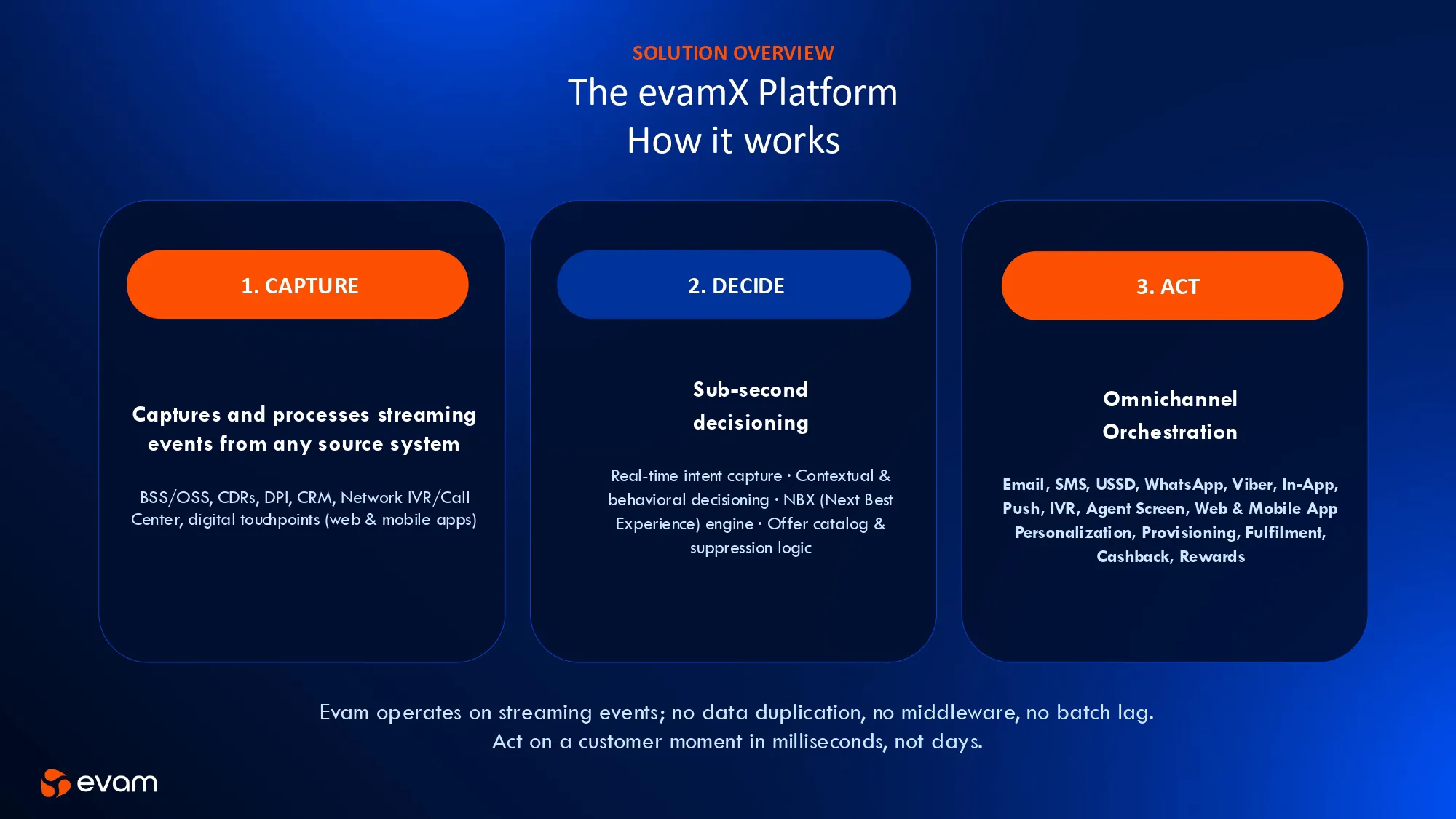
evamX is built on an event-streaming architecture rather than batch import, so customer signals across web, mobile, transactions, and support channels are captured continuously and evaluated the moment they happen, not on the next scheduled cycle. The NBX decisioning engine evaluates each signal against the customer's live context, checks eligibility and suppression, and selects the next best action in milliseconds, sub-second trigger latency by design, not as an occasional best case.
Execution runs from a single omnichannel layer across SMS, push, WhatsApp, in-app, email, and call center, so a decision made in one channel is reflected everywhere else instantly rather than repeated or contradicted. For marketing and CVM teams, Journey Designer provides a low-code way to build and adjust these journeys directly, without waiting on engineering capacity for every change, and evamX connects to existing marketing and data infrastructure without requiring a full stack replacement.
Where to Go Next
The question worth asking about any platform claiming to be real-time isn't how fast it can send a message. It's whether the decision behind that message was actually made in the moment the customer showed up, or planned in advance and just delivered quickly.
If you want to see what this looks like against your own customer signals, our team is glad to walk through it with you. Reach out through our contact page or explore the Product Demo Hub directly.